
The Cost of Balance: Why Lateral Stability Defines the Energetics of Aging Gait
18465_The Effect of Lateral Stabilization on Walking in Young and Old Adults.
This study investigates the effect of lateral stability on gait kinematics and metabolic energetics across different age groups. Using external lateral stabilization via elastic cords, the authors demonstrate that age-related increases in step width and metabolic cost are significant compensations for inherent lateral instability, exacerbated by sensory and motor "noise."
TL;DR
Walking is more than just moving forward; it is a constant battle against falling sideways. New research confirms that the metabolic "inefficiency" of older adults is largely a strategic compensation for lateral instability. By providing artificial lateral support, researchers found that older adults can walk with significantly narrower steps and reduced energy expenditure, nearly matching the performance of younger counterparts.
Background: The Invisible Stability Struggle
In the world of biomechanics, the human gait is often modeled as a "passive dynamic walker." While we are naturally stable in the fore-aft (sagittal) direction due to pendulum-like leg dynamics, we are inherently unstable in the lateral direction. Maintaining an upright path requires active, sensor-driven feedback to place each foot precisely.
The authors of this study hypothesize that aging introduces "noise" into this control loop—degraded vision, vestibular sense, and motor precision. Older adults aren't just slower; they are walking "louder" in a signal-processing sense.
Methodology: Stabilizing the Human Pendulum
To test the impact of lateral instability, the researchers attached subjects to an external stabilization system comprising elastic cords and rubber tubing. This setup acted like a safety net, providing a restorative force whenever the subject moved off-center.
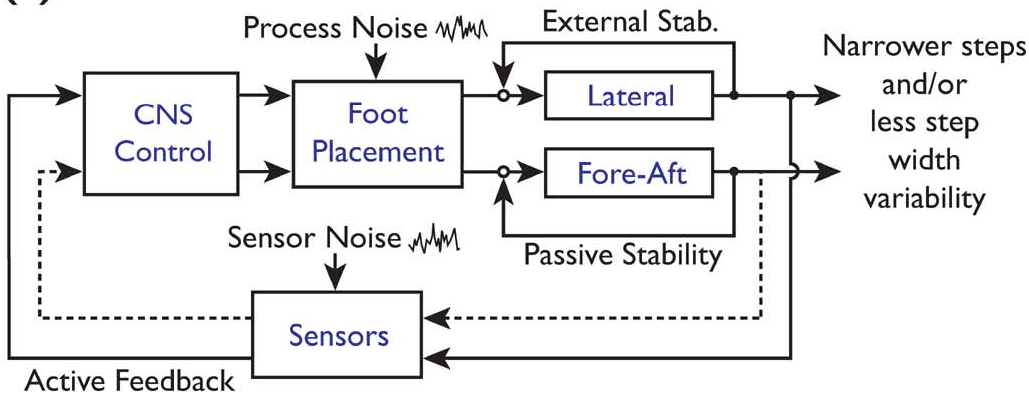 Figure 1: Conceptual model of gait control showing (a) normal active feedback, (b) the 'noise' model of aging, and (c) the mitigating effect of external stabilization.
The experiment compared Young (<30) and Old (>65) subjects across two main conditions:
- Preferred Step Width: Do they choose narrower steps when they feel "safer"?
- Zero Step Width: When forced to walk on a line, how much energy and variability does it cost them?
Key Insights from the Results
The findings provide a clear "Why" for observed clinical behaviors in the elderly:
1. The Strategy of Width
Without support, older subjects walk with steps 41% wider than young adults. However, as soon as the lateral springs were attached, the old subjects chose to narrow their steps by more than half. This proves that wide-track walking isn't a fixed physical limitation, but a deliberate safety strategy to manage instability.
2. The Energetic Penalty
Walking with wide steps has a high metabolic "tax" due to the work required to redirect the center of mass. In the "Zero Step Width" condition—the hardest task for balance—older adults expended 17% more energy than the young. Crucially, when stabilization was added, this energetic cost dropped by 16%, making the metabolic profiles of both groups remarkably similar.
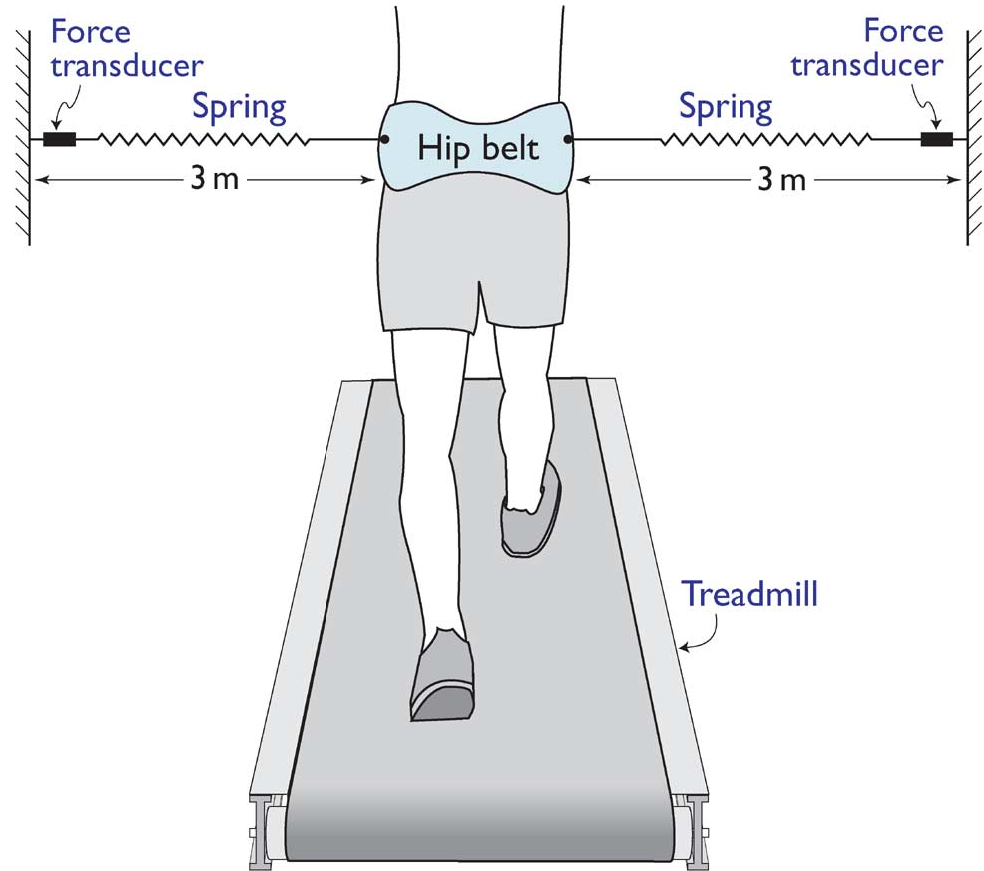 Figure 2: The treadmill setup with lateral elastic stabilization.
3. Step Variability as a Proxy for Noise
The study confirmed that step width variability—the "shaky" nature of foot placement—is an indicator of the central nervous system's noise. External stabilization reduced this variability in older adults, suggesting that the device compensated for their diminished sensory-motor precision.
Deep Insight: A New Engineering Perspective on Aging
The brilliance of this paper lies in its Noise Model. By treating age-related sensory decline not as a "broken" system but as a "noisy" communication channel (in the Information Theory sense), the authors provide a powerful framework for future assistive technology.
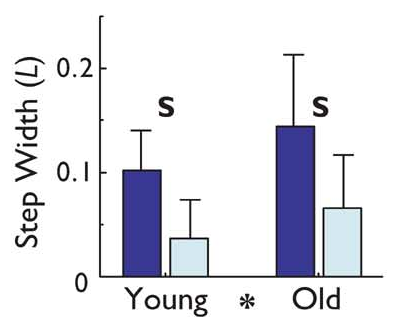 Figure 3: Key metrics showing significant reductions in step width (b) and metabolic cost (e) when stabilization (S) is applied.
Conclusion & Future Outlook
This research shifts the focus of geriatric mobility from simple "strength training" to "stability management."
- Takeaway: The increased energy cost of walking in the elderly is not just about muscle efficiency; it's about the high "computational" and physical cost of balancing.
- Limitation: The study used a treadmill with crossed arms, which isn't perfectly representative of natural overground walking where arm swing contributes to stability.
- Future Impact: These results pave the way for smart, lateral-stabilizing orthotics or walkers that don't just help the user stand, but actively reduce the "noise" of walking, allowing for more efficient, youth-like gait patterns.