
LACE: Breaking the Wall of Isolation in Parallel Reasoning
LACE: Lattice Attention for Cross-thread Exploration
This paper introduces LACE (Lattice Attention for Cross-thread Exploration), a framework that enables large language models (LLMs) to perform parallel reasoning with cross-thread interaction. By adding a lightweight "Lattice Attention" mechanism, the model transforms independent sampling paths into a coordinated process where threads can share breakthroughs and correct each other's errors in real-time.
TL;DR
Standard Large Language Models solve problems in parallel like agents locked in separate rooms—they can't see each other's work or warn about dead ends. LACE (Lattice Attention for Cross-thread Exploration) changes this by adding a "Lattice Attention" layer that allows parallel reasoning threads to communicate. This transforms isolated sampling into a unified, collaborative search, boosting AIME accuracy by over 7 points through emergent self-correction and diversity.
The "Isolation" Problem in Modern Reasoning
Scaling inference-time compute often relies on sampling multiple trajectories (Best-of-N). However, these trajectories are generated in a vacuum. If a model has a specific "hallucination mode" or a common logical pitfall, every single parallel thread might fall into the same trap.
The authors argue that human reasoning is rarely a straight line; it is a process of collateral thinking where we explore multiple hypotheses and let a failure in one thread pivot the search in another. In current LLMs, this synergy is missing—computation is wasted on redundancy rather than discovery.
Methodology: The Lattice Backbone
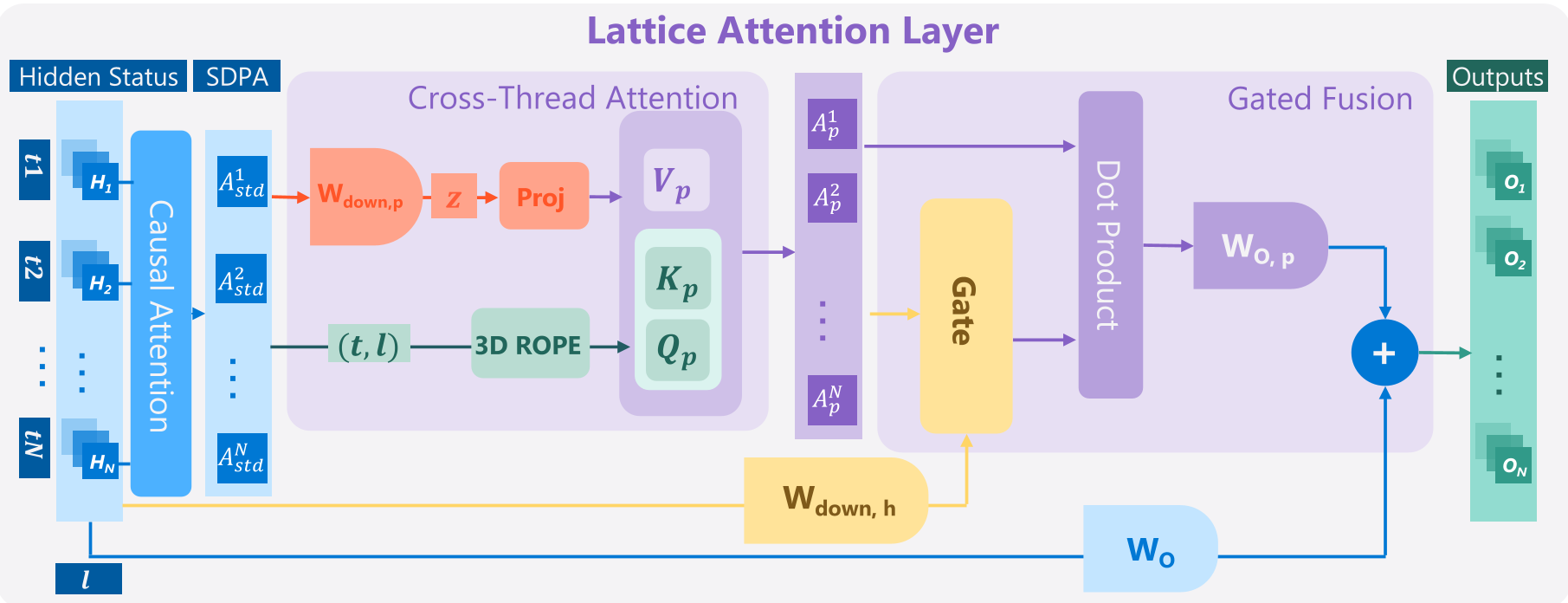
To solve this, LACE introduces a 2D attention structure. While standard attention looks back at previous tokens (time dimension), Lattice Attention looks "sideways" at other threads (width dimension).
1. Architectural Innovation
LACE doesn't replace standard causal attention; it augments it. By plugging in lightweight lattice layers (representing <1% total parameters), it projects the outputs of standard self-attention into a shared space. Using 3D RoPE (Rotary Position Embedding), the model maintains a clear sense of both "which token" and "which thread" it is attending to.
2. Lattice GRPO & Synthetic Data
Collaboration requires a reason to talk. The authors built a synthetic pipeline to create data where threads must compare each other to find the "Best" solution. They then optimized this using Lattice GRPO, a variant of Group Relative Policy Optimization that rewards:
- Accuracy: Identifying the correct answer via self-selection tags.
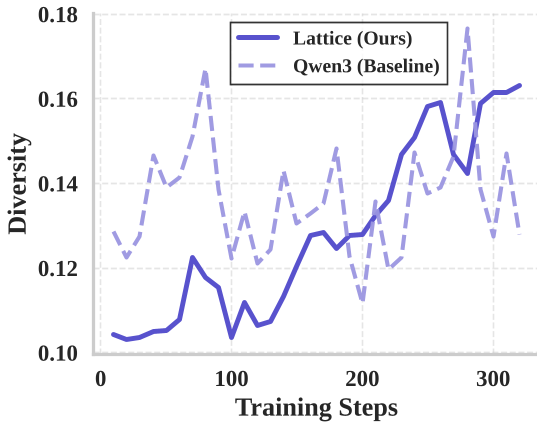
- Diversity: Penalizing threads that produce identical logic, forced via embedding dissimilarity rewards.
Experimental Breakthroughs
The results on elite mathematical benchmarks like AIME 25 demonstrate a clear "Collaboration Gain." LACE-4B outperforms its isolated parallel counterparts significantly, reaching 20% accuracy on AIME 24.
Emergent Early Stopping
One of the most fascinating findings is the "Early-Stopping" phenomenon. As visualized in the paper's qualitative analysis, if Thread 1 finds an elegant solution early, peer threads (2 and 4) detect this via the lattice gates. They then choose to summarize their work as "following Solution 1" and label themselves as successful without wasting tokens on redundant full derivations.
Critical Insights: Why This Matters
The fundamental value of LACE is its proof that interaction is a multiplier for compute efficiency. Specifically:
- Information Flow Peaks at Crisis: Gate visualizations show that cross-thread communication peaks during "core reasoning" steps and "self-assessment," remaining low during trivial token generation.
- Scaling beyond N: Even though trained on 4 threads, LACE shows performance gains as threads scale to 8 or 16 at inference time, proving the collaborative "protocol" is robust.
Limitations & Future Work
While LACE is highly efficient (adding <1.3% FLOPs), it does increase memory-bandwidth pressure because KV caches from multiple threads must be accessible. Future research will likely explore how to scale this to massive thread counts (N=100s) and multi-modal contexts where visual and textual threads might collaborate.
Summary
LACE is a major step toward "System 2" LLMs that don't just think longer, but think smarter by leveraging the collective intelligence of parallel exploration.