
Post-Quantum Security for Social Media: Efficient Lattice-Based Revocable Signatures
Lattice based signature with outsourced revocation for Multimedia Social Networks in cloud computing
This paper introduces the first lattice-based Revocable Identity-Based Signature (RIBS) scheme with outsourced revocation through a Cloud Service Provider (CSP). By leveraging the Short Integer Solution (SIS) problem, it provides a post-quantum secure authentication framework tailored for Multimedia Social Networks (MSNs).
TL;DR
With the rise of quantum computing, traditional RSA and ECC-based signatures face an existential threat. This paper proposes a novel Lattice-Based Revocable Identity-Based Signature (RIBS) scheme specifically designed for Multimedia Social Networks (MSNs). By offloading revocation management to a Cloud Service Provider (CSP), the authors achieve high efficiency, quantum resistance, and public-channel key updates—a first in the lattice-based research landscape.
Background: The Revocation Bottleneck
Identity-Based Cryptography (IBC) simplifies public key management by using a user's identity (like an email) as their public key. However, Revocation is the Achilles' heel of IBC. If a user's key is stolen, how do we efficiently prevent them from signing messages?
Previous solutions were either:
- Computationally Heavy: Requiring the Key Generation Center (KGC) to be online constantly.
- Storage Inefficient: Utilizing binary-tree structures that caused key sizes to grow logarithmically with the number of users.
- Vulnerable: Based on number-theoretic assumptions (CDH/RSA) that quantum computers can easily break.
Methodology: High-Level Architecture
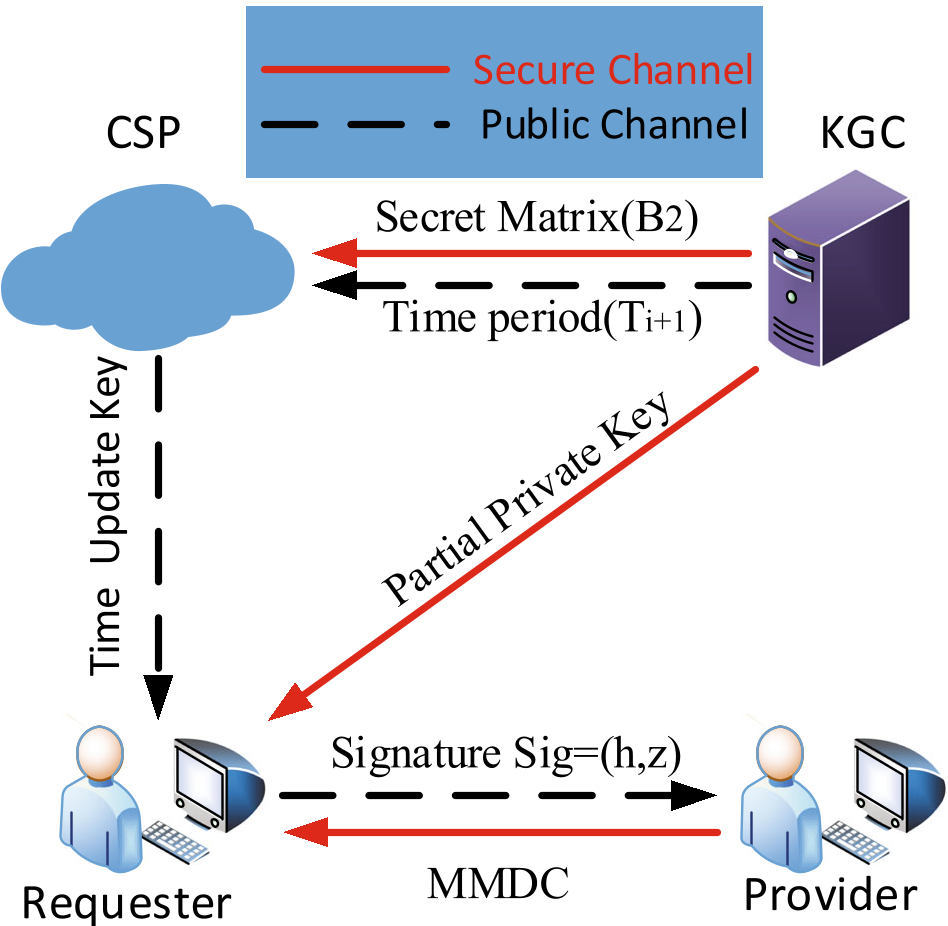
The core "Insight" of this paper is the Hybrid Private Key Strategy. Instead of a single key, each user's signing ability is derived from two components:
- Partial Private Key (): Constant, issued once by the KGC via a secure channel.
- Time Update Key (): Periodic, updated by a Cloud Service Provider (CSP) and sent via a Public Channel.
This architecture creates a "double-lock" system. To forge a signature, an attacker needs both components. If a user is revoked, the CSP simply stops issuing the Time Update Key for the next period.
Mathematical Intuition: The Power of Lattices
The security relies on the Short Integer Solution (SIS) problem. The signing process uses the Rejection Sampling Technique (introduced by Lyubashevsky). In simple terms, this ensures that the final signature does not leak any information about the signer’s secret key by making the signature distribution look like a standard Gaussian distribution, regardless of the key used.
Performance & Results
The authors compared their scheme against leading lattice-based models (Tian-Huang and Xiang).
| Metric | Xiang's RIBS | This Paper's RIBS |
|---|---|---|
| Update Channel | Secure (Expensive) | Public (Efficient) |
| Signature Size | Large () | Small () |
| KGC Workload | High | Low (Outsourced) |
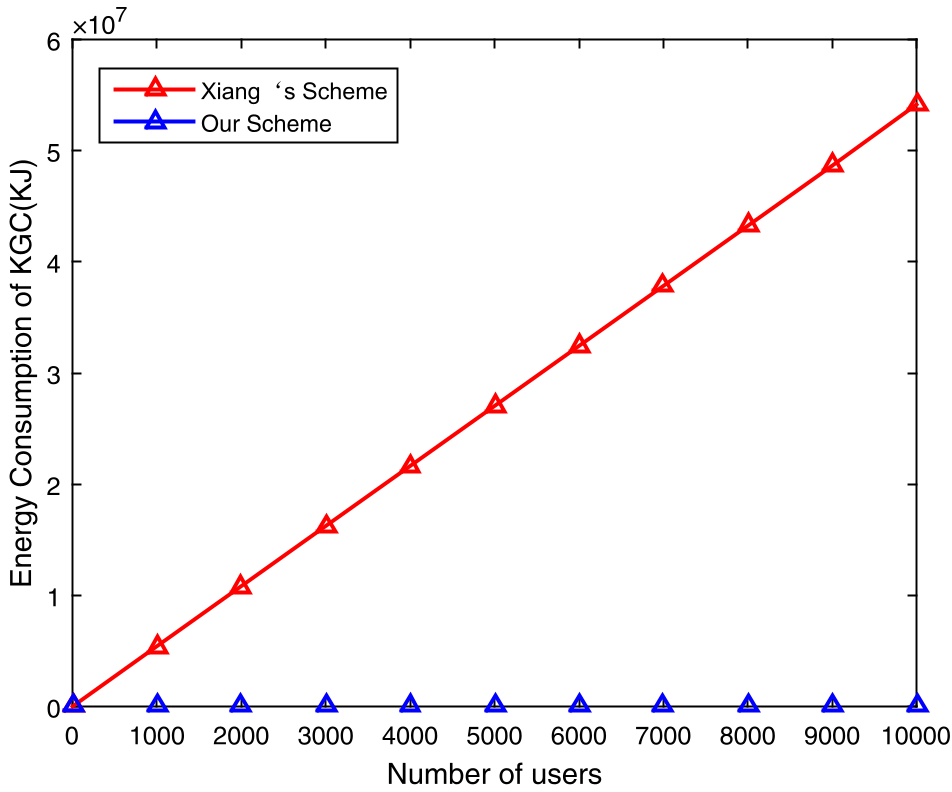 Fig: The proposed scheme significantly reduces the communication energy cost for the KGC by offloading tasks to the cloud.
As shown in the experimental data, the use of SampleMat and Rejection Sampling resulted in shorter signatures and lower energy consumption—critical for mobile users in social networks like YouTube or Facebook.
Deep Insight: Why it Matters
This work represents a shift toward "Realistic Cryptography." In the theoretical vacuum, we assume secure channels are free. In MSN reality, secure channels are expensive bottlenecks. By allowing updates over public channels, this paper makes lattice-based signatures viable for the 5G/6G era where billions of devices require dynamic authentication.
Conclusion
The proposed scheme is a robust answer to the "Quantum Threat" in social networking. While most lattice schemes are criticized for being "too heavy" for real-world application, this paper utilizes cloud outsourcing to mitigate the burden on both central authorities and end devices.
Limitations: The model assumes a "semi-trusted" CSP. If the CSP and KGC were to collude, the identity revocation mechanism could be bypassed. Future research might look into "Zero-Trust" architectures for even higher security guarantees.