
Lattice Deduction Transformers: Solving the "Unsolvable" Sudoku with 800K Parameters
Lattice Deduction Transformers
The Lattice Deduction Transformer (LDT) is a 800K-parameter recurrent transformer designed for logically sound reasoning. It treats deduction as iterative refinement on an abstract lattice, achieving 100% accuracy on Sudoku-Extreme and Snowflake Sudoku, outperforming frontier LLMs like GPT-5.4 and Claude 4.6 which score 0%.
TL;DR
While frontier LLMs (GPT-4/5, Claude 3.5/4) with trillions of parameters frequently fail at basic logical puzzles, the Lattice Deduction Transformer (LDT)—a tiny 800K-parameter model—achieves 100% accuracy on Sudoku-Extreme. It achieves this by abandoning the "Chain-of-Thought" generation paradigm in favor of Abstract Interpretation: it projects its internal thoughts onto a mathematical lattice, ensuring every step is a logically sound deduction rather than a lucky guess.
Background: Why LLMs Fail at Logic
Reasoning in modern AI is dominated by Chain-of-Thought (CoT). However, CoT is essentially "token-level dreaming"—it lacks a formal grounding mechanism to verify if an intermediate step is logically possible. In contrast, classical solvers use Constraint Satisfaction to prune impossible branches. LDT bridges this gap by embedding a symbolic lattice directly into the Transformer's recurrent loop.
Methodology: Thinking in Lattices
The core innovation is the Lattice Projection. Instead of passing hidden vectors that only the model understands, LDT maps its latent state to a Grid Powerset Lattice.
1. Lattice Encoding
For a Sudoku grid, the model tracks which digits are still "viable" for each cell using multi-hot encodings. A deduction step is defined as pushing the confidence sigmoids of impossible candidates toward zero.
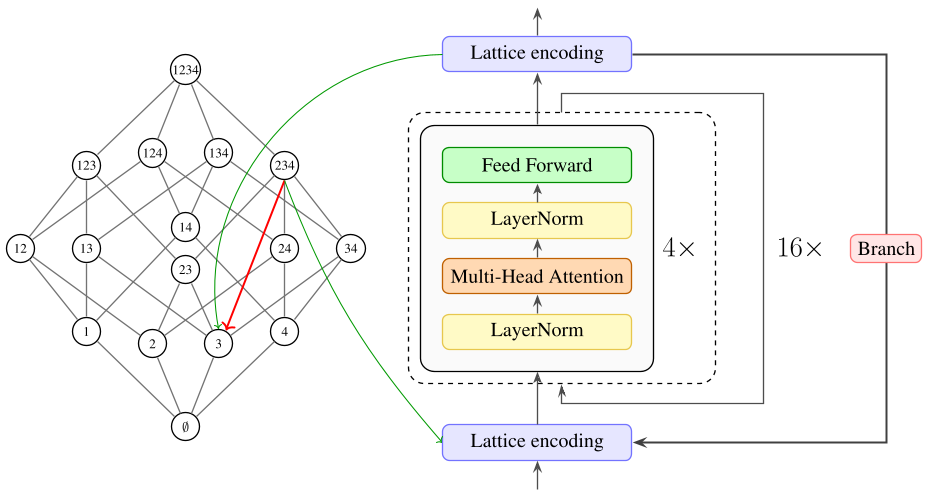 Figure 1: The LDT recurrent loop, alternating between neural deduction and stochastic branching.
2. The Alpha () Operator
To train the model, the authors use the operator from Abstract Interpretation. This operator takes the set of all possible valid solutions and collapses them into the most precise "abstract" state. This allows the model to receive on-policy supervision: it is trained to match the best possible deductive move from its current (potentially messy) state.
3. Soundness vs. Completeness
The model is designed to be empirically sound. It has two heads:
- Candidate Head: Eliminates impossible digits.
- Conflict Head (CLS): Flags when a branch has reached a dead end (inconsistency). If the model isn't sure, it triggers backtracking rather than hallucinating a wrong digit.
Experiments & Results: David vs. Goliath
The performance gap between LDT and frontier LLMs is staggering. On Sudoku-Extreme (puzzles requiring deep search), Claude 4.6 and GPT-5.4 score 0%, whereas LDT hits 100%.
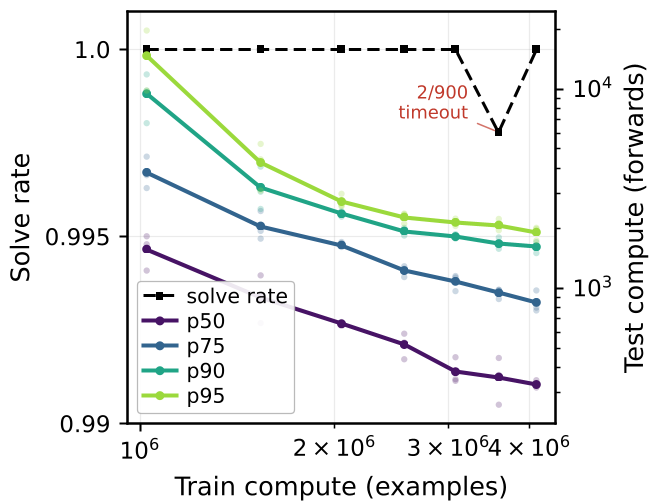 Figure 2: The train/test compute trade-off. As the model trains more, the number of forward passes (inference cost) drops drastically as the model gets "smarter" at deduction.
Key Metrics:
- Sudoku-Extreme: 100% Solve Rate (vs. 0% for LLMs).
- Generalization: A single LDT model solved Snowflake Sudoku (hexagonal grids) of varying sizes, proving it isn't just memorizing 9x9 grids.
- Maze-Hard: 99.9% accuracy on 30x30 mazes by learning to intersect multiple shortest paths using the operator.
Deep Insight: Training Shortens Search
One of the most profound takeaways is the Inference Scaling behavior. The paper demonstrates that more training (Pre-computation) directly translates to shorter search paths at test time. The model essentially "learns" the symbolic shortcuts of the puzzle, moving from a brute-force search mode to a direct "deduction mode."
Critical Analysis & Future Work
Limitations: LDT currently excels where rules are fixed (Sudoku, Mazes). However, on the ARC-AGI benchmark—where rules change every task—the model plateaus. The conflict head becomes unreliable when the model must "infer the rules" before applying them.
Future Outlook: LDT suggests a future where we don't need trillion-parameter models for logic. Instead, we can use "Neural Solvers" that treat reasoning as a fixed-point computation on a lattice. This could revolutionize hardware verification, software synthesis, and any field where "almost correct" is not good enough.
Author's Note: This work proves that "Small Data + Correct Inductive Bias" beats "Big Data + Opaque Architecture" for hard reasoning.