
[CVPR 2024?] Beyond Verdicts: The TL Project and the Quest for Transparent Judicial Reasoning
A Law Reasoning Benchmark for LLM with Tree-Organized Structures including Factum Probandum, Evidence and Experiences
The paper introduces "Transparent Law Reasoning with Tree-Organized Structures" (TL), a novel benchmark and schema for AI-assisted judicial fact-finding. It provides a crowd-sourced dataset and the "TL Agent," a knowledge-enhanced framework that outperforms state-of-the-art models like GPT-4o and DeepSeek-V3 in generating structured legal justifications.
TL;DR
While AI can often predict a court's final ruling, it rarely explains how it bridged the gap between raw evidence and a guilty verdict. This paper introduces the Transparent Law (TL) benchmark, a tree-organized schema that forces LLMs to map out every interim fact and the "human experiences" used to link them. By deploying a specialized TL Agent with a multi-role audit system, the researchers achieved SOTA performance on a new dataset of 453 real-world cases, proving that transparency is a product of structural rigor, not just model scale.
Problem & Motivation: The Black Box of Fact-Finding
In the legal world, fairness depends on the Factum Probandum—the facts that must be proven. Most AI judges excel at applying laws to established facts but fail at the most human part: finding those facts in the first place.
Why is this hard? Because evidence doesn't speak for itself. It requires "Experiences"—unstated bridge logic like "an older woman is more likely to provide emotional support than instigation." When these experiences are biased or hidden, you get miscarriages of justice. The authors argue that if we want "Intelligent Courts," the reasoning process must be as visible and scrutinized as the final verdict.
Methodology: Mapping the Juridical Mind
The authors decompose "Law Reasoning" into a nested tree structure. Instead of a single prompt, they frame the task as a sequence of three sub-tasks:
- Factum Probandum Generation: Moving from fine-grained interim facts to the ultimate "ultimate fact."
- Evidence Reasoning: Pinpointing exactly which sentences in a case description support which fact.
- Experience Generation: Articulating the "common sense" logic used to bridge evidence and fact.
The TL Agent Architecture
The core contribution is a ReAct-based Agent equipped with a specialized toolkit:
- Fact Finding Head: Specialized prompts for structured JSON extraction.
- Multi-Role Checker: An internal "courtroom" where the agent plays the roles of a lawyer, police officer, and public member to critique the generated facts before a "Chief Justice" agent makes the final call.
- Knowledge Search: RAG-enhanced retrieval of legal definitions and similar priors to ground the reasoning.
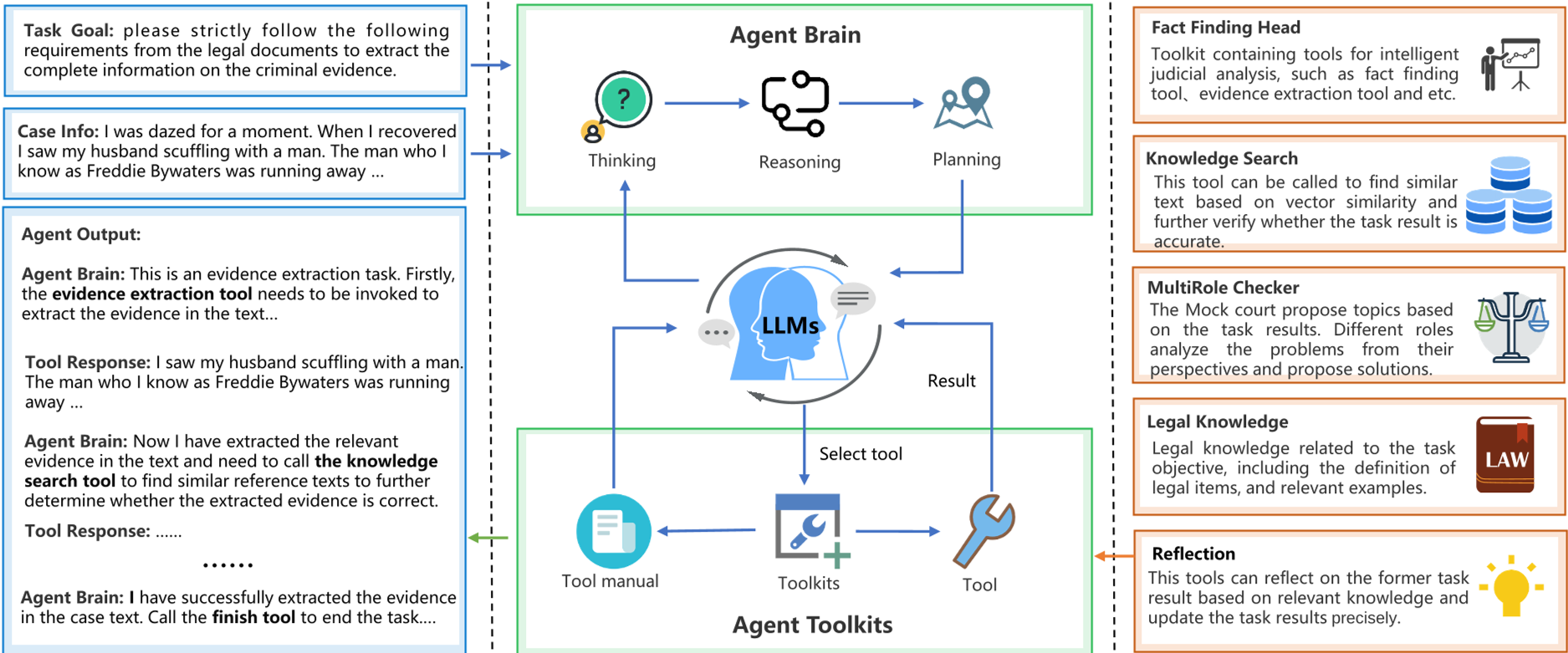 Figure: The TL Agent workflow featuring thought traces, tool invocation, and multi-role reflection.
Experiments & Results: Structure Beats Scale
The findings are clear: even a smaller model (GPT-4o-mini) can crush much larger models (GPT-4o, DeepSeek-V3) if it is wrapped in the right reasoning framework.
- Overall Performance: The TL Agent scored 31.50 on the comprehensive metric, a ~22% improvement over the standard GPT-4o baseline.
- Recall of Evidence: The agent achieved a 40.73% recall in linking evidence to facts, nearly double that of most other LLMs, which struggle with the density of legal documents.
- Ablation Logic: Interestingly, removing the "Multi-role Checker" caused a significant performance drop, proving that self-criticism from different perspectives is vital for objective legal analysis.
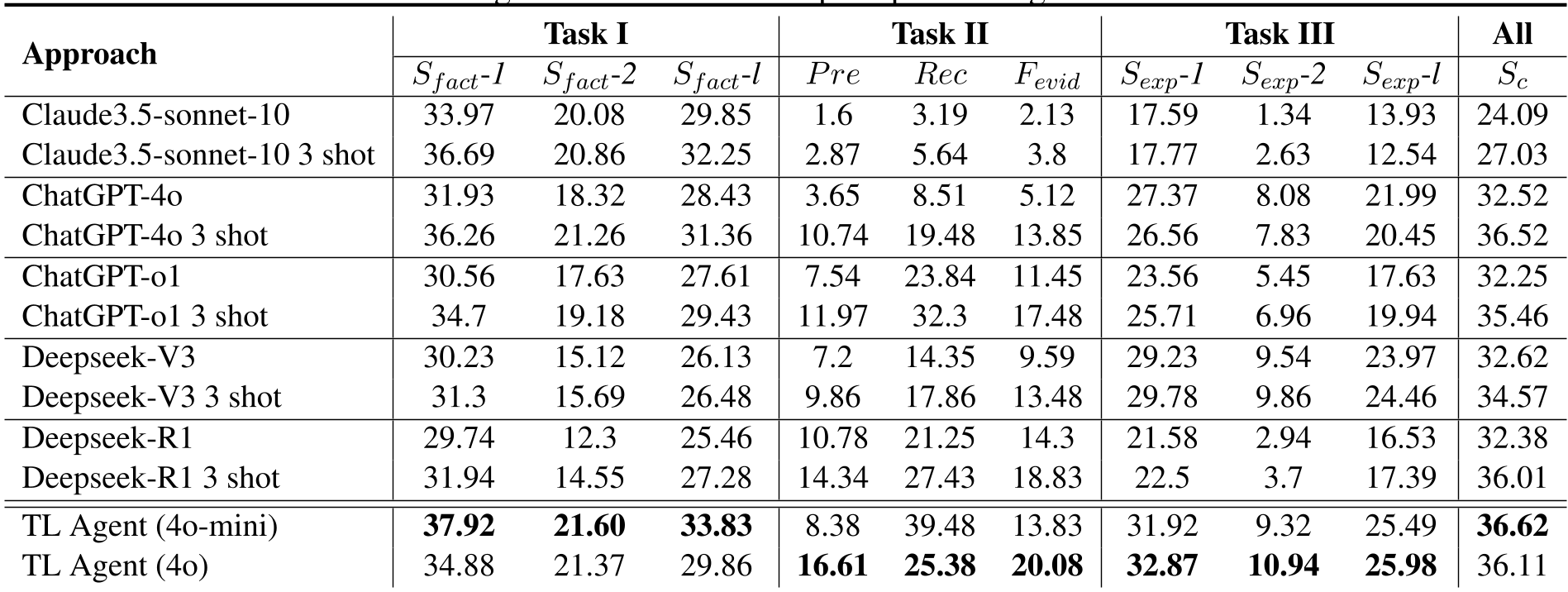 Table: Comparison of the TL Agent against advanced reasoning models like ChatGPT-o1 and DeepSeek-R1.
Critical Analysis & Conclusion
The most striking takeaway is the Experience Generation task. The paper demonstrates that while reasoning-optimized models (like o1 or R1) excel at logical extraction (Task II), they actually underperform on Tasks I and III compared to their base models because these tasks require human-like social experience and "vague" common sense rather than pure cold logic.
Limitations: The dataset, while high-quality, consists of 453 cases. Scaling this to thousands of diverse jurisdictions with different "Experience" priors will be the next frontier. Furthermore, the reliance on open-ended natural language prompts means the system is still sensitive to prompt engineering.
Future Outlook: This benchmark transforms the "Intelligent Court" from a futuristic concept into a measurable engineering challenge. By forcing AI to "show its work" through tree-organized structures, we move away from AI as an oracle and toward AI as a transparent assistant that judges, lawyers, and the public can finally trust.