
Layer Collapse in DLMs: Why Diffusion Models Turn LLM Compression on its Head
The paper investigates the internal activation dynamics of Diffusion Language Models (DLMs), specifically LLaDA-8B, identifying a unique "layer-collapse" phenomenon. It discovers that DLMs are driven by a singular "super-outlier" channel and exhibit superior compression robustness, outperforming Llama-3.1-8B significantly under extreme quantization (3-bit GPTQ).
TL;DR
Researchers have discovered that Diffusion Language Models (DLMs) like LLaDA-8B possess a "Super-Outlier"—a single activation channel so dominant that its removal destroys the model. Paradoxically, this makes DLMs highly redundant in their early layers and incredibly robust to quantization, requiring a complete reversal of the compression strategies used for models like Llama.
The Anatomy of a Super-Outlier
In the world of Autoregressive (AR) models, we are used to "outliers"—sporadic activation spikes that occur at specific token positions or sinks. However, DLMs present something far more extreme.
The authors identified a single channel in LLaDA-8B that remains persistently active across almost all tokens and early layers. While AR models distribute information across many features, DLMs seem to "collapse" their early representations into this one indispensable carrier.
The Fragility Test: Pruning a top outlier in Llama-3.1-8B results in a minor 4% accuracy drop. Pruning the super-outlier in LLaDA-8B results in a total model collapse (0% accuracy), where the model enters "repetitive random token loops."
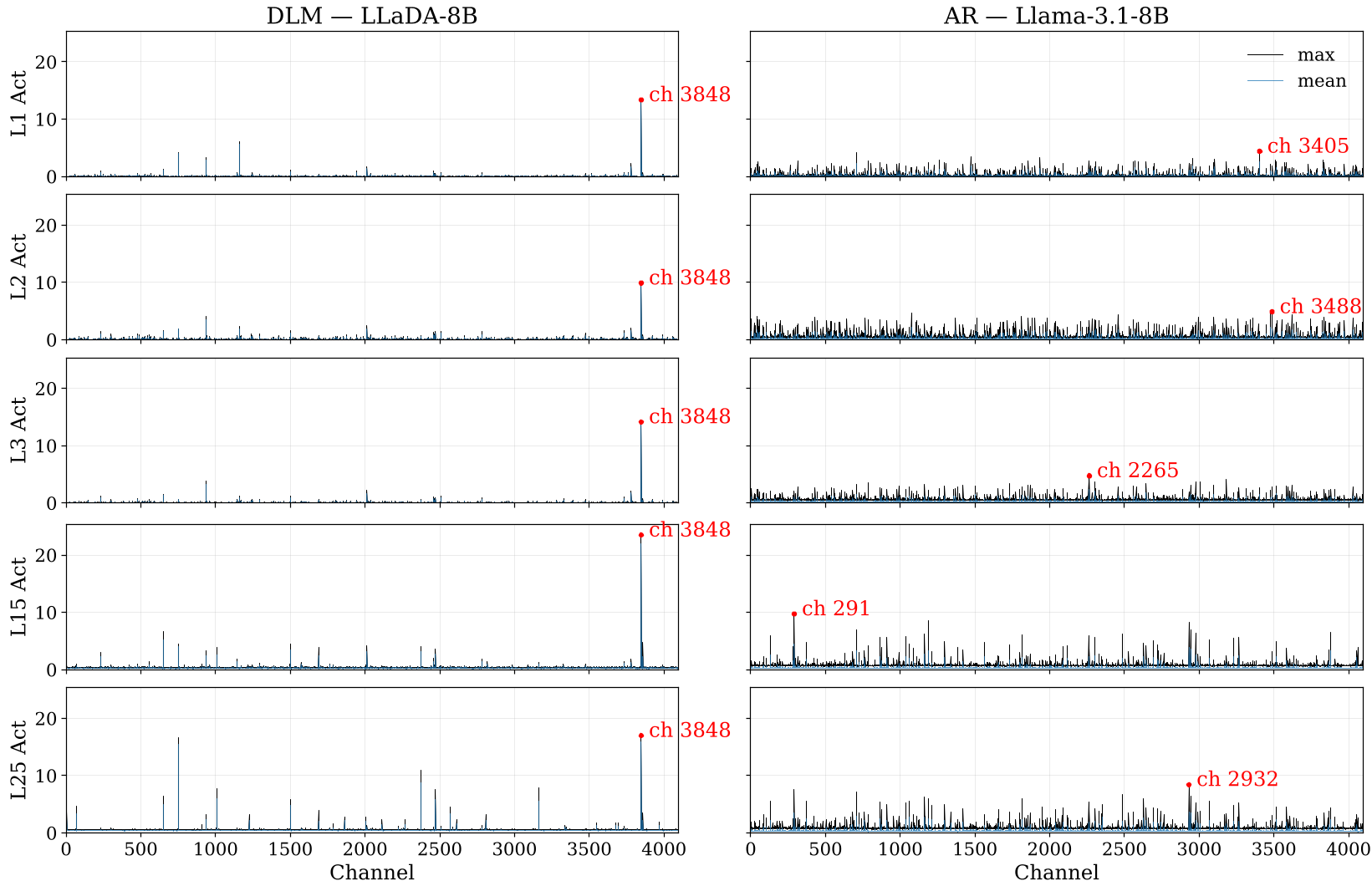 Figure 1: LLaDA (left) shows a single persistent super-outlier channel, whereas Llama (right) has a shifting set of smaller outliers.
A Reversed Logic: Redundancy in Early Layers
Standard LLM wisdom suggests that early layers extract complex features while later layers become redundant (the "Curse of Depth"). DLMs flip this script.
Using per-token cosine similarity, the study found that LLaDA’s early layers are nearly identical. Interestingly, this isn't due to "undertraining." By applying Heavy-Tailed Self-Regularization (HT-SR) theory and the Hill estimator (), the researchers found that these early layers are actually overtrained. They have learned a very strong, low-dimensional structure dominated by the super-outlier.
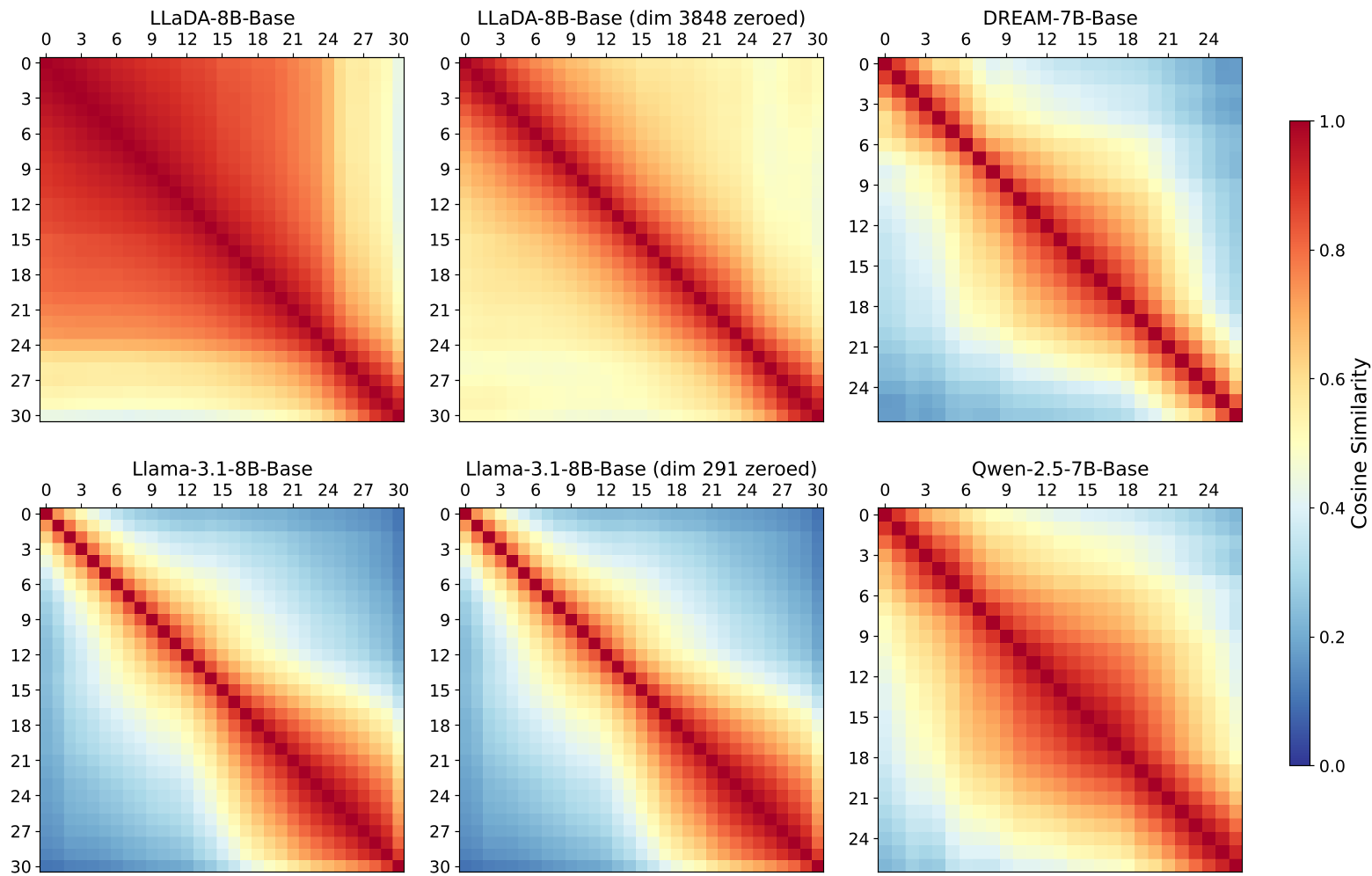 Figure 3: Similarity matrices show that LLaDA (top left) has highly redundant early layers compared to Llama (bottom left).
Flipping the Compression Script
These insights lead to two massive practical breakthroughs for deploying DLMs:
- Extreme Robustness: DLMs are far more resilient to quantization than AR models. In 3-bit GPTQ tests, LLaDA-8B remained functional, whereas Llama-3.1-8B completely broke down.
- Inverted Pruning: For AR models, we usually leave early layers intact and prune the "redundant" deep layers. For DLMs, the Earlier-Is-Sparser (EIS) strategy is superior. Allocating more sparsity to the redundant early layers in LLaDA yielded an 8.4% improvement over the standard approach.
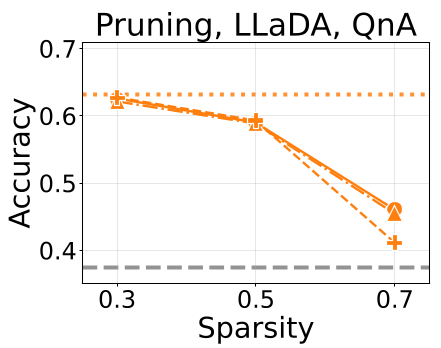 Figure 5: Performance of LLaDA vs Llama under different pruning and quantization regimes.
Why Does This Happen? (The Controlled Twin Experiment)
To prove this wasn't just a quirk of LLaDA’s architecture, the team trained two 160M-parameter models from scratch: one AR and one DLM, using the exact same data and hyperparameters.
The result? The DLM twin naturally developed higher early-layer similarity and higher compression robustness. This confirms that the diffusion objective itself—learning to denoise masked tokens in parallel—fundamentally changes how a Transformer organizes its internal knowledge.
Conclusion & Future Outlook
The discovery of the Super-Outlier and Layer Collapse suggests that we are only beginning to understand the "hidden physics" of non-autoregressive models. While the fragility of a single channel is a risk, the resulting robustness to quantization makes DLMs prime candidates for edge-device deployment where 2-bit or 3-bit precision is necessary.
Future Work: Can we train "outlier-free" DLMs to improve their expressivity, or is the Super-Outlier the secret sauce that allows them to reason in parallel? The hunt for the origin of the super-outlier is now on.