
The Social Butterfly Effect: Connecting Individual Intent to Big Geodata
LBSN Data and the Social Butterfly Effect (Vision Paper)
This vision paper introduces the "Social Butterfly Scale," a 14-tier conceptual framework designed to bridge the gap between individual human cognition and macro-scale Location-Based Social Network (LBSN) data. It categorizes geolocated social events into a hierarchy ranging from neurological capacity to global movement patterns.
TL;DR
Big data in Location-Based Social Networks (LBSN) is often processed through a lens of "cold" statistics—coordinates, timestamps, and frequencies. This vision paper by Clio Andris argues for a "human-first" reconstruction of LBSN analysis. By introducing a 14-tier scale, the author demonstrates how a single butterfly flap of an interpersonal conflict can ripple upward to alter global telecommunication and movement matrices.
Context & Motivation: The Missing Human Variable
In current LBSN research, we excel at mining GPS traces for tortuosity or predicting traffic flow via agent-based models. However, we often ignore the why. A person doesn't just move from Point A to Point B because of "gravity models" or "distance decay"—they move because they are visiting a sister, avoiding an ex-spouse, or seeking social capital.
The author's core insight is that macro-scale phenomena (like migration or city-to-city calling patterns) are built from micro-scale individual human intentions. Without a bridge between the brain and the data row, our understanding of spatial behavior remains superficial.
Methodology: The 14-Tier Social Butterfly Scale
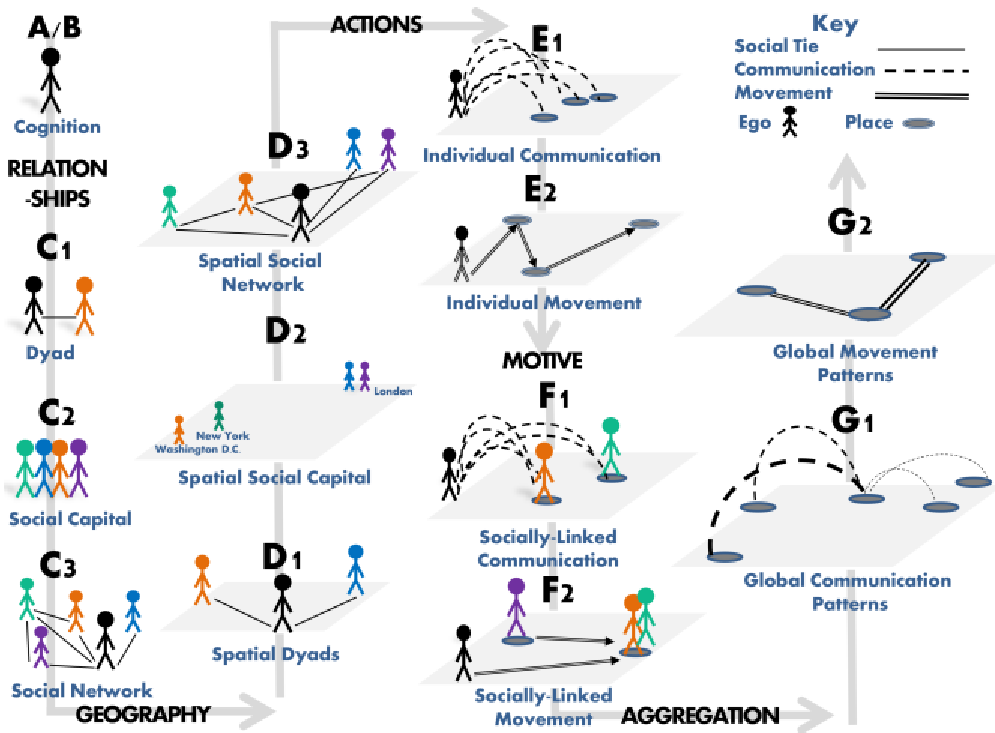
The paper proposes a hierarchical framework to navigate from the individual mind to large-scale spatial patterns (Groups A through G):
- Individual Cognition (A-B): The neurological capacity to socialize and the perception of others as potential friends.
- Social Relationships (C): The formation of dyadic ties and social networks. The author argues that the dyad (the pair) should be the atomic unit of LBSN data, as it naturally represents an origin-destination flow.
- Spatial Distribution (D): Mapping where those social ties live. This is where GIS meets Social Network Analysis (SNA).
- Individual & Socially-Linked Actions (E-F): Physical movement and communication. Tier F is critical: it identifies actions that occur because of a social tie (e.g., flying to visit a specific person).
- Large-Scale Patterns (G): The final aggregation into the big data "flat files" researchers usually see, such as "City X calls City Y 10,000 times."
The "Butterfly" in Action: A Case Study
Consider a woman (W) who is angry with her spouse (M) and decides to visit her sister (S) in Germany. This micro-level emotional event triggers:
- A shift in Social Capital (seeking S instead of M).
- A Spatial Action (booking a flight to Germany).
- A Macro-Data Output (+1 trip in an international O-D matrix).
If the argument is resolved, the flight is canceled. This single interpersonal "butterfly flap" changes the global data trace.
Critical Insight & Industry Value
The paper’s most provocative suggestion is the operationalization of these tiers via SQL or Graph-based query systems. Instead of just querying "all movements in New York," researchers should be able to query "all movements driven by family-clique proximity."
Limitations & Future Work
- Data Privacy: Extracting dyadic social intentions from raw GPS data poses significant ethical and privacy challenges.
- The Burden of Proof: Correlation does not equal causation. Proving that a trip to Germany was caused by a sister's presence requires deeper metadata than most LBSN datasets provide.
Conclusion
Clio Andris challenges the "thermodynamic" view of LBSN data. By treating every data row as a "story" with social intentionality, we can build more robust models for urban planning, migration policy, and telecommunications. The Social Butterfly Scale provide the empirical steps necessary to turn "Big Data" into "Deep Data."