
LBSNRank: Bridge the Gap Between Social Influence and Spatial Dynamics
LBSNRank: Personalized PageRank on Location-based Social Networks ∗
LBSNRank is a personalized ranking framework designed for Location-Based Social Networks (LBSNs) that integrates social relationships with dynamic check-in histories. By utilizing a Monte Carlo-based Personalized PageRank (PPR) on dynamically updated subgraphs and leveraging the MapReduce programming model (Hadoop), it achieves high-efficiency ranking for both influential users and popular locations.
TL;DR
LBSNRank is a specialized ranking algorithm for Location-Based Social Networks (LBSN) that solves the "dynamic ranking problem." Instead of treating social networks as static links, it incorporates frequent check-in updates. By using a Monte Carlo-based Personalized PageRank combined with a dynamic precomputation strategy on Hadoop, it identifies influential people and popular places in real-time.
Context: Why Static Ranking Fails in LBSNs
In traditional social networks (like early Facebook), your connection to a friend is relatively stable. However, in LBSNs (like Foursquare or Dianping), "relevance" is tied to physical space. If you are visiting the Great Wall, you don't care about the globally most popular user; you care about the most influential people at that specific location.
The challenge is twofold:
- High Volatility: People's locations change hourly.
- Scale: With millions of Points of Interest (POIs) and users, precomputing Every-User-to-Every-POI ranking is impossible.
Methodology: The LBSNRank Secret Sauce
The authors break the problem into a mutual-reinforcement loop between Location Ranking and User Ranking.
1. Dynamic Location Set Selection
Following the 80/20 Rule (where 20% of locations attract 80% of check-ins), LBSNRank doesn't try to index everything. It identifies a set of popular locations to precompute offline. Unlike prior work (HubRank), this set is not fixed; it is updated every iteration to reflect shifting trends (e.g., a stadium becoming "hot" during a match).
2. The Personalized PageRank (PPR) Logic
For a specific location , the user ranking is defined by:
To solve this efficiently at scale, they use Monte Carlo Random Walks on the Hadoop (MapReduce) framework. Instead of iterative matrix multiplication, they simulate random walks. The frequency of visits to a node approximates its influence.
 Figure 1: The conceptual framework of ranking users based on check-in history and social ties.
Experiments: Real-world Validation
The authors crawled Dianping, one of China's largest LBSNs. The data confirmed that check-in distribution is heavy-tailed: about 20% of POIs account for the vast majority of user activity.
 Figure 2: The power-law distribution of check-ins across different locations.
Key Findings:
- Efficiency: By reducing the global graph to subgraphs of users who actually visit a specific location (and their immediate neighbors), the online computation time becomes deterministic and manageable ( where is the walk length).
- Hit Rate: Compared to static precomputation, the dynamic adjustment of the location set increased the probability that a user query could be answered using pre-cached results.
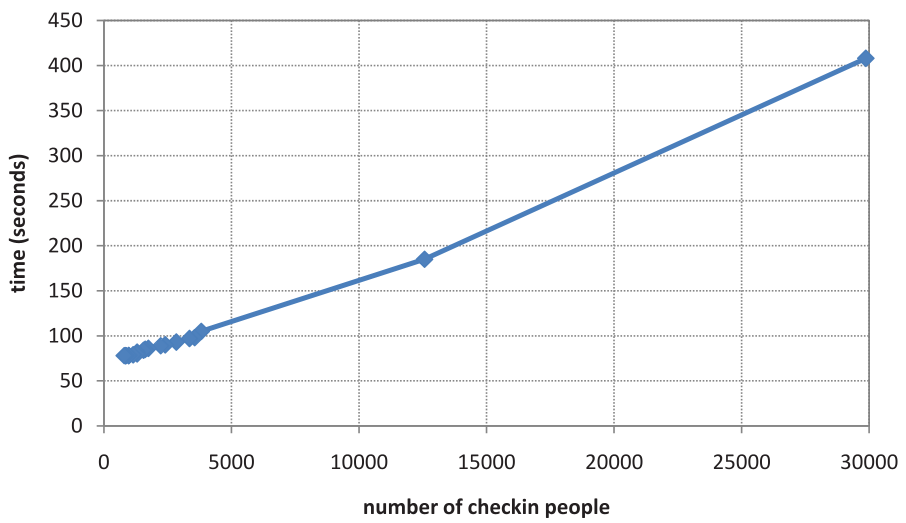 Figure 3: Subgraph-Time distribution showing that smaller, location-specific subgraphs yield faster online responses.
Critical Insight & Conclusion
LBSNRank thrives because it acknowledges the temporal locality of interest. It doesn't treat 2011 social data as equally relevant to a 2012 query.
Limitations: While effective for "Districts" and "Cities," the authors admit that ranking at the "POI" (individual restaurant) level still presents a massive scaling challenge for the offline component due to the sheer number of unique venues.
Future Work: The move toward "always-on" ranking will likely require incremental Monte Carlo methods where walks are updated as check-ins happen, rather than recomputed in batches.