
Leadership and Balance: The Blueprint for Scaling a World-Class Research Group
Leadership and Balance in Research
This paper explores the principles of effective leadership and sustainability in a large-scale research environment. Drawing from over a decade of experience leading a group of 40+ researchers, the authors introduce a framework focused on philosophical alignment, the "flow" of assets (knowledge, networking, funding), and flexible organizational structures.
TL;DR
In the hyper-competitive world of AI and Big Data, leadership is often reduced to "project management." This paper argues that true success requires a philosophical alignment that treats research as a way of life. By balancing a "triple-flow" of knowledge, networking, and funding within a flat, fluid organizational structure, the authors demonstrate how to scale a team of 40+ researchers while maintaining excellence and personal well-being.
The "Hidden" Crisis in Research Management
Most research labs fail not due to a lack of intelligence, but due to a lack of alignment and balance. Prior work often focuses on individual brilliance or rigid administrative KPIs. However, the authors point out three critical failure modes:
- Rigidity: Hierarchies that stifle the "No Rigidness" rule, preventing personal and group progress.
- Short-termism: Chasing data that fits the tools rather than solving meaningful problems.
- Human Friction: A lack of "trust" and "authenticity" that leads to scientific bluffing and internal politics.
Methodology: The Framework of Sustained Excellence
The authors' approach is built upon a high-level philosophical foundation they call the "No Nonsense Rule."
1. The Triple-Flow Model
To be sustainable, a group must manage three concurrent streams:
- Knowledge/Experience: Transitioning from "knowing stuff" to "doing stuff."
- Social Networks: Maintaining an evolving ecosystem of partners that triggers new research directions.
- Stable Funding: Diversifying sources across national agencies, EU commissions, and commercial arms.
2. Flexible Internal Organization
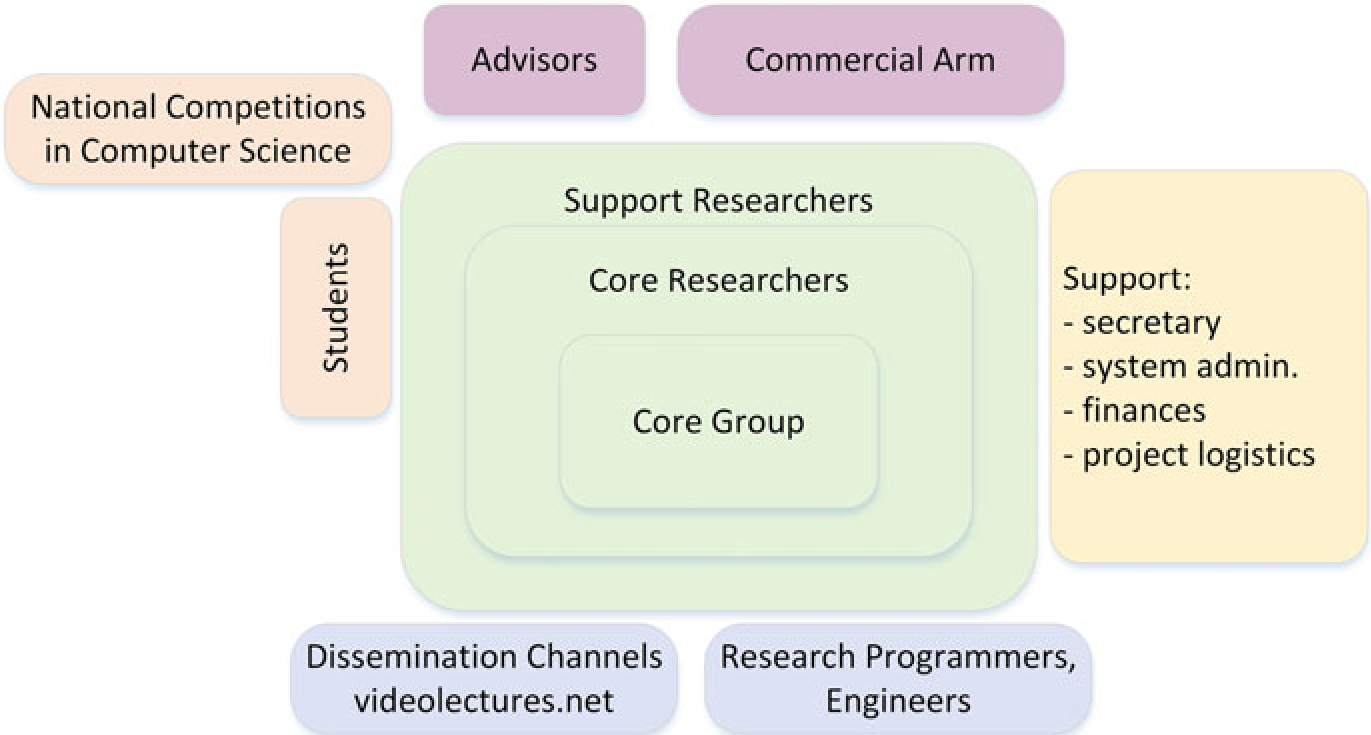
The group structure is designed to be formally defined but functionally fluid. As shown in the organizational roadmap, a healthy group evolves from a core team of enthusiasts to include specialized roles like project logistics, financial managers, and even a "commercial arm" to sustain prototypes.
3. Authentic Leadership (Intelligence + Intuition)
The paper posits that a leader must be "authentic"—combining intellectual strategy with intuitive "gut feelings." This involves:
- Leading by Example: Handling negative results and challenges with "grace."
- Extreme Delegation: If anyone else can do it, the leader must delegate, not just for efficiency, but to build trust and responsibility in others.
- Early Conflict Detection: Maintaining a "no gossip" culture and resolving friction before it poisons the research flow.
Experimental Validation: From Scratch to Global Influence
While not a traditional empirical study, the "results" are the lived trajectory of the research group:
- Scale: Growth to 40+ people within a national research institute.
- Infrastructure: The creation of VideoLectures.Net, a world-leading dissemination portal born from collaborative EU projects.
- Diversity of Impact: Successful navigation across the "research spectrum," from basic multidisciplinary AI (Big Data, Social Networks) to high-impact business applications in media monitoring.
Critical Analysis: Why This Matters for the Future of AI
This paper serves as a vital reminder for the current AI boom: as labs expand, the Inductive Bias of the organization matters as much as the Inductive Bias of the models.
The Limitations: The authors acknowledge this is a subjective reflection. The "No Fighting" and "No Corruption" rules are easy to state but difficult to enforce in high-stakes environments without a very strong "Core Team" acting as a cultural anchor.
Takeaway for Researchers
"Your own success as a leader is measured by the success of the people you are leading." In an era of high-speed publication, building a "flat and fluid" culture of trust is the only way to ensure that scientific advancement doesn't come at the cost of human exhaustion.