
Lean Crowdsourcing: Scaling Annotation Efficiency with Humans and Machines
Lean Crowdsourcing: Combining Humans and Machines in an Online System
The paper introduces "Lean Crowdsourcing," an online system and probabilistic framework (publicly available) that significantly reduces redundant human annotations for binary labeling, part keypoints, and multi-object bounding boxes. It achieves this by combining worker skill modeling, image difficulty estimation, and incrementally trained computer vision models through a sequential risk-based stopping criterion.
TL;DR
Deep learning is fuel-hungry, but the high cost of manual data labeling (like Bounding Boxes and Keypoints) often creates a bottleneck. Lean Crowdsourcing addresses this by introducing an intelligent, online system that knows exactly when to stop asking for human input. By modeling worker reliability and integrating real-time Computer Vision (CV) predictions, the authors reduce human effort by up to 11x while maintaining—or even improving—data accuracy.
The Problem: The High Cost of Unnecessary Redundancy
Most researchers follow a "Majority Vote" rule: ask 3-5 people for a label and take the average. This is fundamentally inefficient because it treats every image and every worker as equal. In reality:
- Some images are easy: A machine or a single human can identify a scorpion instantly.
- Some workers are experts: Their input should carry more weight than a "spammer" or a distracted worker.
- Redundancy is often wasted: If two people independently click the exact same pixel for a bird's beak, the probability they are both "randomly" wrong is near zero.
Methodology: The "In-the-Loop" Architecture
The core innovation is a probabilistic framework that treats Human Workers and Computer Vision models as collaborative agents.
1. The Online Loop
Instead of a static batch process, the system operates in a cycle. It predicts labels, updates worker skill scores, trains a CV model on the fly, and calculates the "Risk" for each image. If the Risk is lower than a threshold (), the image is marked "Finished."
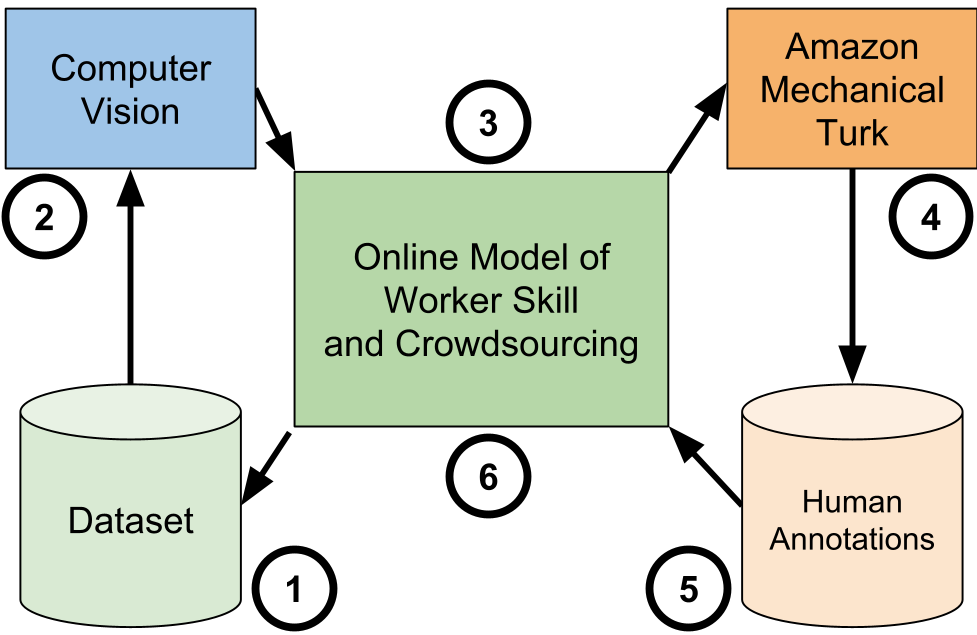
2. Modeling Worker Skill and Difficulty
For tasks like Part Keypoints, the model assumes a worker's click follows a Gaussian distribution around the true location. The variance is a mix of:
- Worker Skill (): How precise is this specific person?
- Image Difficulty (): Is the part obscured or blurry?
- Mistake Probability (): Did the worker just click a random spot?
3. Multi-Object Bounding Boxes
Handling multiple objects is tricky because workers might label them in different orders or miss some entirely. The authors solve this by formulating it as a Facility Location Problem, clustering worker boxes to find the true underlying objects.
Experimental Results: Doing More with Less
The efficiency gains are striking across three major annotation types:
- Binary Classification: Achieving better-than-baseline accuracy with 1.37 workers instead of 15.
- Bounding Boxes: Outperforming majority vote (7 workers) using just 1.97 workers.
- Part Annotation: Collecting 55,000 images with only 2.3 workers per part.
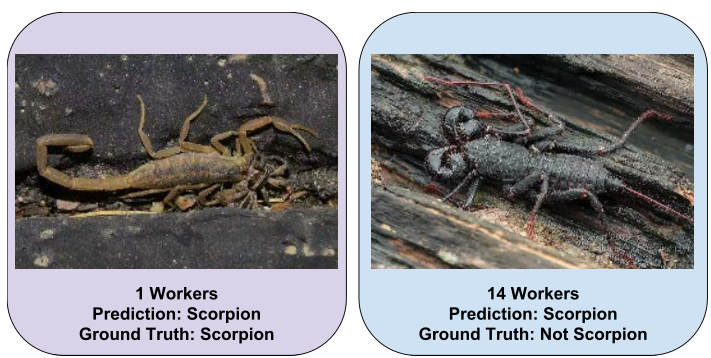 Figure: The "prob-worker-cvonline" method (red line) achieves lower error significantly faster than standard majority voting (blue line).
Deep Insights & Conclusion
Why it Works
The secret sauce is the incremental training of CV. As the system collects human labels, the CV model gets smarter, eventually taking the lead on "easy" images. This creates a virtuous cycle where humans are only used to resolve high-uncertainty samples (Active Learning).
Limitations
- Bias Risk: Relying too heavily on a CV model in-the-loop can bias a dataset toward that model's specific errors.
- Ambiguity: Even with many workers, some images (like "Scorpion Spiders" vs. "Scorpions") are so ambiguous that the crowd will consistently converge on the wrong answer.
The Bottom Line
Lean Crowdsourcing proves that we shouldn't just throw more humans at the labeling problem. By building a mathematical model of "confidence" and "skill," we can treat data collection as an optimization problem, making the bridge between human intelligence and machine learning more efficient and robust.