
LeapAlign: Decoding the Secret to Stable Early-Step Alignment in Flow Matching Models
LeapAlign: Post-Training Flow Matching Models at Any Generation Step by Building Two-Step Trajectories
LeapAlign is a post-training fine-tuning framework designed to align flow matching models (like Flux) with human preferences and text fidelity. It introduces a "leap trajectory" that simplifies long ODE sampling paths into two differentiable steps, enabling the stable backpropagation of reward gradients to early generation steps that determine global image structure.
TL;DR
LeapAlign is a breakthrough post-training method for Flow Matching models (like Flux) that enables stable reward gradient backpropagation across the entire generation path. By compressing long ODE trajectories into two-step "leaps" and selectively discounting gradients, it allows fine-tuning of early generation steps—the ones responsible for layout and composition—without memory explosion or numerical instability.
Background: The Differentiability Dilemma
In the world of Generative AI alignment, Flow Matching models offer a unique advantage over Discrete LLMs: their sampling process is continuous and differentiable. In theory, we should be able to pass a reward (like "high aesthetic score") back through the image generation steps to update the model weights directly via the chain rule.
However, in practice, a 25 or 50-step ODE trajectory is a vanishing gradient's nightmare and a memory hog. Prior works like DRTune solved this by updating only one or two steps or "stopping gradients" at the input, which effectively neuters the model's ability to learn how early layout choices affect the final reward.
Methodology: The Art of the Leap
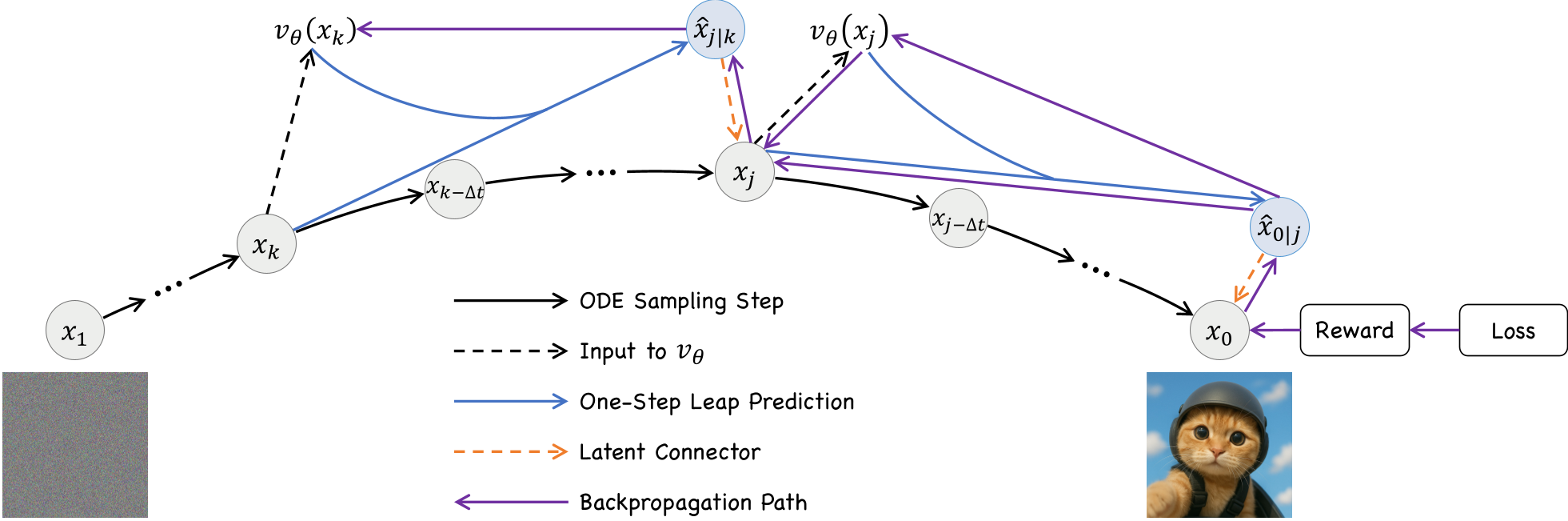
The core innovation of LeapAlign is the Leap Trajectory. Instead of simulating every step of the ODE, LeapAlign picks two random timesteps ( and ) and "leaps" directly to the clean image .
1. Two-Step Leap Trajectory
The model predicts a future latent state in a single step using the velocity field: By using two such leaps (), the method maintains a constant memory cost regardless of the original sampling length. To ensure the gradients remain "grounded" in reality, the authors use Latent Connectors that bridge the gap between the predicted leap and the actual latent found during a standard rollout.
2. Gradient Discounting: Surgical Precision
Traditional methods often suffer from "Nested Gradients"—the complex interactions between steps that usually lead to gradient explosion. While previous researchers simply truncated these terms, LeapAlign introduces a Discounting Factor (). By scaling these gradients (recommended ), they preserve the learning signal while keeping the optimization stable.
3. Trajectory-Similarity Weighting
Not all leaps are created equal. If a one-step prediction deviates too far from the actual trajectory, it provides a noisy, misleading gradient. LeapAlign assigns higher weights to updates where the "leap" and the "real path" are most similar, ensuring that the model learns from high-fidelity trajectories.
Experiments & Results: Redefining SOTA
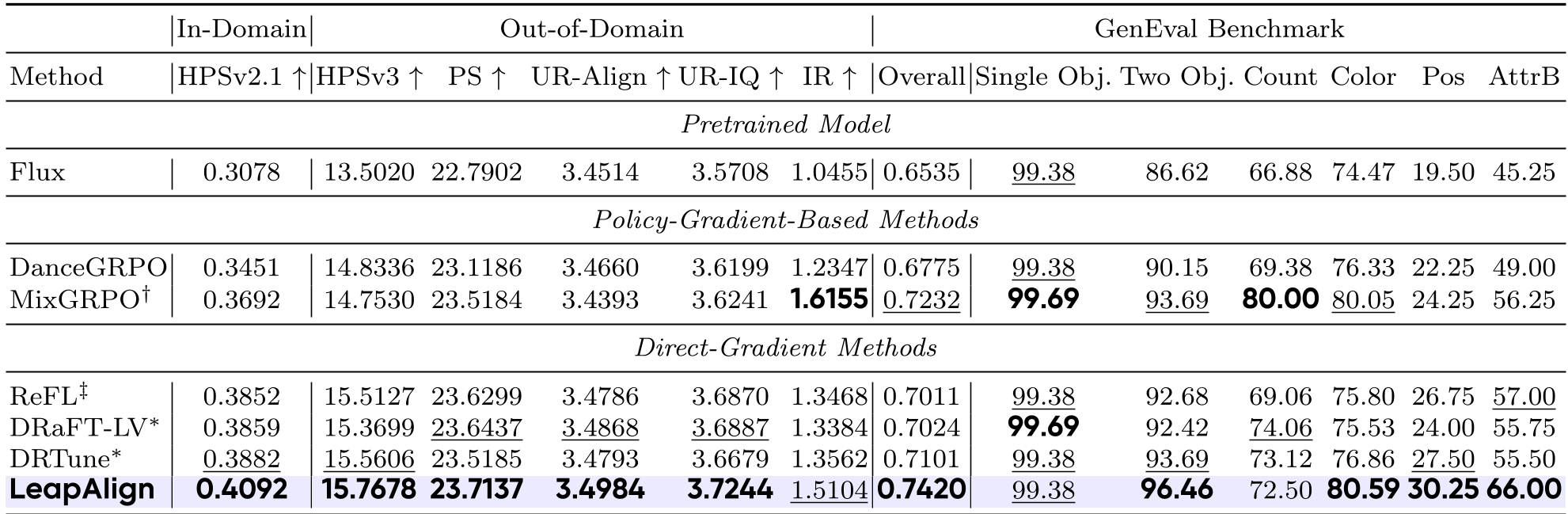
The researchers tested LeapAlign on Flux.1-Dev, comparing it against the heavyweights of the field, including MixGRPO and DRTune.
- Human Preference: LeapAlign achieved the highest scores on HPSv2.1 (0.4092) and PickScore (23.7137).
- Compositional Power: On the GenEval benchmark, which tests if a model can follow complex instructions (e.g., "a red ball to the left of a blue cube"), LeapAlign saw a massive jump, particularly in spatial positioning and attribute binding.
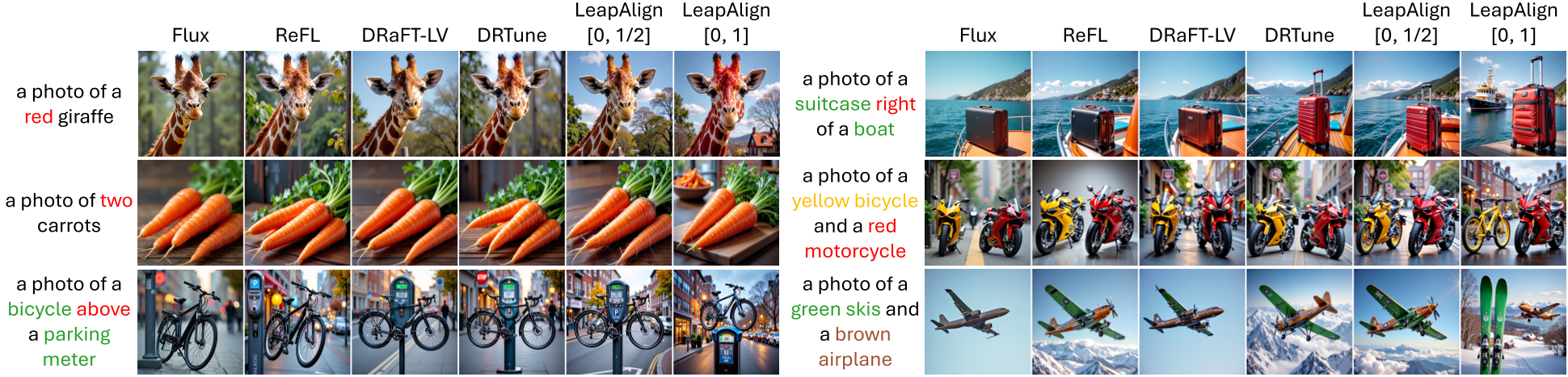
The qualitative evidence is clear: while other methods produce images similar to the base model, LeapAlign has the "courage" to rearrange the global layout to better fit the prompt, thanks to its ability to update early generation steps.
Critical Insight & Conclusion
LeapAlign proves that Direct Gradient methods are likely the future of diffusion alignment, provided we manage the "trajectory physics" correctly. By acknowledging that early steps are the "architects" of an image while late steps are the "decorators," LeapAlign provides a unified framework to optimize both.
Future Outlook: The authors suggest the next frontier is Video Generation. In video, where temporal consistency adds a massive new dimension of complexity, the memory-efficient leap trajectory might be the only viable way to perform end-to-end reward alignment.