
[Hyperscanning Insight] Beyond the Expert: How Brain-to-Brain Sync and Prior Knowledge Shape "Learning by Teaching"
The influence of learners' prior knowledge composition on interpersonal brain synchronization and learning outcomes in learning by teaching
This study investigates the "Learning by Teaching" (LBT) paradigm using fNIRS hyperscanning to explore how prior knowledge composition in dyads affects instructional behaviors and Interpersonal Brain Synchronization (IBS). It identifies that high-knowledge teachers excel in transfer tasks, while specific neural couplings in frontal-parietal-temporal regions (e.g., IPL-aPFC, SMG-SMA) significantly predict learning success.
TL;DR
Is the best way to learn really to teach? A new study using brain-imaging (fNIRS) reveals that while a teacher's prior knowledge is the strongest driver of performance, the dyad's composition—specifically when a knowledgeable student guides a novice teacher—creates unique neural signatures of "bridging inferences" that are just as critical for deep learning.
Positioning: This work moves beyond the "What" of peer learning into the "How" of neural coordination, proving that Interpersonal Brain Synchronization (IBS) is a real-time predictor of educational success.
The "Expertise" Trap: Problem & Motivation
In traditional pedagogy, we assume knowledge flows from the expert to the novice. However, in Learning by Teaching (LBT), both parties are learners. Prior research often ignored the interactive dynamic, treating teaching as a solo act of explanation.
The authors hypothesized that the chemistry between a teacher's and student's background knowledge doesn't just change the conversation—it changes how their brains "sync up." Why do some pairs feel like they are "on the same wavelength" while others struggle? This study looks for the answer in the Mirror Neuron System (MNS) and the Prefrontal Cortex (PFC).
Methodology: Mapping the Social Brain
The researchers categorized 120 dyads into four groups based on English proficiency:
- HT-HS: Both High Knowledge
- HT-LS: High Teacher, Low Student
- LT-HS: Low Teacher, High Student
- LT-LS: Both Low Knowledge
Using fNIRS (functional Near-Infrared Spectroscopy), they measured blood oxygenation in regions responsible for action understanding (IPL, SMG), perspective-taking (rTPJ), and executive planning (dlPFC).
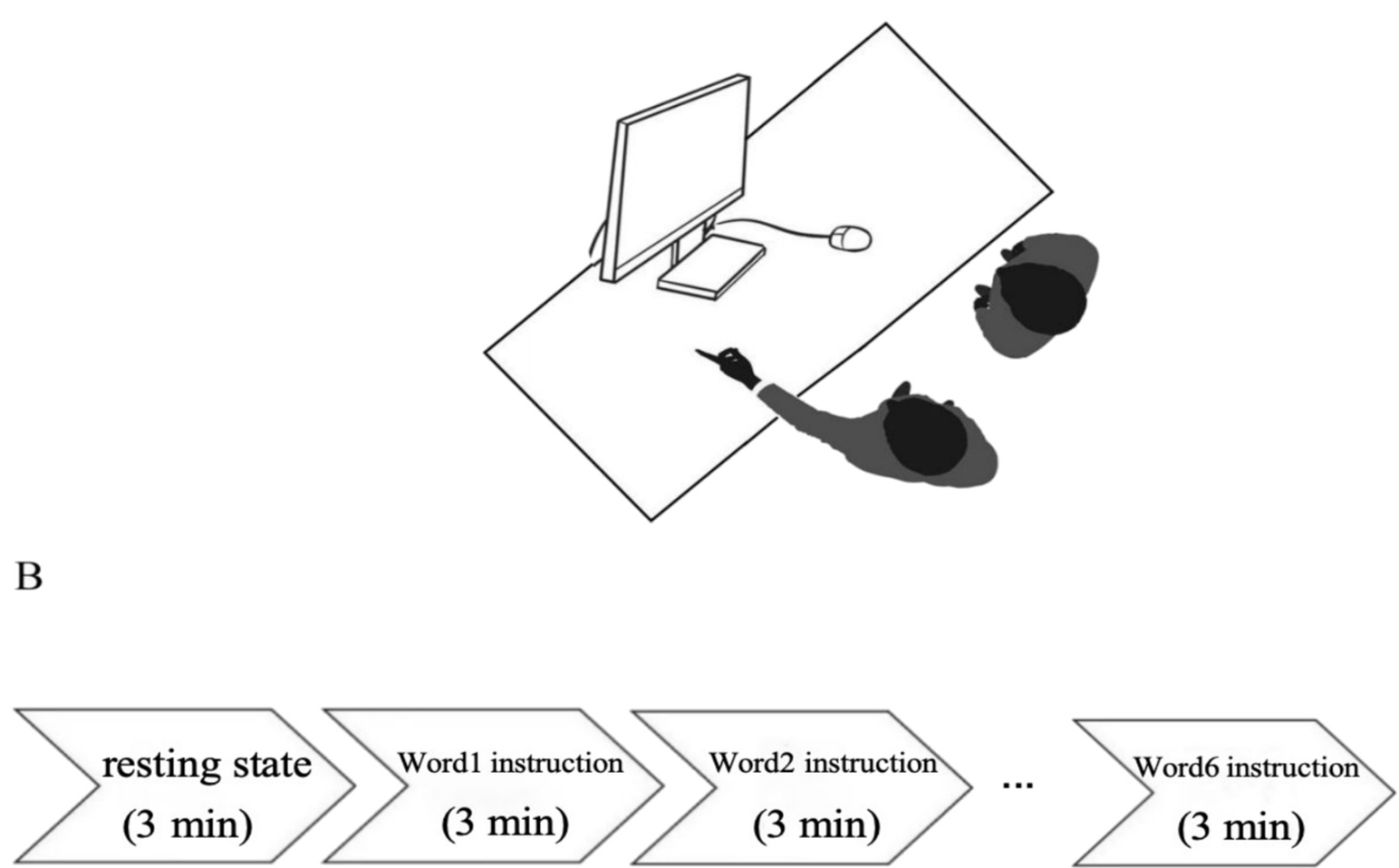 Figure 1: The dual-brain recording setup allowed for real-time tracking of neural alignment during a live 3-minute vocabulary teaching task.
Key Insights: Why "LT-HS" is the Dark Horse
The most fascinating result wasn't just that "experts are better." It was the LT-HS (Low Teacher, High Student) group.
- The Compensatory Effect: In these dyads, the student’s high prior knowledge acted as a "scaffold." They asked better questions, forcing the "novice teacher" to make bridging inferences—connecting new words to known concepts.
- Neural Synchronization: The study identified 5 Dynamic IBS States. State 3 and 4, characterized by intense frontal-parietal coupling, peaked during the middle of the instruction, signaling peak cognitive "entrainment."
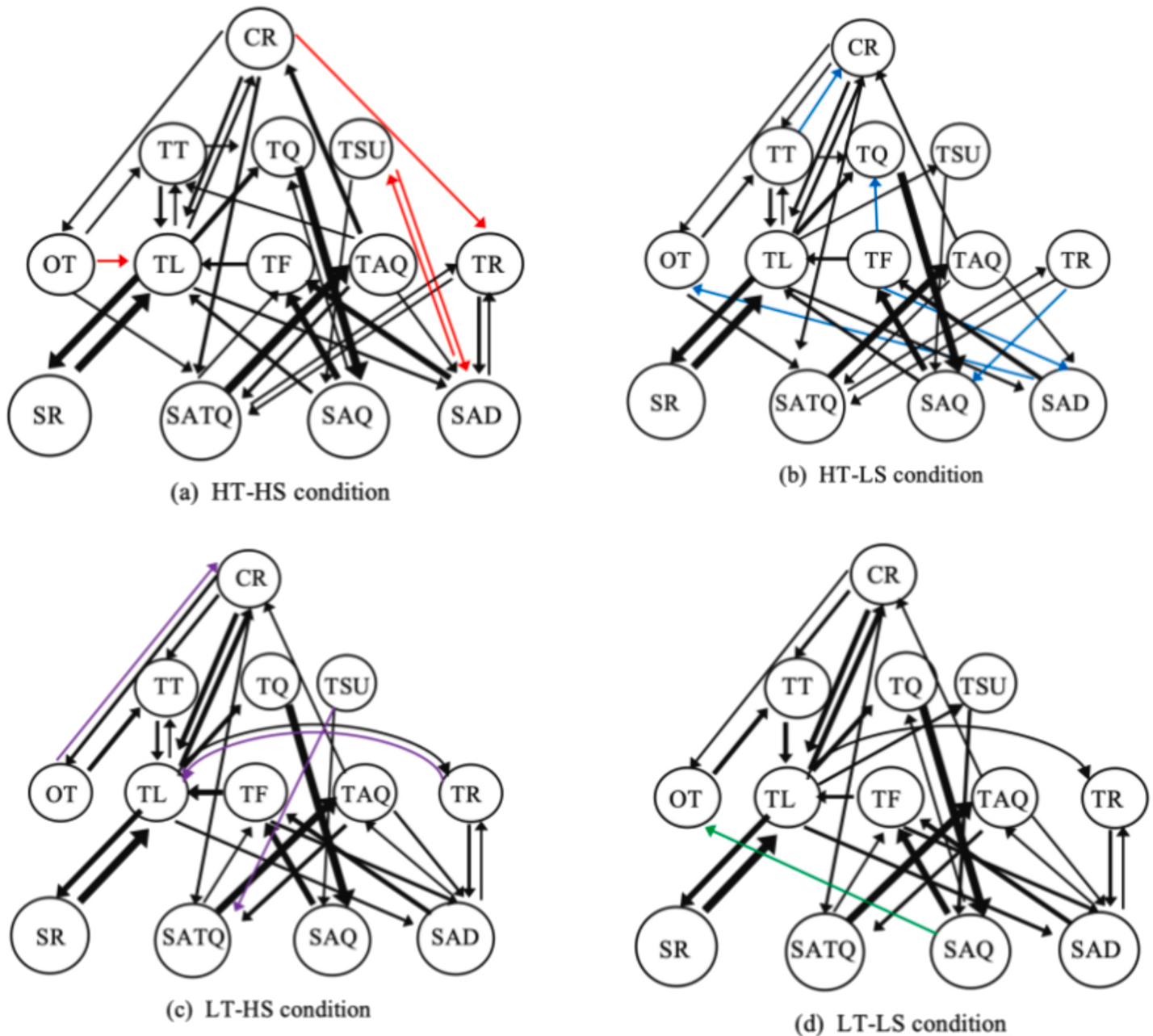 Figure 2: Lag Sequential Analysis (LSA) shows that high-knowledge dyads (HT-HS) exhibit more "Co-Regulation" (CR) and "Teacher Regulation" (TR), while low-knowledge pairs often drift "Off-Task" (OT).
Experiments & Results: Predicting Success
The researchers used backward regression to see which brain regions actually mattered for the final test scores:
- Transfer Performance: Predicted by IBS in the IPL-rTPJ and SMA-SMA pairings. This suggests that "sharing a mental map" of the task and its social goals is more important than just listening.
- Instructional Quality: "Bridging inferences" (connecting A to B) was the single strongest predictor of whether the teacher actually mastered the material they were teaching.
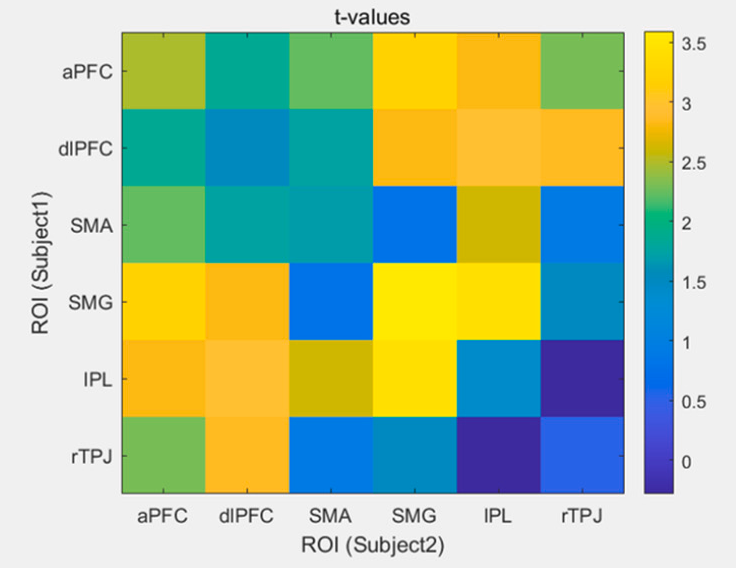 Figure 3: Comparison between real and pseudo-dyads. The high t-values in the SMG-SMG and aPFC-aPFC regions (warmer colors) indicate locations where genuine instructional interaction leads to synchronized brain activity.
Critical Analysis & Conclusion
This paper provides a neurobiological "seal of approval" for Reciprocal Teaching. It proves that:
- Prior knowledge is an anchor: It dictates the floor for performance.
- Synchrony is the engine: IBS provides the "neural window" into whether a teacher and student are actually co-constructing knowledge or just talking past each other.
Limitations: The study used a "median split" for prior knowledge, which can hide nuance. Furthermore, the participants were strangers; social friction or chemistry remains a "hidden variable" in IBS research.
Future Outlook: For AI-driven education, these findings suggest that "AI Students" should be designed to prompt "Bridging Inferences" from human learners, maximizing the human's "Learning by Teaching" benefits through intentional scaffolding.