
LAK vs. EDM: Bridging the Governance and Algorithm Gap in Digital Education
Learning analytics and educational data mining: towards communication and collaboration
This seminal paper compares two emerging fields: Educational Data Mining (EDM) and Learning Analytics and Knowledge (LAK). It maps their shared goals of improving education through big data while highlighting their distinct methodological identities and advocating for formal collaboration.
TL;DR
As education entered the era of "Big Data" in the early 2010s, two distinct communities emerged to make sense of it: Educational Data Mining (EDM) and Learning Analytics and Knowledge (LAK). This foundational paper by George Siemens and Ryan Baker serves as a manifesto for collaboration, arguing that while their methods differ—one favoring automated algorithms and the other human-centric insight—their survival depends on a unified academic front.
The Great Divide: Reductionism vs. Holism
The fundamental tension in educational research often boils down to how one views a student.
- EDM tends to be reductionist: It breaks learning down into specific components, such as a single response in an intelligent tutoring system, and uses Bayesian modeling or clustering to predict behavior.
- LAK tends to be holistic: It views learning as a complex system of social networks, sentiments, and institutional contexts, favoring methods like Social Network Analysis (SNA) and discourse analysis.
The authors argue that these are not conflicting truths but different "lenses." Without EDM, we lack the granular accuracy for personalized software; without LAK, we lose the "why" and the social context that makes education human.
Methodology Comparison: A Tale of Two Philosophies
The paper provides a critical roadmap (Table 1) of how these fields diverge technically and ideologically.
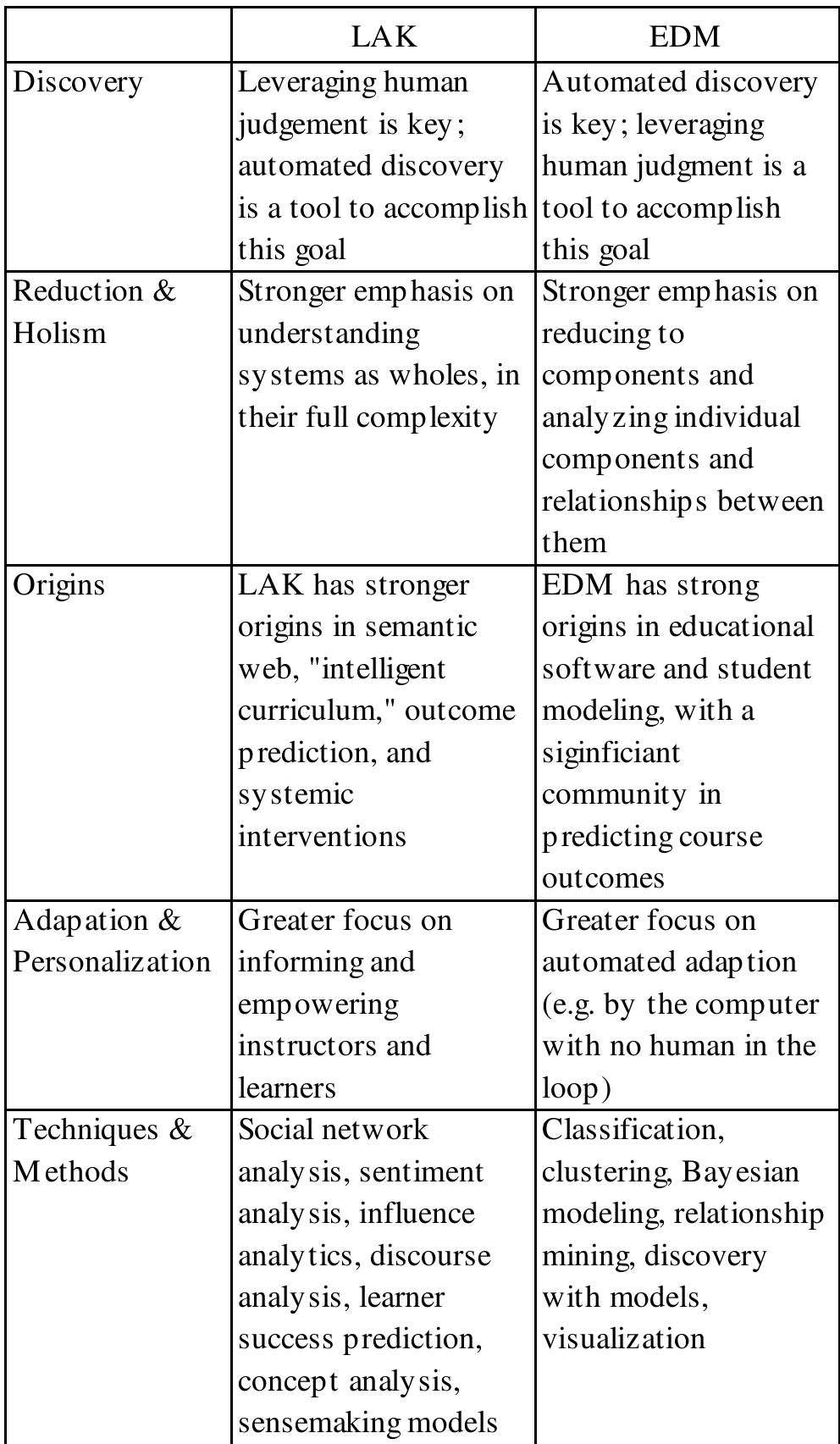
1. Automation vs. Human Judgment
In the EDM world, automated discovery is the star. The goal is often "no human in the loop"—think of an adaptive learning platform that adjusts difficulty automatically. In LAK, automation is merely a tool to serve human judgment, providing dashboards for teachers to make better pedagogical interventions.
2. Adaptation vs. Empowerment
EDM models are frequently the engine under the hood of Intelligent Tutoring Systems. LAK, conversely, focuses on Empowerment, helping learners understand their own "sensemaking" processes and helping administrators optimize institutional outcomes.
Why Interdisciplinary Collaboration Matters
The authors point out a looming threat: Commercialization without Rigor. As ed-tech companies rush to market with "analytics" features, they often ignore academic gold standards like multi-level cross-validation.
By collaborating, the EDM and LAK communities can:
- Set Standards: Define what "good" educational research looks like (e.g., student-level vs. lesson-level validation).
- Cross-Pollinate: Apply EDM's model generalizability to LAK's systemic interventions.
- Influence Policy: Move beyond "black box" algorithms toward transparent, research-backed educational tools.
Critical Insight: The "Friendly Competition"
The paper doesn't suggest merging the two fields into a single monolithic entity. Instead, it advocates for "healthy competition." Much like the historical split between AI and Learning Sciences in the 90s, having two communities allows for a broader diversity of researchers and specialized tools. However, the dissemination of research must be cross-boundary to prevent a "reinvention of the wheel."
Conclusion & Future Outlook
Twelve years after this paper was published, its message is more relevant than ever. As Generative AI enters the classroom, the line between "automated discovery" (EDM) and "human-centric empowerment" (LAK) is blurring. The takeaway is clear: the most effective educational technology is one that is both mathematically rigorous and socially grounded.
Takeaway for Researchers: Don't just pick a camp. If you are building an algorithm (EDM), ask how a teacher will use it (LAK). If you are analyzing a social network (LAK), ask how it can be modeled with statistical rigor (EDM).