
edX-MAS+: Cracking the Code of MOOC Attrition via Predictive Analytics
A Learning Analytics Tool for Predictive Modeling of Dropout and Certificate Acquisition on MOOCs for Professional Learning
This paper introduces edX-MAS+, a comprehensive Learning Analytics tool designed to predict student dropout and certificate acquisition in MOOCs. By leveraging 10 different Machine Learning algorithms and engineering 15 specific interaction indicators, the tool achieves high-precision predictive modeling across 15 course deliveries on the edX platform.
TL;DR
Massive Open Online Courses (MOOCs) are the backbone of modern lifelong learning, yet they are plagued by massive dropout rates. This paper presents edX-MAS+, a sophisticated toolkit that transforms raw platform logs into actionable predictions. By analyzing student behavior—specifically how they interact with videos and problems—the system can predict whether a student will earn a certificate with over 90% accuracy as early as three weeks into the course.
Background: The Retention Crisis in Digital Education
While MOOCs offer unparalleled access to knowledge, the "curiosity gap" is vast. Many learners enroll but few finish. For industry leaders using these platforms for professional development, this represents a significant loss of human capital potential. The challenge for educators is that they are "flying blind"—they don't know who is struggling until it is too late. Learning Analytics (LA) aims to fix this by turning "data trails" into "early warning systems."
The Problem & Motivation
Most predictive systems face a "cold start" or "labeling" problem: how do you define a "dropout" in a way that a machine can learn when the raw data doesn't provide a "dropped out" flag? Prior works often relied on manual tagging or simple thresholds that didn't account for the diversity of learner behaviors (e.g., "curious" learners vs. "at-risk" learners). The authors' insight was to create an empirical tagging rule based on clustering (K-means) and association rules to automatically label historical data for supervised training.
Methodology: The edX-MAS+ Architecture
The edX-MAS+ tool follows a rigorous data science pipeline divided into three modules:
- Import & Preprocessing: Cleans raw edX logs and constructs an Activity Matrix.
- Model Generation: Implements a "Day-by-Day" or "Week-by-Week" training frequency using 10 diverse algorithms (from Random Forest to XGBoost).
- Visualization: A dashboard for instructors to see AUC (Area Under the Curve) trends and variable importance.
Feature Engineering: The 15 Indicators
The heart of the system lies in its 15 engineered features, categorized into interaction, consistency, and effectiveness.
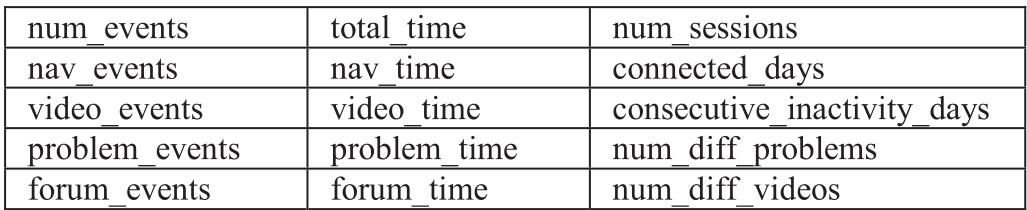 The 15 behavioral indicators used to train the predictive models.
Experimental Results & Insights
The researchers tested the system on 15 deliveries of 7 MOOCs, involving nearly 19,000 active learners.
Key Findings:
- The "20-Day" Threshold: Model accuracy stabilizes significantly after the first 20 days. AUC values jump from ~0.60 to over 0.90 for certificate acquisition.
- Problem-Solving is the Best Predictor: The most important variables for predicting success were
num_diff_problemsandproblem_events. Simply watching videos isn't enough; active problem-solving is the hallmark of a learner who will finish the course. - Algorithm Efficiency: While XGBoost and Random Forest are powerful, the Bayesian Generalized Linear Model provided the best balance of high accuracy, stability, and low training time.
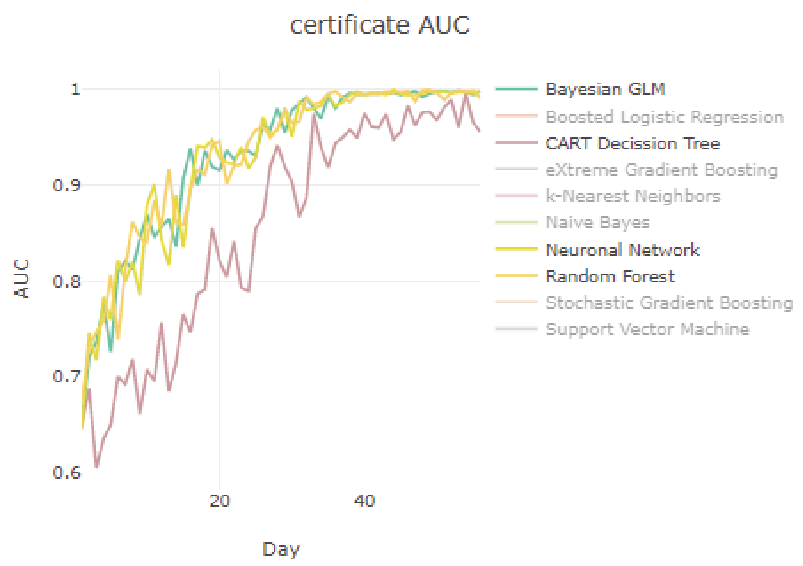 AUC growth over time: Predictive power increases as the learner's digital footprint grows.
Critical Analysis & Future Outlook
The strength of edX-MAS+ is its practicality. By using R's caret package and Python, it creates a bridge between complex data science and the end-user (the instructor).
Limitations: The definition of dropout remains somewhat heuristic (relying on a 10% activity threshold). Future iterations could benefit from Deep Learning (RNNs/LSTMs) to capture the sequential nature of learning rather than just aggregated daily statistics.
Takeaway for Professional Learning: For HR and industry leaders, tools like edX-MAS+ are essential. They allow for "proactive intervention"—if the system flags an employee as a potential dropout on Day 15, the organization can provide additional support or motivation, significantly increasing the ROI of corporate training programs.
Conclusion
This work demonstrates that while MOOC data is messy, it is highly structured by learner intent. By focusing on active engagement metrics rather than just "logins," edX-MAS+ provides a roadmap for the next generation of intelligent, responsive educational platforms.