
DGPA-SC: Accelerating Social-Aware Caching in D2D Networks
Learning automaton based distributed caching for mobile social networks
This paper introduces a distributed caching strategy for Mobile Social Networks (MSNs) using a Learning Automaton-based approach called the Discrete Generalized Pursuit Algorithm with Social Characters (DGPA-SC). By leveraging Device-to-Device (D2D) communications and social ties, the method optimizes content placement to maximize system throughput and outperform traditional Q-learning and MRU baselines.
TL;DR
Distributed caching at the network edge is essential for reducing backbone traffic, but traditional methods fail to account for user motivation and convergence speed. This paper proposes DGPA-SC, a framework that uses Social Network Analysis (SNA) to identify key nodes and a discretized learning automaton to optimize file caching. It achieves SOTA convergence speeds, outperforming Q-learning by over 16 times while significantly lowering transmission latency.
Problem & Motivation: The "Selfish" User Challenge
In Device-to-Device (D2D) underlay networks, the system relies on users sharing their local storage to serve others. However, why would a user sacrifice their battery and storage for a stranger?
Previous works attempted cooperative games or basic Q-learning, but they faced two fatal flaws:
- Impractical Incentives: They ignored the inherent social structures (kinship, colleagues, interests) that naturally drive data sharing.
- Latency: Q-learning moves through Markov Decision Processes too slowly for the fast-changing topology of mobile users.
The authors' insight is to treat the network as a Social-Physical Graph, where social ties (trust) and physical distance (feasibility) jointly determine the probability of a successful D2D transfer.
Methodology: Social Intelligence meets Learning Automata
The strategy unfolds in three main stages:
1. Identifying the "Important Users" (IUs)
Not all nodes are equal. The system selects IUs based on Betweenness Centrality (how often a node lies on the shortest path between others) and Storage Capacity.
u \cdot \mathbf{C} $$ Nodes with high $I$ act as the community's cache servers. ### 2. The DGPA-SC Core Unlike standard pursuit algorithms that only update the best action, the **Discrete Generalized Pursuit Algorithm (DGPA)** "pursues" all actions that show better reward estimates than the current selection. 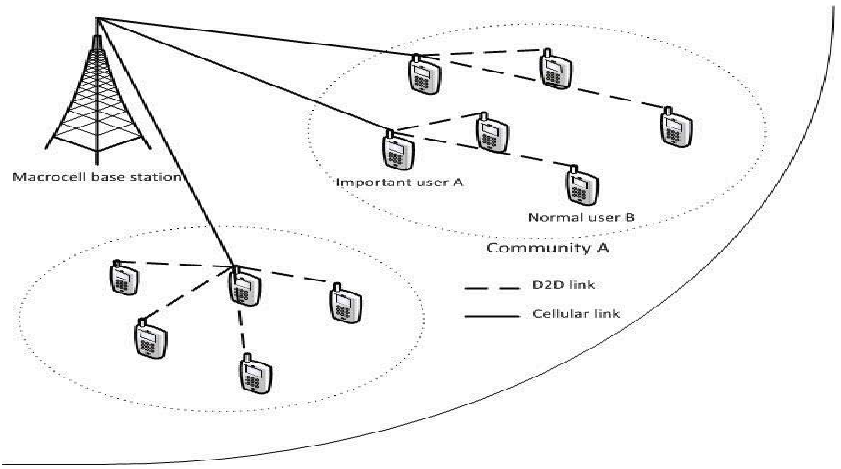 *Fig 1. Social-Physical community division where IUs serve normal users via D2D links.* ### 3. Reward with Social Characters The feedback $\beta(t)$ is not just a binary success/fail. It is weighted by **Similarity** $S_{d,c}$, calculated by common neighbors. An IU is rewarded more for caching a file that its "closest" social neighbors frequently request. ## Experiments & Results: Speed and Efficiency The most striking result is the **convergence speed**. In a library of 32 actions: * **Q-Learning**: >2000 iterations. * **DGPA-SC**: 123 iterations. 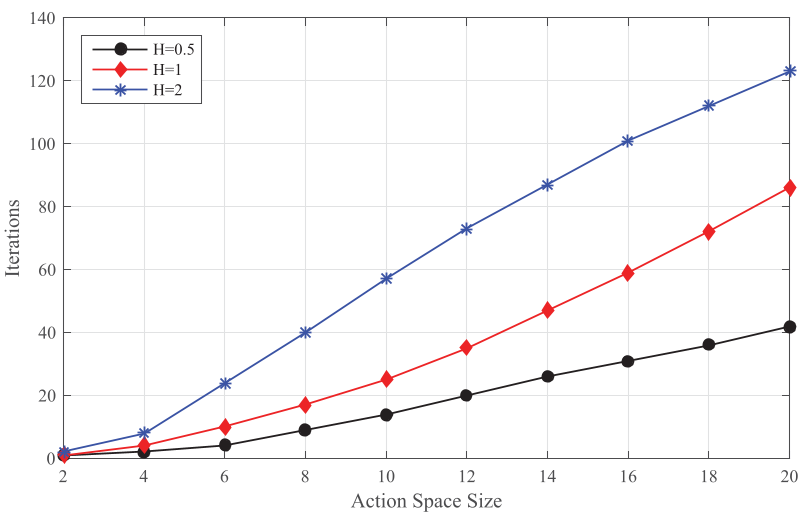 *Fig 2. Iterations vs. Action Space. Higher Resolution parameters (H) lead to higher accuracy but slightly slower convergence.* ### Transmission Performance When testing transmission time against MRU (Most Recently Used) and Random caching, DGPA-SC consistently shows a lower delay. Interestingly, the advantage of this algorithm **increases** as the user density grows, making it a "density-friendly" solution for urban environments. 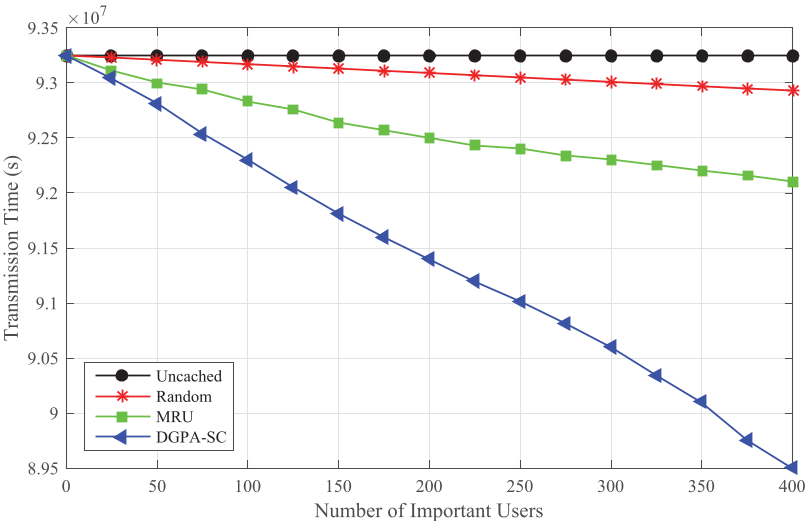 *Fig 3. Total transmission time across different strategies. DGPA-SC (the bottom blue line) maintains the lowest latency as the number of IUs increases.* ## Critical Analysis & Conclusion ### Takeaway The paper proves that "Social Awareness" is not just a buzzword but a mathematical constraint that can improve caching accuracy and solve the "cold start" problem in distributed learning. By prioritizing files for social clusters, the network creates a natural incentive for D2D cooperation. ### Limitations * **Privacy**: Calculating betweenness centrality and similarity requires knowledge of a user's social graph, which raises significant privacy concerns. * **Mobility**: While the paper assumes users are movable within a community, high-speed mobility (e.g., vehicular networks) might break the social ties before the learning automaton converges. ### Future Work The next logical step is integrating **federated learning** to compute these social metrics locally on-device, ensuring that the "Social Characters" are utilized without exposing the raw social graph to the Base Station.