
CSIF: Decoding Social Influence through Joint Content-Social Representation Learning
Learning content–social influential features for influence analysis
The paper introduces Content-Social Influential Features (CSIF), a representation learning framework that maps user pairs and tweet content into a unified latent space. By leveraging similarity in this joint space, the method predicts the probability of information propagation (retweeting) across large-scale social networks.
Executive Summary
TL;DR: This work moves beyond simple follower counts to answer why and how information spreads. By embedding user relationships and tweet content into a unified mathematical space called Content–Social Influential Features (CSIF), the researchers can predict the probability of a retweet with unprecedented accuracy, even for topics or users not seen during training.
Academic Context: This paper marks a shift from heuristic-based influence analysis (like PageRank variations) to representation learning. It bridges the gap between Social Network Analysis (SNA) and Natural Language Processing (NLP) by treating influence as a distance measurement in a latent feature space.
Problem & Motivation: The "Million Follower Fallacy"
The industry has long suffered from the "Million Follower Fallacy"—the assumption that high follower counts equate to high influence. Scholarly work has previously attempted to fix this using:
- Network-only models: These ignore the content (e.g., a sports influencer has zero influence when talking about quantum physics).
- Topic-aware models: These treat topics as discrete buckets, failing to capture the nuance of how specific wording affects propagation.
The authors' core Insight is that influence is a pairwise interaction conditioned on content. To model this, we need a "bridge" that allows us to compare a user-pair's relationship directly against a piece of text.
Methodology: The CSIF Framework
The core innovation is the projection of two disparate entities—a user pair and a tweet —into the same -dimensional space.
1. The Probabilistic Formulation
The model defines the probability of retweeting from using a softmax function: Here, and are transformation matrices that "translate" raw social features and raw text features into the influential manifold.
2. Scaling via Hierarchical Softmax
Computing the denominator for millions of users is , which is impossible. The authors adapt Hierarchical Softmax, reducing the complexity to . By organizing user pairs into a binary tree, the model only needs to make a series of binary decisions to estimate the propagation probability.
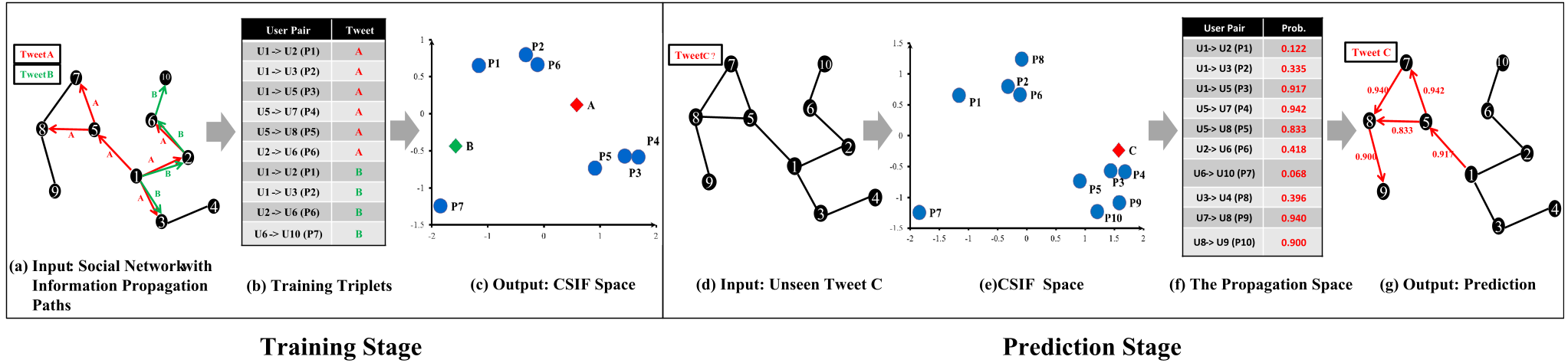 Figure 1: The workflow from raw social triplets to the learned CSIF space, enabling both user prediction and global influence ranking.
3. Asynchronous Parallel Learning
The authors utilized a 24-core architecture to scan 8 million triplets. They proved that because social interactions follow a Power Law, the risk of "parameter collisions" in asynchronous updates is negligible (approx. 0.00002%), allowing for massive parallel speedups.
Experiments & Results
The model was stress-tested on a massive snapshot of Tencent Weibo (53M users).
Propagation User Prediction
The task: Given a sender and a tweet, who will retweet it?
- CSIF + SVM achieved significantly higher AUC than standard SVMs or static probability models.
- The model demonstrated high generalization, performing well even on topics that were withheld during the training phase.
Domain Expert Identification
By plugging CSIF probabilities into a PageRank-style algorithm, the authors identified "Domain Experts." Unlike TwitterRank, which uses simple retweet counts, CSIF captures "higher-order" relations between content and the social fabric.
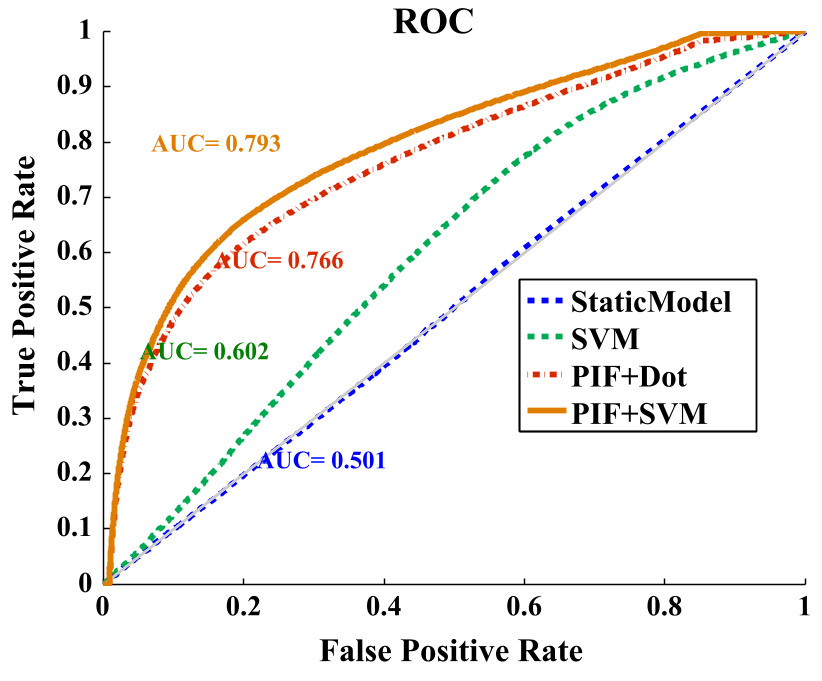 Figure 2: Performance comparison (ROC curves) showing CSIF (PIF) significantly outperforming baseline models in both time-related and topic-related predictions.
Critical Analysis & Conclusion
Takeaways
- Pairwise is Fundamental: Influence isn't a property of a user, but a property of an interaction (User A User B) under a specific Context (Content C).
- Latent Factors: The learned dimensions in CSIF act as "hidden factors"—some might represent topic affinity, while others represent social tie strength.
Limitations
A notable weakness identified by the authors is multi-modality. In topics like "Food," the model struggled because it relied on text, whereas users often propagate images. Future iterations would require integrating Computer Vision (CV) features into the content embedding.
Future Outlook
This work lays the groundwork for Prescriptive Influence. Instead of just predicting who will be influenced, can we optimize the content to maximize the propagation probability across a specific target audience? That is the billion-dollar question for the next generation of social marketing.