
DGC: Purifying Social Networks through Distilled Graph Clustering
Learning Distilled Graph for Large-Scale Social Network Data Clustering
2021-02-25
Summary
Problem
Method
Results
Takeaways
Abstract
This paper introduces Distilled Graph Clustering (DGC), a novel framework for large-scale social network analysis. It simultaneously learns a refined affinity graph and selects representative features by integrating both user content data and link information, achieving state-of-the-art results on datasets like BlogCatalog and Flickr.
In the era of explosive social media growth, analyzing user communities is like finding needles in a haystack. We are faced with two types of data: **Content** (what users post) and **Links** (who users follow). However, content is often noisy, and links are notoriously incomplete.
The paper *"Learning Distilled Graph for Large-Scale Social Network Data Clustering"* introduces **Distilled Graph Clustering (DGC)**, a method that doesn't just use the data it's given—it "distills" it to find the underlying truth.
## The Core Challenge: Noise vs. Incompleteness
In spectral analysis, we represent a network as a graph. Historically, researchers faced a dilemma:
1. **Content-only graphs**: Suffer from the "curse of dimensionality." Irrelevant tags or sparse features make Euclidean distances meaningless.
2. **Link-only graphs**: Links are often missing. Furthermore, a "follow" doesn't always imply community membership (e.g., a scientist following a celebrity's hobby blog).
DGC suggests that these two data sources should not be treated in isolation. Instead, they should be used to refine each other.
## Methodology: The Virtuous Cycle of Distillation
DGC moves away from static graph construction. It treats the problem as an iterative optimization task.
### 1. The Iterative Framework
The algorithm starts with a rough graph based on existing links. It then enters a loop:
* **Feature Selection**: It identifies which features (tags/keywords) best align with the current graph structure.
* **Graph Refinement**: It rebuilds the graph using *only* those selected features, effectively filtering out the noise.
### 2. Solving the "NP-Hard" Problem
Matching features to a graph is mathematically complex (NP-hard). The authors transform this into a **Convex Quadratically Constrained Linear Programming (QCLP)** problem. They use an **Accelerated Proximal Gradient (APG)** method to ensure the algorithm stays fast even with millions of users and features.

*The objective function (Eq. 10) targets the minimization of regression residuals while enforcing sparsity through a binary indicator vector.*
## Experimental Evidence
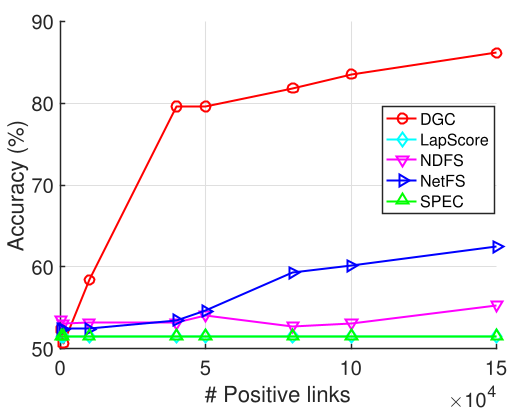
The authors tested DGC against heavyweights like *NetFS* and *NDFS* using synthetic and real-world data (BlogCatalog and Flickr).
### Resilience to Noise
In synthetic tests, as the number of "noisy" features increased from 0 to 15,000, most algorithms saw their accuracy plummet. DGC remained remarkably stable, holding high accuracy long after other methods failed.
*Visualizing the Distillation: Note how the similarity matrix starts sparse (Iteration 0) and becomes increasingly clear and structured by Iteration 10.*
### Real-World Performance
On the **Flickr** dataset, DGC achieved an **Accuracy of 51.07%**, outperforming the nearest competitor by a significant margin. More importantly, its computation time was significantly lower than traditional methods when handling large feature sets, proving its scalability for actual social platforms.
## Deep Insight: Why DGC Works
The secret to DGC’s success lies in its **Inductive Bias**. By assuming that "true" community structures are reflected in both content and link patterns, it uses the link data to "supervise" the content feature selection. This prevents the model from being distracted by the vast amount of irrelevant metadata generated by social media users.
## Conclusion & Future Look
DGC represents a shift from "learning from graphs" to "learning the graph itself." By distilling noisy content through the lens of social links, it provides a cleaner, more robust representation of human communities.
**Takeaways for Practitioners:**
* **Don't trust raw features**: In high-dimensional social data, 90% of your features might be noise.
* **Fusion is Key**: Combining structural (links) and attribute (content) data creates a more resilient model than either could provide alone.
* **Scalability**: Iterative distillation with proximal gradients is a viable path for processing massive datasets without needing infinite compute.
*Note: The authors suggest that this "distillation" logic can be easily extended to semi-supervised and supervised tasks, potentially revolutionizing how we handle graph embeddings in the future.*