
RLL: Solving the Sparse and Noisy Label Dilemma in Educational AI
Learning Effective Embeddings From Crowdsourced Labels: An Educational Case Study
The paper introduces RLL (Representation Learning with crowdsourced Labels), a unified framework designed for education applications to learn high-quality data embeddings from limited and inconsistent crowdsourced annotations. It combines a grouping-based deep architecture for data augmentation and a Bayesian confidence estimator to handle label noise.
TL;DR
Deep learning thrives on data "quantity" and "quality," but in specialized fields like education, we often have neither. RLL (Representation Learning with crowdsourced Labels) is a novel framework that turns sparse, inconsistent crowdsourced labels into robust embeddings by combining a smart data-grouping strategy with a Bayesian estimator that acknowledges: "not all labels are created equal."
The "Education" Challenge: High Cost, Low Consistency
In the context of the TAL AI Lab study, two tasks were analyzed: predicting the fluency of student math speeches and the quality of 60-minute online classes. Unlike labeling an image of a cat (which takes seconds), a crowd worker must watch an hour-long video to label class quality.
This leads to two critical bottlenecks:
- Extreme Scarcity: A limited budget translates to very few samples ( is small).
- High Subjectivity: Professional 1v1 classes are ambiguous. One worker might call a class "Good," while another calls it "Average," leading to noisy, inconsistent labels.
Methodology: The RLL Framework
The authors propose a two-pronged solution to solve these issues simultaneously within a single Deep Neural Network (DNN) training loop.
1. Grouping-Based Deep Architecture
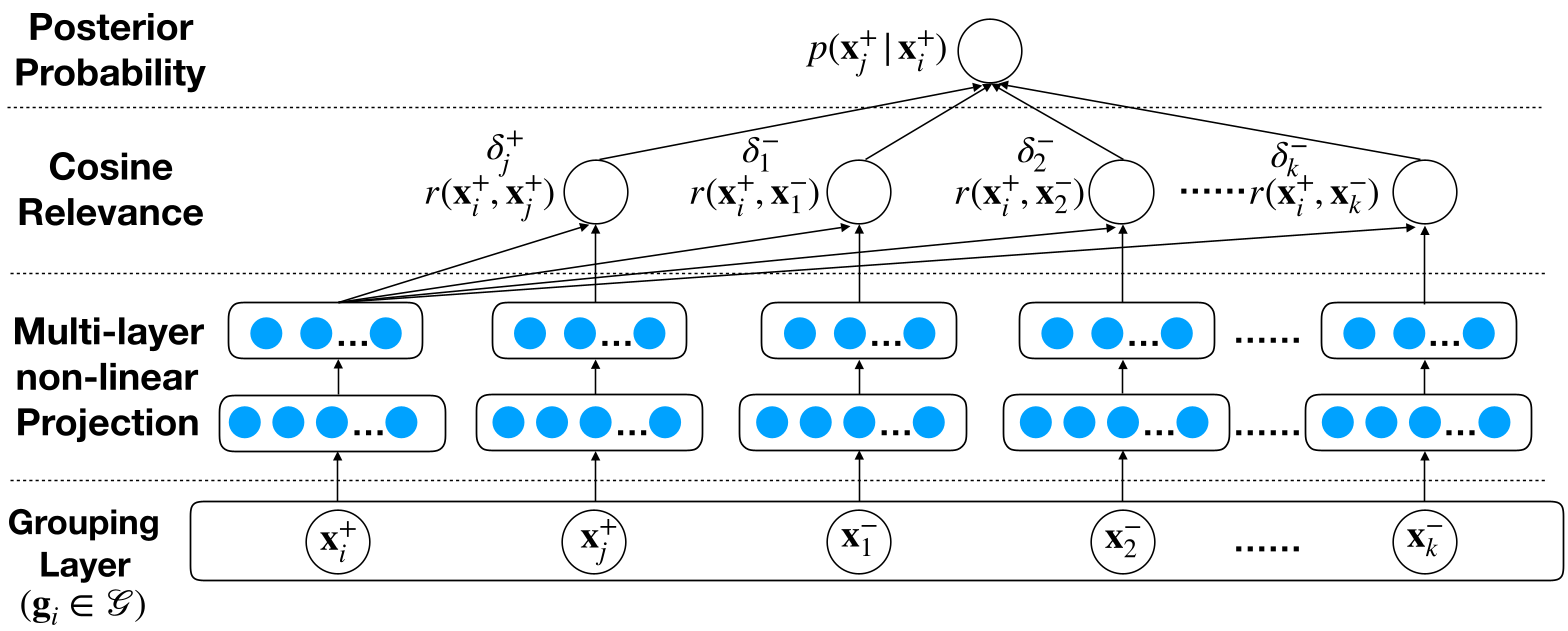
To prevent overfitting on small datasets, RLL reassembles the data into "groups." For every positive sample, it pairs it with another positive sample and negative samples.
- The Intuition: Instead of learning "what is a good class," the model learns to "make two good classes similar and distinguish them from several bad ones."
- Combinatorial Explosion (The Good Kind): This strategy theoretically increases the training instances to , effectively providing the DNN with enough "contrastive perspectives" to learn robust features without more raw data.
2. Bayesian Confidence Estimator
Standard models treat labels as 100% true. RLL knows better. It assigns a confidence to each label.
- Beyond MLE: If 5 workers label a sample and the result is (1, 1, 1, 0, 0), the Maximum Likelihood Estimate (MLE) is simply 0.6. However, with very few workers, MLE is unreliable.
- Beta Prior: RLL uses a Beta Distribution as a prior to refine the confidence score, ensuring the model doesn't over-rely on labels with high worker disagreement. This is then used to weight the softmax function in the loss objective.
Experimental Performance
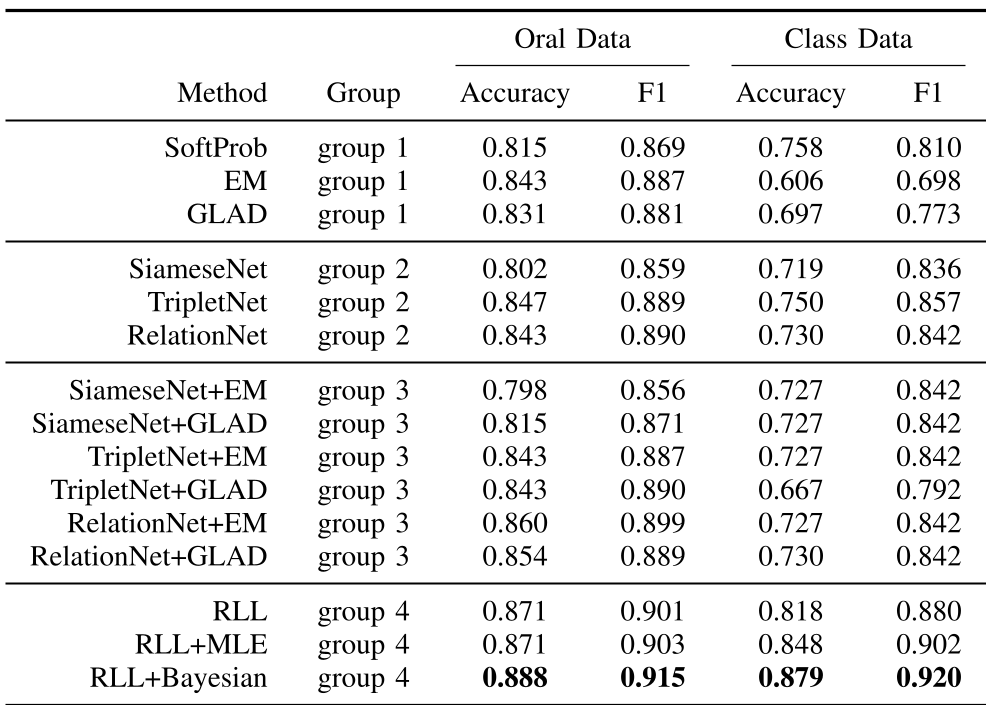
The framework was tested against heavyweights like Siamese Networks, Triplet Networks, and RelationNet.
Key Results:
- Superiority Over Two-Stage Models: Traditionally, researchers fix the labels first (EM/GLAD) and then train the model. RLL proves that joint optimization (learning labels and embeddings at the same time) is superior.
- Robustness to Noise: On the "Class" dataset, RLL-Bayesian outperformed the best two-stage model by nearly 15% in accuracy.
The "k" Factor:
The authors found that the number of negative samples () in a group is a double-edged sword. While provided the best results, increasing it further introduced too much noise, causing performance to drop.
Critical Analysis & Conclusion
The beauty of RLL lies in its pragmatic approach to "messy" real-world data. It treats the shortcomings of crowdsourcing not as a data cleaning problem, but as a feature of the learning process.
Takeaway: If you are working in a domain where data is expensive to label and human annotators disagree frequently, stop trying to find the "perfect label." Instead, use a framework like RLL to model the uncertainty of your labels as part of your representation learning.
Future Work: The current RLL framework treats all workers as an anonymous collective. Incorporating individual "worker profiles" (tracking which worker is consistently reliable) could be the next jump in performance for this architecture.