
PJFFF: Revolutionizing Person-Job Fit via Explicit and Implicit Feature Fusion
Learning Effective Representations for Person-Job Fit by Feature Fusion
The paper introduces PJFFF (Person-Job Fit based on Feature Fusion), an advanced recruitment matching framework that combines explicit content analysis with implicit intention modeling. It achieves state-of-the-art results on a 10-month real-world dataset by fusing semantic entity features from resumes with historical application behaviors.
TL;DR
Matching the right candidate to the right job is the "Holy Grail" of HR technology. PJFFF (Person-Job Fit based on Feature Fusion) breaks away from traditional text-only matching by integrating semantic entity extraction (Explicit Intention) with historical application sequences (Implicit Intention). It achieves a staggering 95.3% AUC, significantly outperforming baseline deep learning models.
Context & Motivation: Why Textual Matching is Not Enough
Most existing AI recruiters "read" resumes like a human would—focusing on the text. However, they suffer from two critical flaws:
- Ignoring Structure: Deep learning models often treat resumes as flat chunks of text, ignoring the crucial semantic weight of entities like "Top 50 University" or "5 years of Python experience."
- The Hidden Requirement: Job descriptions are often incomplete. A recruiter might say they want a "Data Scientist," but their history of rejecting PhDs in favor of practical engineers reveals an implicit preference that isn't in the text.
Methodology: The Fusion of Two Worlds
1. Learning Explicit Intentions (The "What")
The model processes the resume and job post through two parallel paths:
- Adapted DeepFM: Extracts semantic entities (Age, Gender, University Tier, Skills) through rules and BERT-based classifiers. These are fed into a Factorization Machine (FM) block to capture high-order feature correlations.
- CNN Stream: Processes the free text fields (Working Experience, Job Descriptions) to capture local contextual semantics.
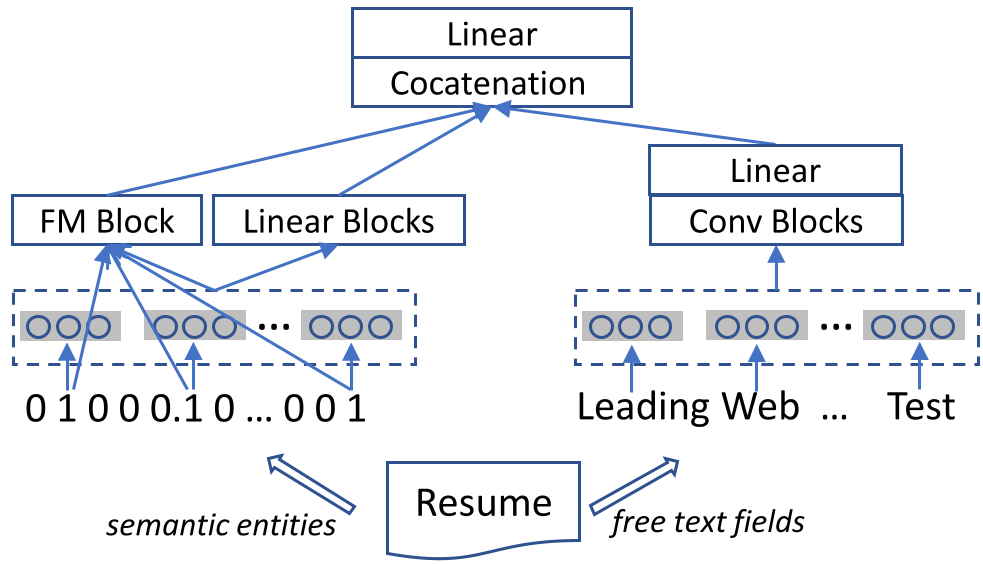 The dual-stream architecture of PJFFF for explicit feature extraction.
2. Learning Implicit Intentions (The "Why")
This is the core innovation. By using an LSTM, the model analyzes the history of a job post (who was accepted? who was rejected?) and a candidate (where did they apply?). This sequence acts as a "preference profile" that compensates for vague job descriptions.
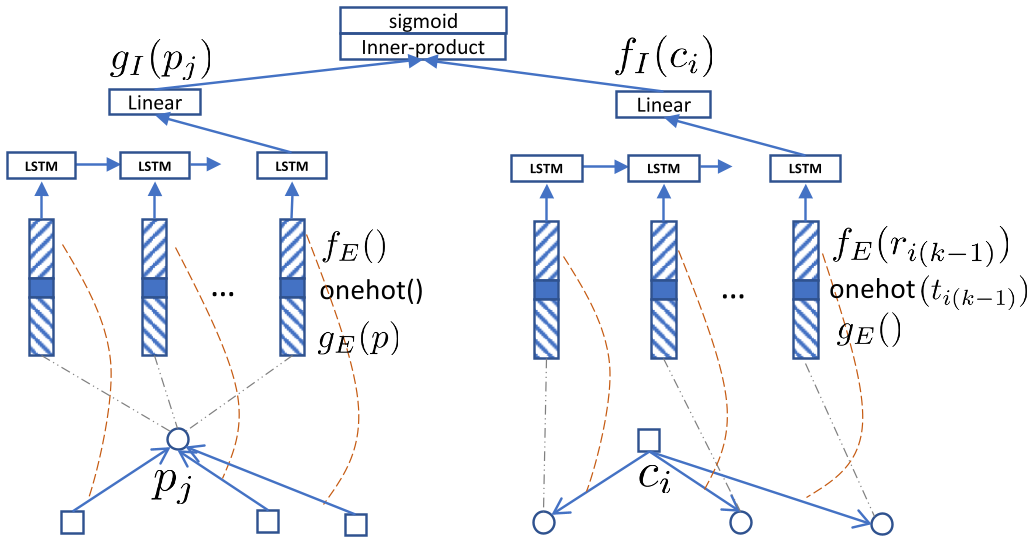 Capturing historical interactions to infer hidden preferences.
Performance: Dominating the Baselines
PJFFF was tested against heavyweights like LightGBM, APJFNN, and JRMPM.
| Method | AUC (%) | F1 (%) | Prec@Rec=0.8 |
|---|---|---|---|
| LightGBM | 91.7 | 67.6 | 56.9 |
| JRMPM | 91.3 | 66.7 | 51.8 |
| PJFFF (Ours) | 95.3 | 77.1 | 73.3 |
The ablation study revealed that while semantic entities alone are powerful, the addition of implicit features (application history) provides the final boost needed to reach SOTA performance.
Deep Insight: Interpretability and Deployment
Unlike "black-box" models, PJFFF offers high interpretability. By looking at the extracted semantic entities, HR managers can see exactly which skills or education tiers triggered a high matching score.
Online Reality Check: Scaling such a model is hard. The authors shared that they used Model Distillation to compress the heavy BERT components and re-implemented preprocessing in Go to achieve a low latency of 0.2~0.3 seconds per sample on standard CPUs.
Conclusion
PJFFF demonstrates that recruitment is not just a search problem, but a behavior-modeling problem. By fusing the explicit "Skill-Requirement" match with the implicit "Preference-Intention" history, it sets a new standard for automated Person-Job Fit. The future of talent acquisition lies in this hybrid approach where semantic understanding meets historical intuition.