
Bridging the Semantic Gap: Leveraging I-W-B-E Graphs for Cross-Modal Retrieval
11132_Learning Effective Representations from Sparse Mutlimodal Data on Content Curation Social Networks.
The paper proposes a novel framework for cross-modal similarity learning by bridging the gap between images and semantic words. It introduces a specialized graph structure (I-W-B-E) and a Deep Neural Network (DNN) optimization strategy to learn joint embeddings for Image-Word-Entity relations, achieving SOTA results in cross-modal retrieval.
TL;DR
This research tackles the "semantic gap" in cross-modal retrieval by introducing a comprehensive graph-based framework. By modeling relationships between Images (I), Words (W), and Entities (E), and incorporating user Behaviors (B), the authors created a robust embedding space. Their approach significantly outperforms standard Deep Belief Networks (DBN/DBM) on visual-semantic benchmarks.
Background & Motivation
Mapping images and text into a shared vector space is the cornerstone of modern search engines. However, raw visual features (VGG/ResNet) and word embeddings (Word2Vec) naturally reside in different manifolds. The core problem is that simple linear projections often fail to capture the complex, non-linear relationships between a specific entity and its various visual representations. The authors argue that by introducing a "behavioral" layer, we can better anchor these modalities.
Methodology: The I-W-B-E Graph and DNN Optimization
The innovation lies in the transition from a simple bipartite graph to a multi-layered heterogeneous graph: .
1. Graph Construction
The model doesn't just link images to words. It maps:
- I-W: Image to Tag relationships.
- W-E: Word to Entity (semantic categorization).
- Behavior (B): Interaction data that provides context for why certain images are associated with specific entities.
2. Learning the Embedding
The authors utilize a biased random walk (DeepWalk-BIW) to generate node sequences. These sequences are then used to optimize a transition probability objective:
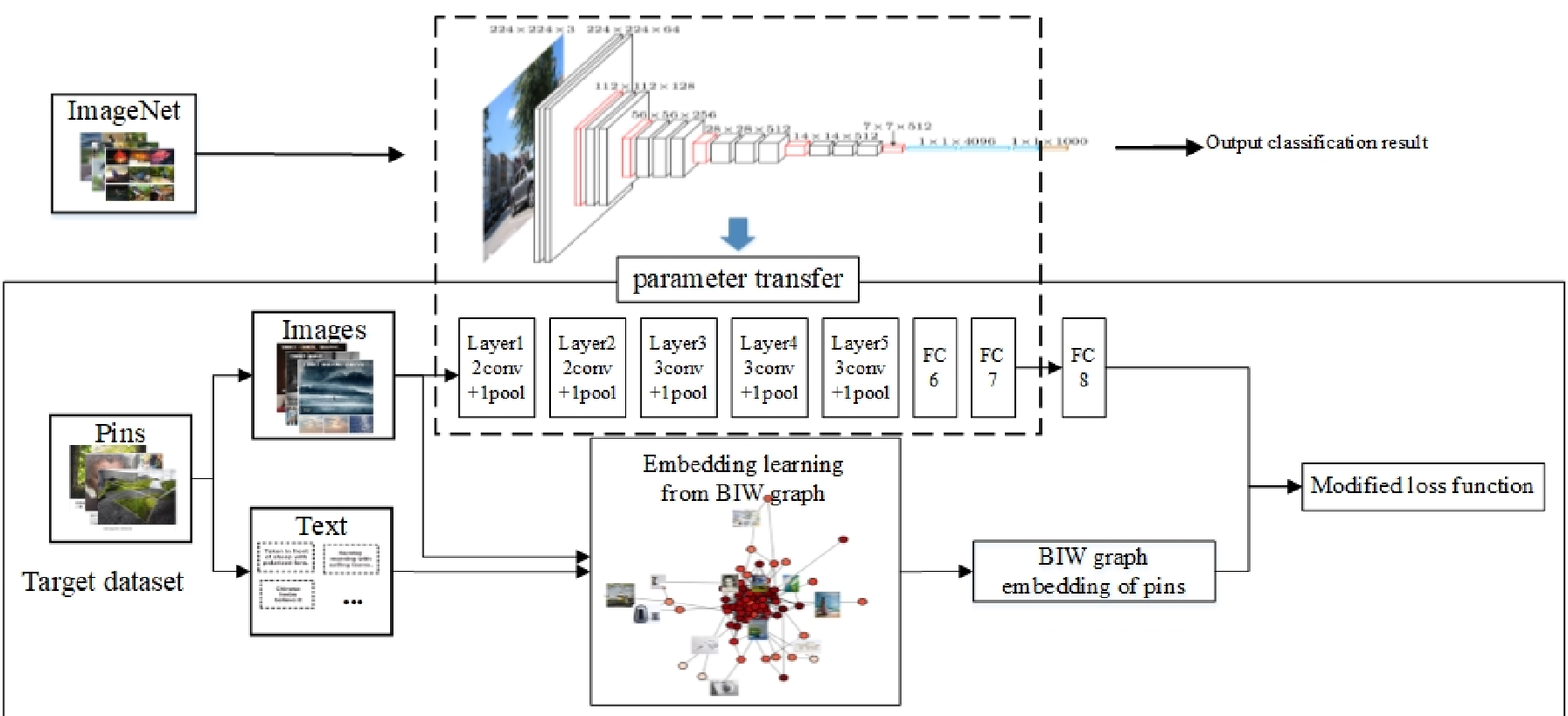
3. The Objective Function
The most critical part of the methodology is the DNN loss function, which forces the visual projection to stay close to both specific word anchors and broader entity clusters: This ensures the learned representation is globally consistent (Entity-level) and locally precise (Word-level).
Experimental Analysis and Results
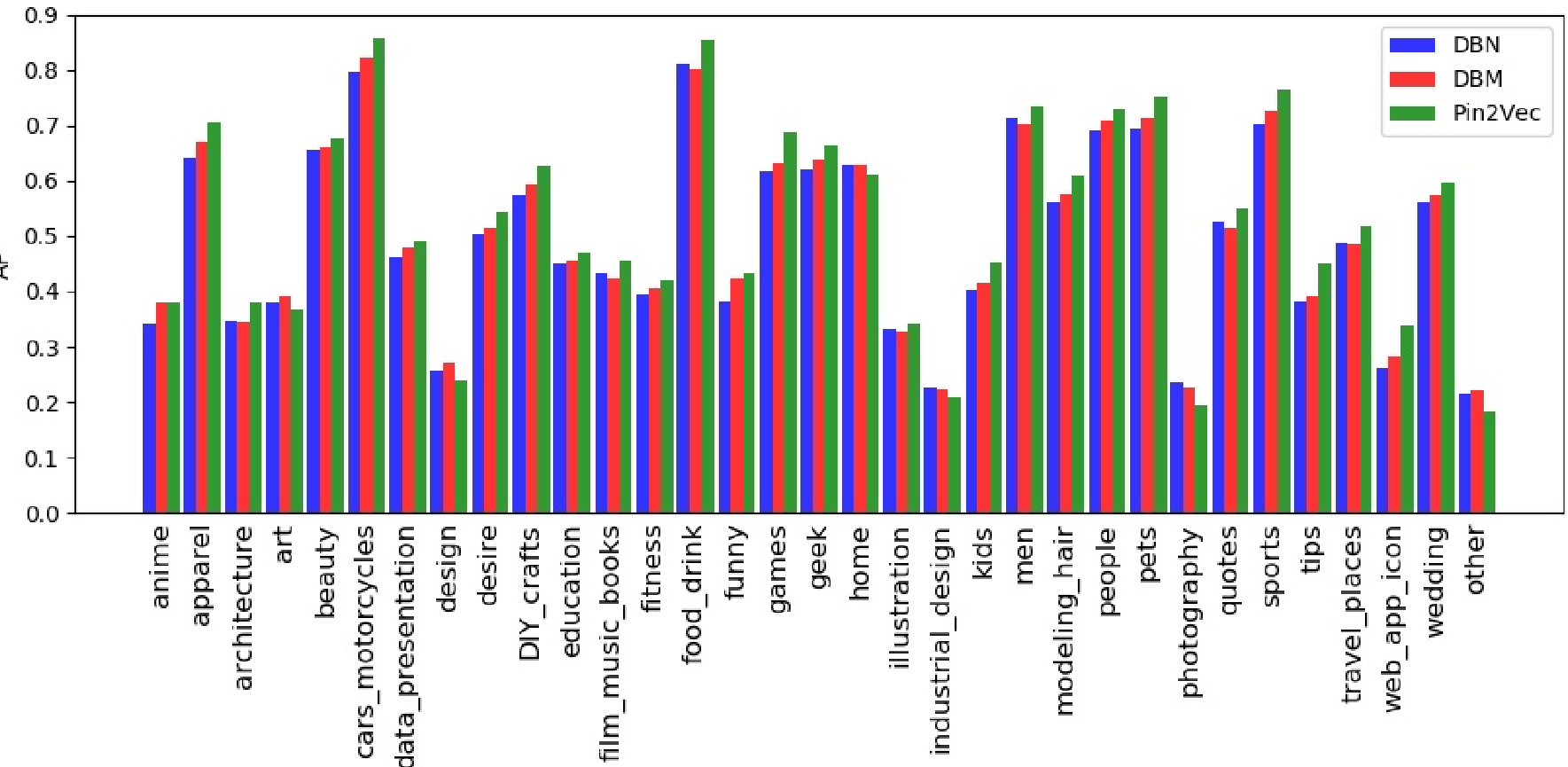
The authors tested their framework against traditional benchmarks like Huaban and NUSWIDE.
MAP Performance
The "Ours" method achieved a MAP of 56.96%, proving that structured graph information provides a much stronger inductive bias than purely data-driven DBNs or DBMs.
| Method | Huaban (MAP %) | NUSWIDE (MAP %) |
|---|---|---|
| Image-VGG | 47.85 | 39.96 |
| Text-Word2Vec | 33.42 | 36.31 |
| DBN | 52.15 | 45.12 |
| Ours | 56.96 | 48.26 |
Retrieval Precision
In cross-modal retrieval (Image-to-Text), the model reached an MRR of 40.06%, indicating that the target text is ranked significantly higher in the results compared to baseline VGG or Word2Vec models.
Critical Insight & Conclusion
The success of this method lies in the Semantic Anchor. By treating words not just as labels but as nodes in a graph that includes high-level entities, the model effectively "constrains" the visual features to align with human-understandable categories.
Takeaway: If you are building an industry-scale retrieval system, don't rely solely on CLIP-like contrastive learning. Incorporating a structured graph of entities and user interaction behaviors can provide the necessary context to solve fine-grained retrieval challenges.
Limitations: The framework relies on the availability of a well-defined entity graph. In domains where such hierarchical definitions are missing, the performance gain might diminish.