
Thermodynamics through the Lens of Learning: Why Complexity Limits Energy Efficiency
Learning to erase quantum states: thermodynamic implications of quantum learning theory
The paper introduces a "learning-to-erase" framework that bridges quantum learning theory and thermodynamics. It demonstrates that a reversible quantum learning algorithm can identify an unknown quantum state from multiple copies and subsequently erase additional copies at the information-theoretically optimal energy cost.
TL;DR
Is learning a "free" physical process? This paper establishes a profound connection: Quantum learning is a thermodynamic resource. The authors show that while we can "learn to erase" quantum states at the optimal Landauer limit, our ability to do so depends entirely on the computational complexity of the state. For some states, it is cryptographically impossible to extract energy efficiently, even if the laws of physics theoretically allow it.
Background: The Cost of Ignorance
Landauer’s principle famously states that "information is physical." Erasing a bit of information at temperature costs at least energy. In the quantum realm, if you don't know the state you are erasing, your "ignorance" (entropy) forces you to pay a higher energy price.
The classical workaround is to learn the state first. But does the act of learning itself cost energy? Previous researchers thought so, because measurements usually destroy quantum information. This paper refutes that by making the learning process fully reversible.
Methodology: Reversible Learning-to-Erase
The core innovation is a protocol that transforms a standard learning algorithm into a coherent unitary .
1. The Reversible Learner
Instead of performing irreversible measurements that collapse the wave function, the authors use "coherent versions" of measurements. They store the "junk" information in ancilla qubits that are later uncomputed.
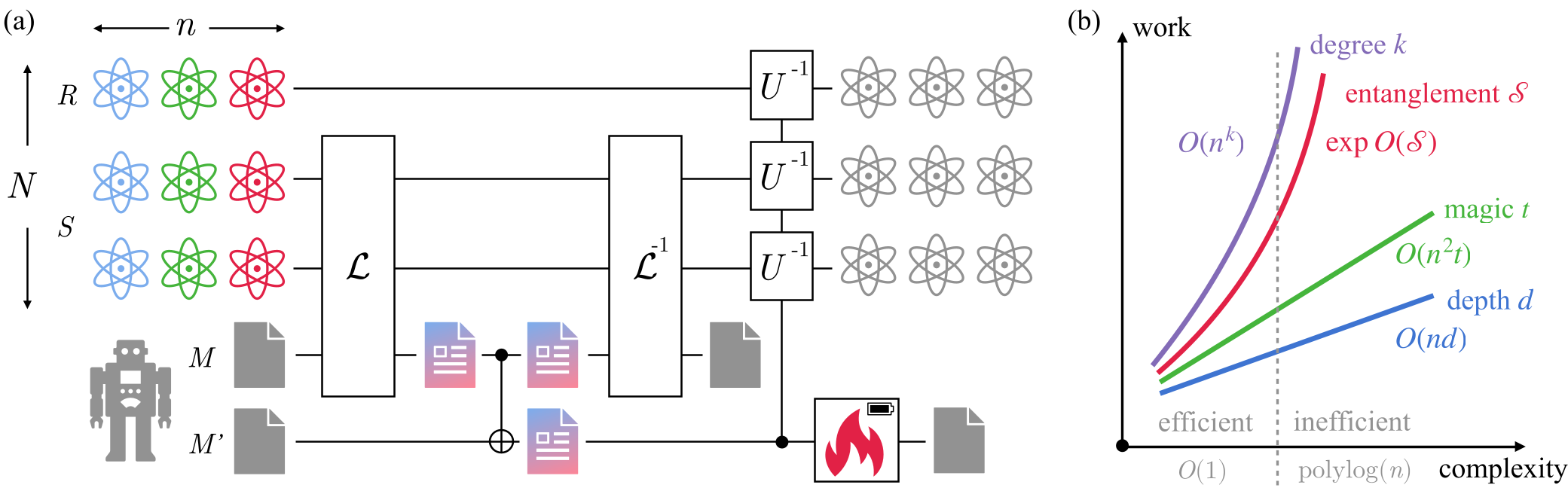
2. The Erasure Flow
- Step 1 (Learn): Use copies of the unknown state to extract its "identity" into a memory register.
- Step 2 (Copy & Uncompute): Copy the result to a second memory and run the learning algorithm backward to restore the original copies and ancillas.
- Step 3 (Unprepare): Now that we "know" the state, apply the inverse preparation circuit () to all copies.
- Step 4 (Final Erasure): Only the tiny classical memory needs to be erased, which costs negligible energy compared to erasing many-body states blindly.
Work and Complexity: A New Hierarchy
The paper maps the energy cost of erasure () to different physical measures of complexity. If you can learn the state efficiently, you can erase it efficiently.
- Shallow Circuits: grows linearly with depth .
- T-doped Stabilizer States: scales with "magic" (non-stabilizerness).
- Matrix Product States (MPS): grows exponentially with entanglement entropy .
This creates a "Thermodynamic Map of Complexity" where entanglement and magic are not just abstract mathematical properties, but variables that directly determine the power bill of a quantum computer.
The "Hardness" Wall: Encrypted Batteries?
The most striking result is the No-Go Theorem for Pseudorandom States (PRS). PRS are states that look like total noise to any polynomial-time observer but actually have low entropy.
The authors prove that if you could erase a PRS at the optimal Landauer cost, you would effectively be "breaking" the underlying cryptography. Since we stay within the bounds of standard cryptographic assumptions (like the hardness of LWE), we must conclude that:
Any efficient protocol trying to erase pseudorandom states must pay the maximum energy price, even though a "smarter" (exponential-time) agent could erase them for nearly free.
Figure: The gap between information-theoretic work cost (low) and computationally-bounded work cost (high) for pseudorandom states.
Critical Insights
- Learning is Compression: The authors frame learning as the ultimate form of compression—turning high-dimensional quantum states into concise classical descriptions.
- Physical Significance of Cryptography: This work suggests that the "Third Law of Thermodynamics" (the inability to reach absolute zero) has a computational cousin: you cannot reach optimal energy efficiency if the state's structure is cryptographically hidden.
- Future Tech: This paves the way for "Encrypted Batteries"—energy storage systems where the work can only be extracted by someone holding a "quantum key" to unlock the state's structure.
Conclusion
This paper elevates quantum learning theory from a data-processing tool to a fundamental pillar of physics. It tells us that the universe doesn't just care about how much entropy is in a system, but also how hard it is to find that entropy. As we build larger quantum computers, the bottleneck for sustainability might not be the cooling hardware, but the algorithmic complexity of the tasks we run.