
STAR: Leveraging the "Friend Effect" to Master Sparse Mobility Representations
Learning from Your Network of Friends: A Trajectory Representation Learning Model Based on Online Social Ties
The paper introduces STAR (Social Trajectory Amplification and Representation), a Probabilistic Graphical Model designed for trajectory representation learning in Location-Based Social Networks (LBSNs). It leverages online social ties via a Generalized Pólya Urn sampling mechanism to augment sparse check-in data, achieving SOTA performance in social link prediction.
TL;DR
Researchers from KAUST have developed STAR, a representation learning model that solves the headache of sparse LBSN data. By recognizing that you are likely to visit places your friends (and even friends-of-friends) go, STAR uses social networks to "fill in the blanks" of incomplete trajectories. It beats traditional LDA methods by over 20% in link prediction tasks while keeping the math efficient.
The Sparsity Trap in Mobility Data
In the world of Location-Based Social Networks (LBSNs) like Gowalla or Brightkite, data is notoriously "thin." The check-in distribution follows a truncated power law: a tiny fraction of "power users" check in everywhere, while the vast majority (up to 35%) have trajectories with fewer than five data points.
If you are trying to learn a low-dimensional feature space for similarity tasks, these "incomplete" users are usually either thrown out or subjected to noisy estimation. The authors of "Learning from Your Network of Friends" ask a pivotal question: If we don't know where a user goes, can we look at their friends to find out?
The Insight: The 2-Hop Correlation
Before building the model, the authors performed a reconstruction analysis. They found a significant correlation between an individual’s mobility and their social ties. Specifically, 2-hop friends (friends of friends) provided a powerful signal for reconstructing missing mobility patterns, even more so than 1-hop direct friends in some settings.
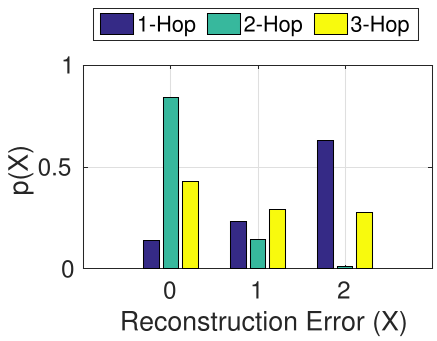 Figure: Error distribution showing that social links—especially 2-hop ties—can effectively reconstruct mobility vectors.
Methodology: STAR (Social Trajectory Amplification and Representation)
STAR is built on the foundation of Latent Dirichlet Allocation (LDA), but with a "Social Twist." In this analogy:
- Locations are Documents.
- Users are Words.
- Latent Activities are Topics.
1. The Generalized Pólya Urn (GPU)
The "secret sauce" is how STAR handles Factor 3: Social Influence. Standard LDA assumes words (users) are independent. STAR uses the Generalized Pólya Urn model. When a user is sampled for an activity at a location, the probability of their friends being associated with that same activity is boosted.
2. Asymmetric Priors
Standard LDA often fails because it assumes a uniform distribution of topics. STAR adopts an asymmetric location-activity prior (), which is optimized using fixed-point iteration. This allows the model to naturally handle the power-law nature of check-ins without manual tuning.
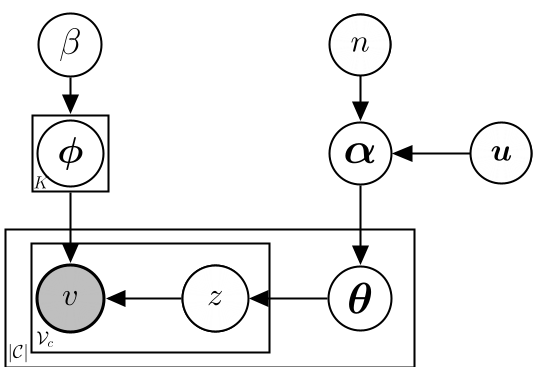 The STAR PGM: Note the inclusion of the user adjacency matrix A in the sampling process.
Experiments: Proving the Social Link
The authors evaluated the learned user representations via an unsupervised link prediction task. If the representations are good, users who are friends in real life should be close to each other in the latent feature space.
Performance vs. Baselines
STAR crushed both standard LDA and LDA-A (asymmetric LDA). On the Gowalla dataset, STAR achieved an AUC of 0.838, compared to LDA's 0.669. This proves that incorporating social ties isn't just a minor tweak—it's a fundamental improvement for sparse data.
| Dataset | Topology (CN) | LDA | LDA-A | STAR |
|---|---|---|---|---|
| Gowalla (GW) | 0.592 | 0.669 | 0.596 | 0.838 |
| BrightKite (BK) | 0.661 | 0.686 | 0.554 | 0.840 |
Visualizing Latent Activities
By checking specific locations on Google Maps, the researchers verified that STAR’s "activities" made sense. A Dunkin' Donuts produced a "pure" representation (single activity), while a busy street near a bus station produced a "mixed" representation, reflecting the diverse reasons people check in there.
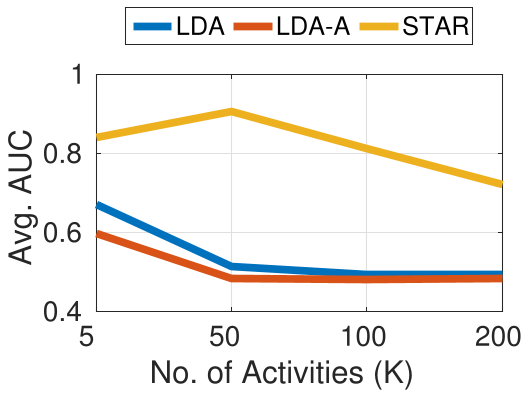 Analysis showing STAR remains robust even as the number of latent activities (K) varies.
Critical Insight & Conclusion
STAR's brilliance lies in its data fusion approach. It treats social networks not as a separate entity to be predicted, but as an extrinsic feature that informs the primary task of trajectory learning.
Key Takeaways:
- Privacy-Friendly: It works on anonymized location IDs; no need to know what the place is, only who is there.
- Efficiency: It retains the computational scalability of LDA, making it practical for massive datasets.
- Future Impact: This framework could easily extend to other domains where data is sparse but secondary networks exist, such as e-commerce (item-user graphs) or academic citations.
STAR proves that when we lack individual data, our "network of friends" is the most reliable fallback for understanding our behaviors.