
Wikipedia Reverts: Predicting the Fate of Your Edit at the Word Level
Learning from history: predicting reverted work at the word level in wikipedia
This paper introduces a machine learning approach to predict whether a Wikipedia contribution will be "reverted" (undone) using word-level features from an article's edit history. By training on per-article data, the model achieves high diagnostic accuracy (up to 89.4%) and identifies specific controversial terms that trigger reverts.
TL;DR
Contributing to Wikipedia is often a high-stakes endeavor where "good faith" edits are frequently discarded due to invisible norms and local policies. This paper presents a machine learning framework that analyzes an article’s history to predict if an edit will be reverted based strictly on the words added or removed. With nearly 90% accuracy, the model provides a blueprint for real-time editing assistants that flag controversial terms before they spark a "revert war."
The "Newcomer Bias" and the Cost of History
As Wikipedia matured, the barrier to entry rose. Newcomers are being reverted at increasingly high rates, often because they lack the context of thousands of previous edits or lengthy Talk-page debates. For contentious topics like Abortion or Scientology, the edit history is essentially a massive, unreadable archive.
The author's core insight is that history repeats itself. If specific terms (e.g., "murder" vs "termination") have caused reverts in the past, they are likely to do so again. Current tools often focus on the person (vandal vs. veteran), but this model focuses on the message.
Methodology: Digging Into the Diffs
Unlike simple vandalism detectors that look for profanity, this model operates on a per-article basis to capture contextual sensitivity.
- Tokenization: Wikipedia syntax (links, refs, images) is treated as "words."
- Unicode Diffing: Consecutive edits are compared by mapping tokens to unique characters, allowing for precise tracking of word additions and deletions.
- Ensemble Learning: The researchers compared Naïve Bayes, SVM, and Random Forests.
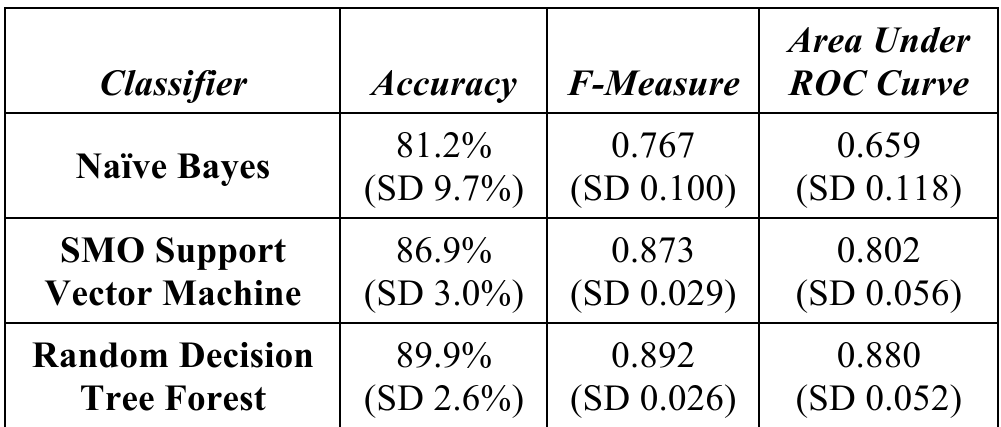
The Random Decision Tree Forest emerged as the superior choice, particularly for handling the "unbalanced class" problem—since most edits are not reverts, the model must be carefully tuned to recognize the rare event of a rejection.
Why Does It Work? Feature Ablation
A critical question was whether the model was just "cheating" by recognizing known vandals or bots. The researchers conducted an ablation study on the Genetic Engineering article to test this.
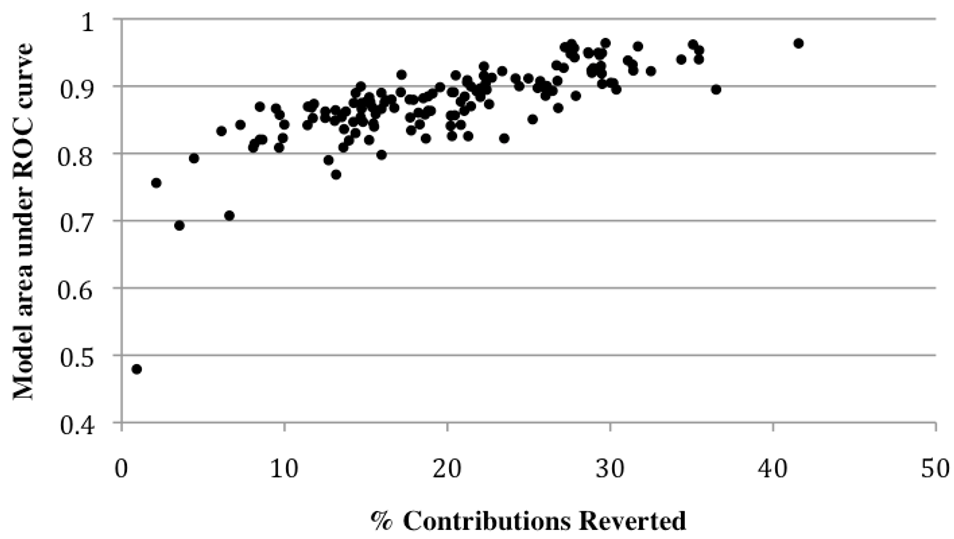
Even when bot and vandalism data were removed, and the model was limited strictly to the words an editor added (ignoring what they removed), the accuracy remained remarkably high. This suggests that certain "battlezone" words are inherently predictive of community conflict.
Decoding the "Weight" of Words
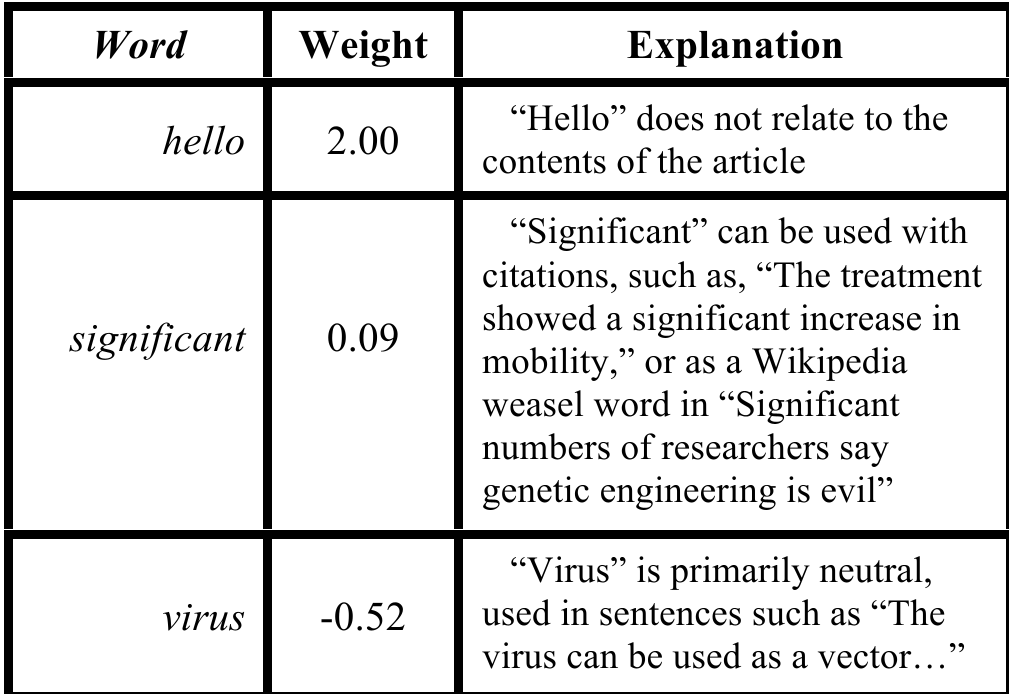
By extracting weights from the SVM, the study reveals the "orthodoxy" of an article.
- High-revert words: Often include "weasel words" (e.g., "many people say"), spelling errors, or policy-violating terms.
- Neutral words: Standard domain terminology (e.g., "virus").
- Safe words: Specifically accepted scientific terms or citations that reinforce the article's existing structure.
Critical Insight: Beyond Vandalism
The true value of this work lies in its ability to provide constructive feedback. Instead of just telling a user "You are wrong," the model can highlight a specific phrase and say, "In this article, this term has been reverted 80% of the time; consider using 'X' instead."
Limitations
- Cold Start: The model requires at least 1,000 edits to be accurate. It cannot help very new or obscure articles.
- Sarcasm and Context: While word-level analysis is powerful, it may miss clever vandalism or changes in consensus over long periods.
Conclusion
This research transforms the "revert" from a punitive action into a training signal. By learning from the "Discarded Work" of the past, we can build more inclusive social production systems that guide users toward high-value contributions rather than simply discarding their efforts wholesale.