
Hierarchical Social Networks: How Organization Affects the Speed of Learning
Learning in Hierarchical Social Networks
This paper investigates the social learning problem in hierarchical M-ary rooted trees, common in organizational and military structures. It characterizes the Type I, Type II, and total error probability decay rates at the root as the number of leaf agents () grows, proposing an "alternative majority dominance" strategy and a non-binary message-passing scheme to overcome limitations in even-degree trees.
TL;DR
How fast can a CEO or a General make the right decision if only the "front-line" soldiers see the data? This paper analyzes M-ary relay trees to reveal the mathematical limits of information aggregation. It finds that standard voting (majority rule) is often suboptimal in even-numbered hierarchies and proposes a "tie-breaker toggling" strategy and non-binary messages to reach near-optimal learning speeds.
Background: The Cost of Hierarchy
In social learning, agents usually observe others' actions and update their beliefs. While most studies look at feedforward chains (like people lining up for a restaurant), real organizations are hierarchical. In a tree, information is summarized at every step—a process that naturally leads to "information degradation."
The authors frame this as a binary hypothesis testing problem ( vs ). Only leaf nodes (the bottom level) take measurements. As info moves up the tree, the central question is: How fast does the error probability at the root vanish as the network size () grows?
The "Evenary" Problem and Mathematical Insight
The core of the paper lies in the distinction between Oddary trees (where each supervisor has an odd number of subordinates) and Evenary trees (even number).
In Oddary trees, the "Majority Dominance" rule (voting) is clean and hits the optimal error exponent. However, in Evenary trees, the "Tie" scenario ( for, against) creates a bottleneck. If ties are broken randomly, the learning rate drops significantly.
Methodology: Majority vs. Bayesian LRT
The authors analyze two primary fusion rules:
- Majority Dominance: A simple, non-Bayesian threshold rule.
- Bayesian Likelihood-Ratio Test (LRT): A locally optimal rule where each agent minimizes the probability of error based on received messages.
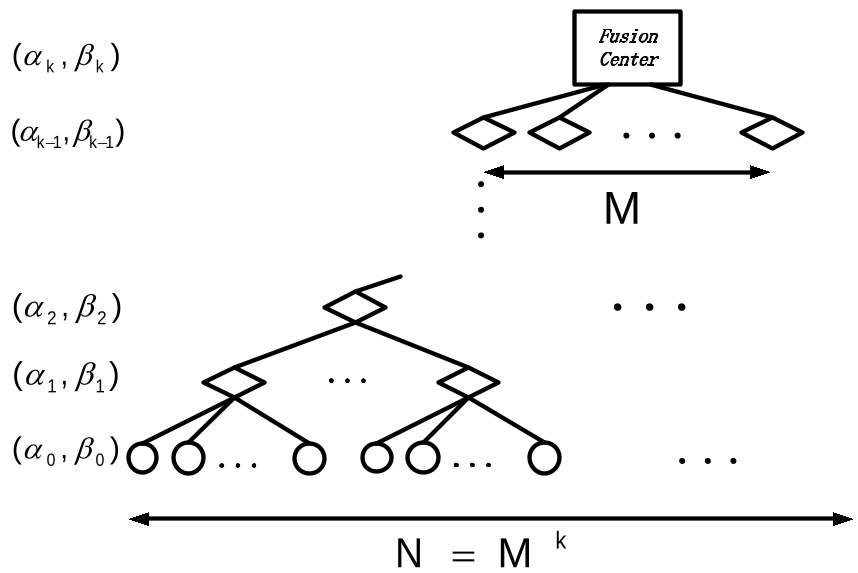 Figure 1: The M-ary relay tree structure where leaf nodes (circles) measure data and info flows to the root.
Two Major Breakthroughs
1. The Alternative Majority Dominance Strategy
To fix the "Evenary" gap, the authors propose a clever tweak: Toggling Tie-breakers. Instead of 50/50 random tie-breaking, level tips the tie toward , and level tips the tie toward .
The result? The error exponent improves from a simple floor function to a value involving the geometric mean (), which is much closer to the theoretical limit for large organizations.
2. Non-Binary Message Alphabets
What if agents can send more than just a "Yes" or "No"? The authors explore (M, D)-trees where the message alphabet size is .
- They find that even a small increase in message richness (bits) can drastically speed up learning.
- Interestingly, the Average Message Size required to stay near-optimal is surprisingly low—hardly more than 1 bit per agent in many configurations.
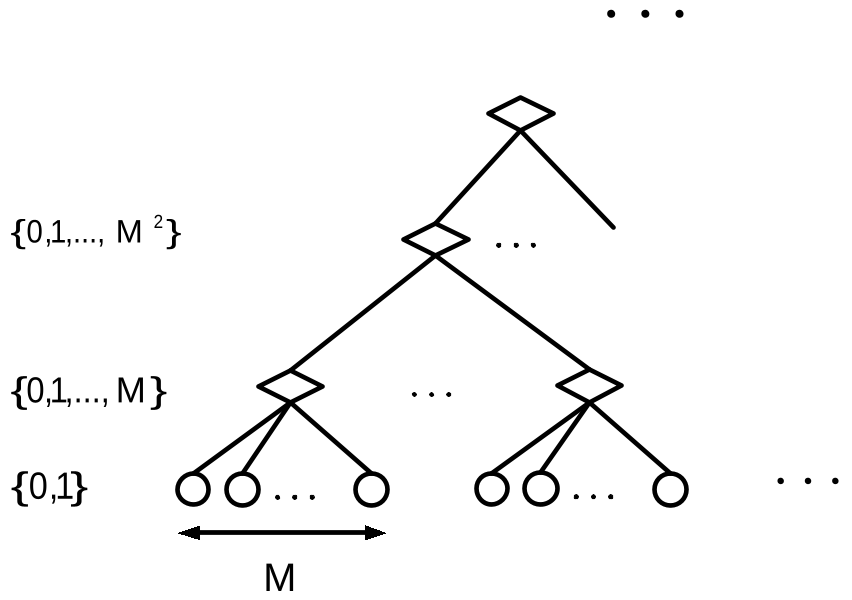 Figure 2: Performance vs. Message Alphabet Size — even small increases in D accelerate convergence.
Experiments and Analytical Results
The paper is largely theoretical, providing rigorous proofs for Type I and Type II error bounds.
- For , the error rate is .
- For (binary trees), standard majority rules fail (error stays constant), but the authors' proposed LRT or alternating rules achieve type decay.
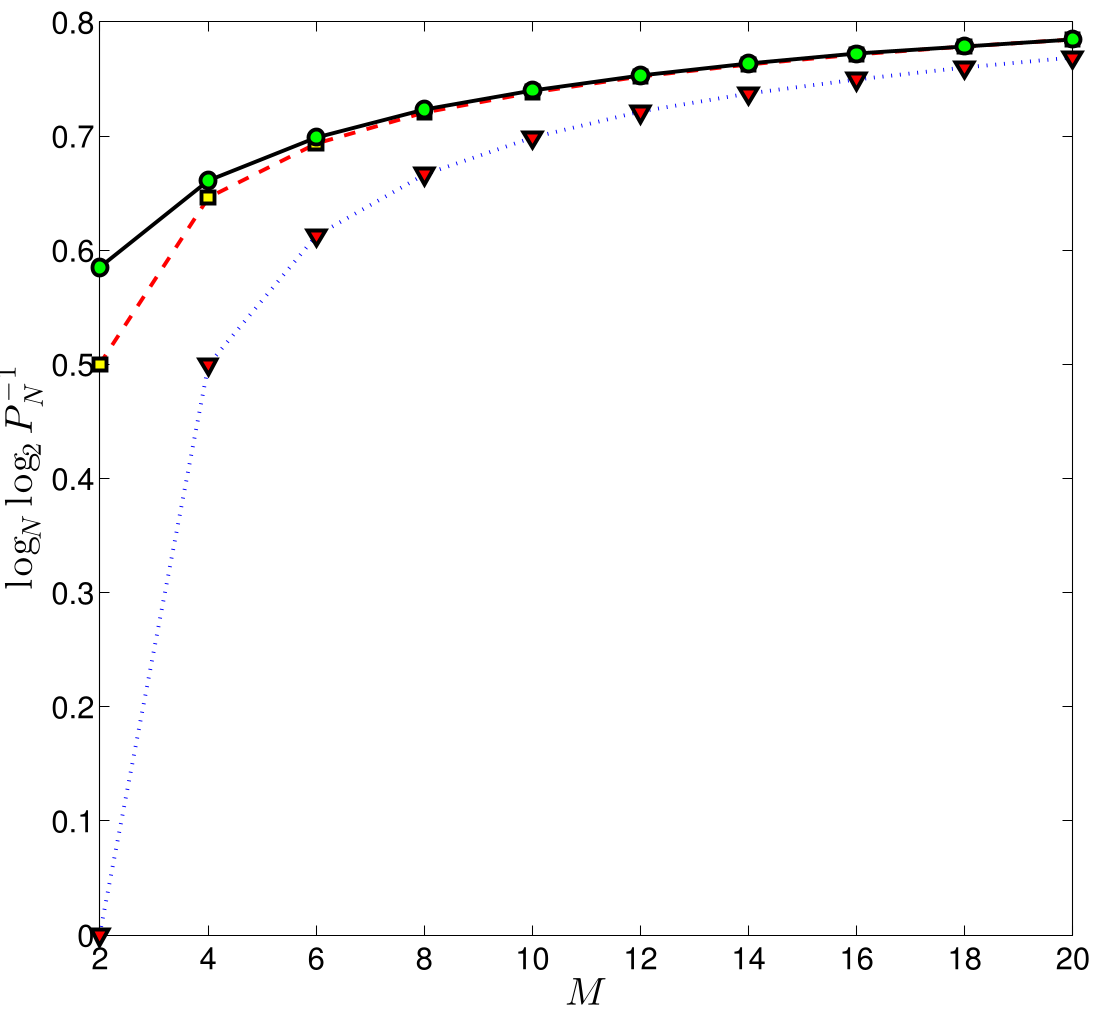 Figure 3: Comparison of error exponents across different branching factors M.
Critical Insight & Conclusion
The "Takeaway" for practitioners is profound: The structure of your organization dictates the quality of your decisions.
If you have an even number of subordinates, your choice of tie-breaking protocol isn't just a matter of fairness—it's a mathematical necessity for accurate learning at scale. The authors show that while hierarchies are efficient for command, they are fragile for information aggregation unless "myopic" local rules (like LRT) or smart alternating strategies are employed.
Limitations
The study assumes conditional independence of agent measurements. In the real world, "echo chambers" and correlated noise (where subordinates are influenced by the same external bias) could potentially degrade these rates further. This remains the next frontier for hierarchical social learning research.