
MFIC: Decoding the Push and Pull of Social Influence via Multipolar Factors
Learning the Influence Probabilities Based on Multipolar Factors in Social Network
This paper introduces the Multipolar Factors aware Independent Cascade (MFIC) model, a novel influence propagation framework that integrates both positive and negative social influences. By utilizing an Expectation-Maximization (EM) algorithm to learn hidden user-to-user influence probabilities from behavior logs, the model achieves state-of-the-art performance in user behavior prediction on real-world datasets like Flixster and Digg.
TL;DR
Social networks are often modeled as engines of "positive" contagion, but what happens when a friend's bad review stops you from buying a product? This paper introduces MFIC (Multipolar Factors aware Independent Cascade), a model that treats social influence as a dual-force system—both positive and negative. By learning these hidden probabilities from real-world logs using an EM algorithm, the authors significantly boost the accuracy of user behavior prediction.
Background: Beyond the "Follower" Logic
Most social influence research focuses on the Independent Cascade (IC) or Linear Threshold (LT) models. These frameworks operate on a simple "activation" logic: if your friend buys a phone, you are more likely to buy it. However, the real world is subtler. In platforms like Flixster (movie ratings) or Digg (news voting), a friend’s low rating can explicitly discourage you from an action. This is Negative Influence.
The authors identify two critical gaps in the status quo:
- Missing Polarity: Existing models ignore the deterrent effect of negative feedback.
- Unknown Probabilities: Most studies assume influence weights () are known, whereas, in reality, they must be reverse-engineered from noisy behavior logs.
Methodology: The Mechanics of Dual Influence
The core of the paper is the MFIC Model. It treats every interaction as a multipolar event.
1. The Probability Split
Instead of a single probability for a user becoming active, MFIC calculates:
- Positive Influence (): The collective probability that positive neighbors (high ratings) trigger an action.
- Negative Influence (): The collective probability that negative neighbors (low ratings) prevent an action.
2. The Interaction Logic
A user becomes active if:
- They are successfully triggered by positive influence.
- OR negative influence fails to stop them.
Conversely, they stay inactive if:
- Negative influence succeeds.
- OR positive influence fails to reach them.
3. Learning via EM Algorithm
Since we only see if someone performed an action—not who specifically influenced them—the authors use the Expectation-Maximization (EM) algorithm. It treats the specific "influencer" as a latent variable and iteratively updates until the model's likelihood for the historical data is maximized.
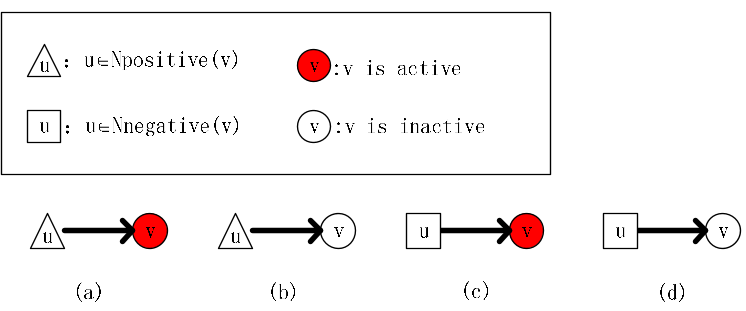 Figure: The four scenarios of influence—(a) positive success, (b) positive failure, (c) negative failure, and (d) negative success.
Experiments: Real-World Evidence
The authors tested MFIC on two iconic datasets: Flixster (social movies) and Digg (social news).
Key Findings:
- The Power of Negative Influence: In Flixster, adding negative factors improved the F1-measure by up to 10%. This suggests that for subjective products like movies, "dislikes" are highly informative.
- Context Matters: In Digg, the improvement was more modest (around 1.6%). The authors hypothesize that "voting" on a story is a low-friction action where negative influence is less impactful than in "watching a movie."
- Superiority Over Baselines: MFIC consistently outperformed the "Static Model" (which uses simple frequency counts) and the standard "IC Model" (which uses fixed probabilities).
| Metric | Model | Digg (Best) | Flixster (Best) |
|---|---|---|---|
| F1-Measure | PIC (Positive only) | ~0.17 | ~0.24 |
| F1-Measure | MFIC (Proposed) | ~0.18 | ~0.28 |
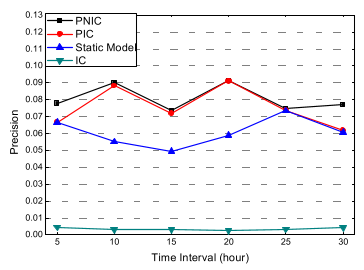 Figure: Prediction performance on Digg, showing MFIC's steady lead over traditional methods.
Critical Insight & Conclusion
The true value of this work lies in its Inductive Bias: social networks are not just conduits for "yes" signals; they are complex ecosystems of "yes" and "no."
Comparison with SOTA:
Unlike previous works that focused on the Influence Maximization problem (finding the best nodes to start a fire), this paper addresses the Inference Problem (understanding the physics of the fire). By providing a formal way to learn under multipolar conditions, it lays the groundwork for more nuanced viral marketing campaigns.
Limitations & Future Work:
While MFIC is powerful, it assumes influence probabilities are static. Future research could explore Temporal Dynamics—how my influence over you might fade as our interests diverge over time. Additionally, integrating user preferences (content-based filtering) with this propagation model could create a "hybrid" recommendation system that is even more resilient to noise.
Final Takeaway: To predict what a user will do, don't just look at who is cheering them on; look at who is holding them back.