
Decoding Culture: Mapping the Dynamics of Influence and Selection in Social Systems
Learning a Macroscopic Model of Cultural Dynamics
This paper introduces a macroscopic framework for modeling cultural dynamics by quantifying the twin forces of influence and selection. Using a non-linear system identification approach, the authors propose a "Cultural Hypercube Model" to learn edge influence strengths and selection parameters from longitudinal mass data on Last.FM and Wikipedia.
TL;DR
Understanding how culture evolves—whether it's the music we listen to or the topics we edit on Wikipedia—remains a fundamental challenge. This research moves beyond theoretical speculation by introducing a Macroscopic Hypercube Model that treats cultural shifts as fluid flows between feature-based identity groups. By training on years of real-world data, the authors demonstrate that cultural evolution is not random but follows a learnable, non-linear dynamical structure.
Context: Micro vs. Macro Social Modeling
For decades, social dynamics research has been split into two camps:
- Microscopic Models: Focusing on individual-to-individual interactions (Axelrod, 1997). These require knowing the exact social graph, which is rarely possible for millions of users.
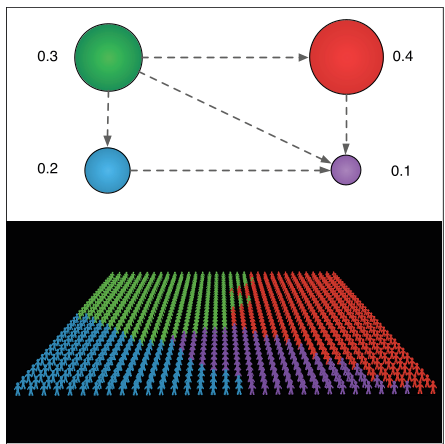
- Macroscopic Models: Treating cultural groups as "masses" of population. While theoretically elegant, these models often oversimplify human behavior—assuming, for instance, that if a "Rock" fan is influenced by "Jazz," they must suddenly become 100% "Jazz."
This paper bridges the gap by introducing a feature-based geometry to macroscopic flows.
The Problem: The "All-or-Nothing" Fallacy
Prior work by Kempe et al. assumed that when influence occurs, the target switches entirely to the influencer's type. This is biologically and sociologically unrealistic. If you like Rock and start listening to Jazz, you become a "Rock-Jazz" listener, not just a "Jazz" listener.
The authors identify that culture exists in a multidimensional feature space. To solve this, they propose the Cultural Hypercube Model.
Methodology: The Hypercube Architecture
The core innovation is the transition graph . Instead of allowing mass to jump between any two arbitrary types, mass flows only between types that differ by exactly one feature (Hamming Distance = 1).
The Governing Equation
The flow from type to is determined by:
- Selection (): The tendency to stick with one's own kind (homophily).
- Influence (): The probability of being pulled toward a different trait.
- Mass (): The current "size" of the cultural group.
The authors use Particle Swarm Optimization (PSO) with regularization to handle the massive parameter space (over 1,000 parameters for just 5 cultural features).
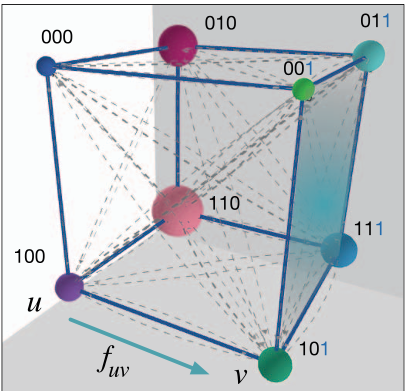 In the figure above, mass flows from to not just through direct interaction, but through "indirect" influence from all nodes sharing the target feature.
Experiments: Last.FM and Wikipedia
The model was validated on two massive datasets:
- Last.FM: 38,000 users, 721 million listens, categorizing users into genres like Pop/Rock, Jazz, and Electronic.
- Wikipedia: 2,500 active editors, categorizing interests into Science, Politics, Arts, etc.
Results & Predictive Power
The Hypercube model proved highly robust. It didn't just fit the training data; it successfully predicted short-term future trends (the "test" portion of the time series).
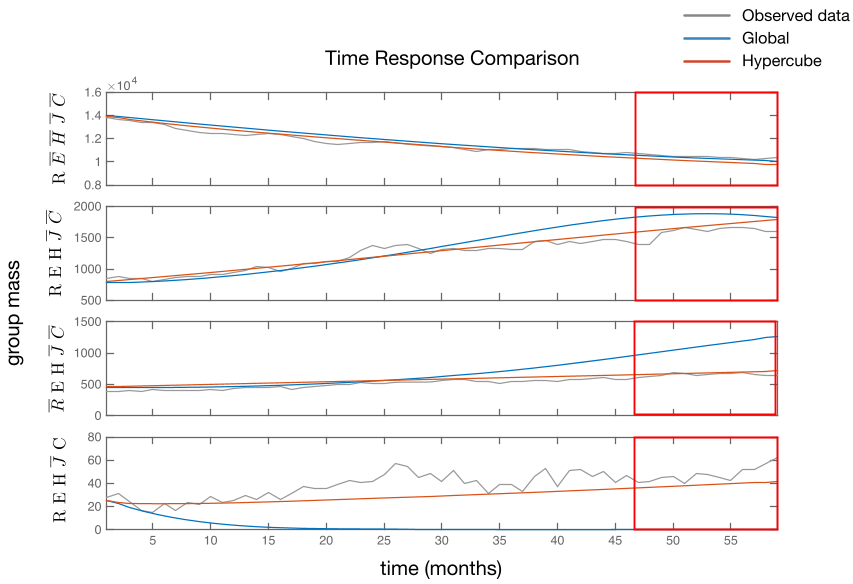 The model (solid lines) tracks the observed mass (shades) with remarkable accuracy across different cultural types.
Critical Insight & Conclusion
The success of this work suggests that cultural evolution at a population level is more deterministic than previously thought. By framing culture as a Hypercube transition system, we can quantify how specific traits (like "interest in Science") act as catalysts for other traits (like "interest in Philosophy").
Limitations: The model assumes a "closed system" (no users entering or leaving the population), which isn't true for the internet. Future work could incorporate "open-system" dynamics where new cultural features emerge organically over time.
Final Takeaway: For AI and data scientists, this proves that complex social behavior can be modeled using differential-style equations and search algorithms, even when individual-level social links are hidden.