
PrAISe '16: Beyond Manual Privacy Settings—Learning Rules Cooperatively
Learning Privacy Rules Cooperatively in Online Social Networks
PrAISe '16 presents a multiagent approach to automate privacy configurations in Online Social Networks (OSNs). It leverages Machine Learning (specifically SVMs) and collaborative filtering among user agents to suggest who should be denied access to specific posts based on context.
TL;DR
Managing social media privacy is a chore. This paper introduces a multi-agent framework where your personal "software agent" learns your sharing habits using Machine Learning. When you don't have enough history, your agent "asks" your friends' agents for advice, using a weighted trust system to ensure the recommendations are reliable without compromising anyone's raw data.
The Problem: The High Cost of Human Error
Current Social Network Sites (OSNs) force users to set privacy policies upfront—usually a blanket "Friends Only" or "Public" setting. However, privacy is inherently context-dependent.
Imagine Alice visiting New York; she wants her photos public to everyone except Bob and Carol because her visit is a surprise. Usually, Alice has to remember to manually untick their names for every single post. One slip-up at the Statue of Liberty, and the surprise is ruined.
The paper identifies two main pain points:
- Dynamic Context: Privacy depends on what is being shared, where, and when.
- Cold Start: New users have no history for an AI to learn from, making them the most vulnerable to leaks.
Methodology: Contextual Intelligence via Multi-Agent Systems
The authors treat privacy protection as a classification problem. Each post is an instance with features like:
- Post Type (Image, Text, Link)
- Location & Location Context
- Time of Sharing
- Tagged Friends
1. The Single-Agent Approach
For established users, the agent uses algorithms like Support Vector Machines (SVM) and Random Forests to predict whether a friend should be denied access.

2. The Multi-Agent Social Approach (The "Help from Friends")
When Alice is a new user, her agent consults other agents (representing Bob, Carol, Dave). Crucially, agents don't share their rules (which would be a secondary privacy violation). Instead:
- Alice's agent sends a "Post Request" to others.
- Other agents return a simple "Yes/No" (Allow/Deny) based on their own logic.
- Alice's agent calculates a Trust Score for each neighbor based on how well their previous advice matched Alice's final decisions.
- A Weighted Majority Vote determines the final recommendation.
Experiments and Results
The study evaluated the system against "noise"—the reality that humans sometimes act inconsistently with their own privacy preferences.
- Data Sufficiency: Accuracy hits 100% once a user has shared approximately 50 posts.
- Low Data Performance: When a user has only ~7 posts, accuracy drops to 64% in a vacuum. However, by consulting peers, the agent can recover accuracy by weighing the opinions of "restrictive" vs "permissive" agents.
- Noise Tolerance: SVMs proved to be the most robust against human inconsistency, maintaining over 90% accuracy even when users "go rogue" and ignore their own rules 10% of the time.
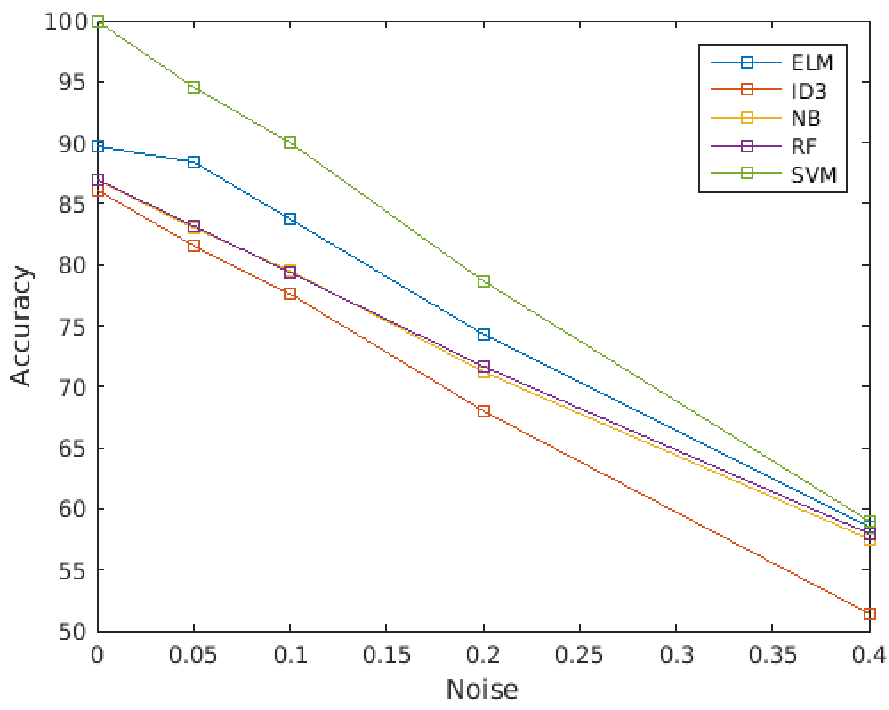 Figure 1: Comparison of different ML models (SVM, NB, RF, ELM) under varying levels of user decision noise.
Critical Insights & Future Directions
The core genius of this work lies in its Inductive Bias: it assumes that users with similar social circles likely have similar privacy concerns. By using a Multi-Agent System (MAS), it solves the "Cold Start" problem without requiring a centralized server to snoop on everyone's data.
Limitations: The current model relies on explicit feature extraction (Location, Time, etc.). In the era of modern AI, we could extend this to Semantic Inference. For example, even if Alice hides her location, a photo of the "Empire State Building" textually or visually implies she is in New York. Future iterations of such agents will likely need to incorporate Vision-Language Models (VLMs) to catch these subtle leaks.
Summary
PrAISe '16 serves as a foundational blueprint for Cooperative Privacy Learning. It moves us away from tedious manual toggles toward a future where our digital doubles protect us by learning not just from our past, but from the collective wisdom of our social network.