
Rhetoric Style Matters: Why Facebook "Flames" Are Killing Your Learning
Learning from reading argumentive group discussions in Facebook: Rhetoric style matters (again)
This study investigates how reading argumentative group discussions on Social Network Sites (SNS) affects learning. By comparing "disputative" and "deliberative" rhetoric styles in a controlled Facebook-based experiment, the authors demonstrate that the social framing and tone of an interaction significantly influence declarative knowledge acquisition.
TL;DR
Can you learn just by "lurking" in a Facebook debate? A study from the Hebrew University of Jerusalem reveals a surprising catch: how people argue is more important than what they are arguing about. Reading a "disputative" (aggressive) argument significantly impairs your ability to learn the facts presented, even if the information available is identical to a polite, "deliberative" discussion.
Background: The Rise of the Silent Learner
In the age of Social Network Sites (SNS), most "participation" is actually "listening" (or lurking). Statistics show that in online courses, students spend roughly 75% of their time reading others' posts rather than writing their own. While previous research has focused on the benefits of active debating, this study explores whether simply observing a peer-to-peer argument on a "hot" topic (in this case, immigration policy) leads to genuine knowledge gains.
The "Style" Over "Substance" Problem
The researchers identified a major gap in pedagogical theory: we often assume that as long as the "correct" information is provided, learning will occur. However, social media is frequently a "hotbed" of polarized, emotional, and disputative discourse.
The authors hypothesized that:
- Deliberative Argumentation (comparing ideas to reach a solution) facilitates learning.
- Disputative Argumentation (trying to "win" or crush an opponent) creates a "face threat" that might distract or demotivate the reader.
Methodology: The FB Experiment
Undergraduates were randomly assigned to read one of three formats regarding a controversial socio-economic topic:
- Disputative Style: Peer comments were dismissive ("You're talking nonsense!") and competitive.
- Deliberative Style: Peer comments were inquisitive ("I think we should think about...") and collaborative.
- Control: Just the source links, no social "chatter."
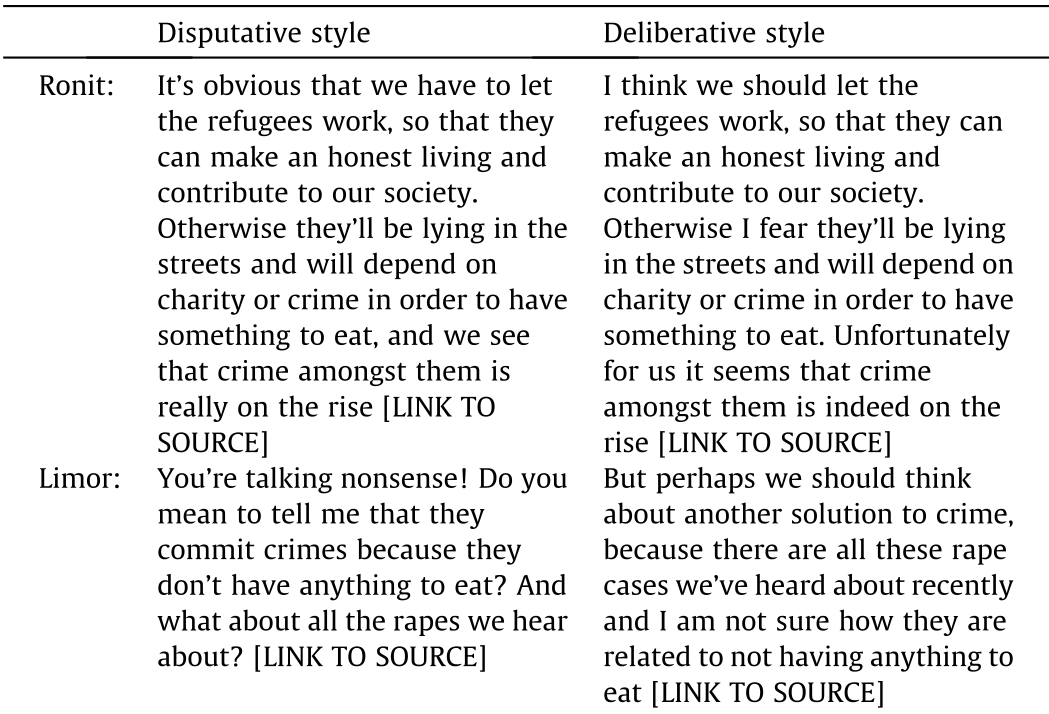
The researchers used screen-recording software to track exactly how much time students spent reading the discussion versus the actual cited evidence.
The Results: Ignorance is the Cost of Aggression
The findings were stark. Despite having access to the exact same articles and data:
- The Disputative Penalty: Students reading the aggressive debate performed significantly worse on the post-test (approx. 13% lower than the control).
- The Efficiency of Deliberation: While the deliberative group didn't necessarily "beat" the control group in scores, they achieved the same knowledge levels in 7 minutes less time spent reading sources.

Deep Insight: Why Why Does Style Inhibit Cognition?
The most fascinating part of the results is that reading behavior was similar across both groups. Users in the disputative condition didn't necessarily read less; they just learned less from what they read.
This suggests a covert cognitive interference. When we observe aggressive social behavior:
- Cognitive Load Shifts: Our brains may switch from "information processing" to "social appraisal" (e.g., judging the character of the rude poster).
- Epistemic Discounting: Readers might subconsciously view information shared in a toxic context as less "serious" or biased, leading to shallower encoding.
- Arousal Interference: The vicarious stress of a "heated" debate may induce a level of anxiety that narrows cognitive flexibility.
Critical Analysis & Conclusion
This paper is a wakeup call for digital educators and social media designers. If we want platforms to be more than just echo chambers—if we want them to be places of learning—the "vibe" of the discourse is non-negotiable.
Takeaway for Designers: Designing for "engagement" often prioritizes high-arousal (disputative) interactions because they generate clicks. This study proves that such engagement comes at a direct cost to the user's intellectual growth.
Future Work: We need eye-tracking data to see if readers are physically "skipping" content when it follows a rude comment, or if they are simply failing to synthesize it. As we move toward more AI-mediated social spaces, fostering a deliberative "Rhetoric Style" might be our best defense against digital illiteracy.