
DCGAN for Emotion: Leveraging Unlabeled Data to Crack the Valence Code
Learning representations of emotional speech with deep convolutional generative adversarial networks
This paper introduces a semi-supervised representation learning approach for emotional speech recognition using Deep Convolutional Generative Adversarial Networks (DCGANs). By leveraging 100 hours of unlabeled meeting data to pre-train a discriminator, the method achieves 49.80% accuracy on a 3-class valence task, matching state-of-the-art performance without manual feature engineering.
TL;DR
Emotion recognition, specifically determining whether a speaker is "positive" or "negative" (valence), is a high-hanging fruit in affective computing. This paper demonstrates that we don't need more labeled data to improve; we need better representations. By using a Deep Convolutional Generative Adversarial Network (DCGAN) to learn from 100 hours of unlabeled meeting audio, the researchers achieved state-of-the-art performance on valence classification using raw spectrograms, bypassing the need for traditional handcrafted features.
The Problem: The "Overshadowing" Effect
In speech analysis, Activation (energy/excitement) is easy to detect—it’s loud and high-pitched. Valence (pleasure/displeasure) is much subtler. High-energy anger and high-energy joy often look similar in acoustic space. This "overshadowing" effect, combined with the extreme scarcity of labeled emotional datasets like IEMOCAP, makes training robust valence classifiers a massive challenge.
Methodology: Adversarial Representation Learning
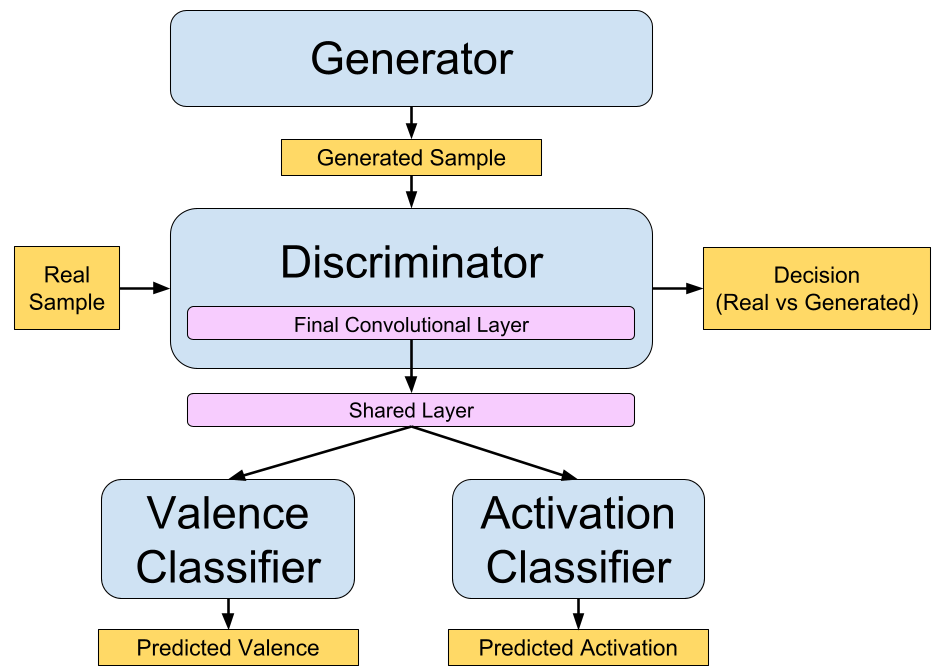
The authors propose a hybrid architecture that merges unsupervised GAN training with supervised classification. Instead of feeding the model pre-calculated MFCCs, they feed it raw spectrograms.
1. The DCGAN Engine
The core innovation lies in the Discriminator. In a standard GAN, the discriminator only learns to tell "real" from "fake." Here, the authors add a classification head to the discriminator's final layer.
- Unsupervised Phase: The model looks at 100 hours of unlabeled data from the AMI meeting corpus. It learns the fundamental "physics" of human speech—phonemes, rhythms, and textures—to beat the Generator.
- Supervised Phase: The model uses the IEMOCAP dataset to map these learned features to 5-point Likert scales for valence and activation.
2. Fuzzy Labels and Multitask Learning
To handle the subjectivity of human emotion, the authors used "fuzzy labels." If three annotators split their vote between a 4 and a 5, the model is trained on a probability distribution [0, 0, 0, 0.5, 0.5] rather than a hard integer. They also implemented Multitask Learning, attempting to predict Activation and Valence simultaneously to see if the features of one would help the other.
Key Results: Unlabeled Data is the Winner
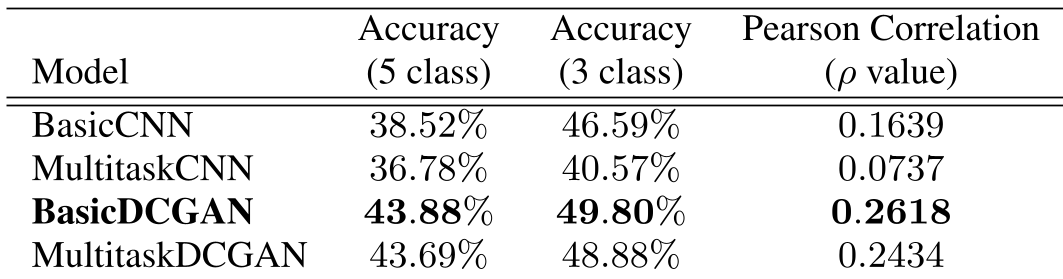
The experiments compared four models: BasicCNN, MultitaskCNN, BasicDCGAN, and MultitaskDCGAN.
The DCGAN Advantage
The jump in performance from the BasicCNN to the BasicDCGAN is the headline result.
- Accuracy (5-class): Improved by over 5% absolute.
- Pearson Correlation (ρ): Improved from 0.16 to 0.26.
This confirms that the filters learned while trying to distinguish real speech from "fake" generated speech are significantly more discriminative for emotion than filters learned from a small labeled dataset alone.
The Multitask Surprise
Contrary to prevailing wisdom, multitask learning actually hurt performance in 5 of 6 metrics. The authors hypothesize that the alternating update strategy (swapping between valence and activation) might have introduced instabilities in the gradients, or that the tasks aren't as complementary as previously thought in the context of GAN-based features.
Deep Insight: Beyond Handcrafted Features
The significance of this work is that it approaches SOTA (49.80% on 3-class valence) using zero feature engineering. While previous leaders used specialized acoustic toolkits, this model learns what is important directly from the pixels of a spectrogram.
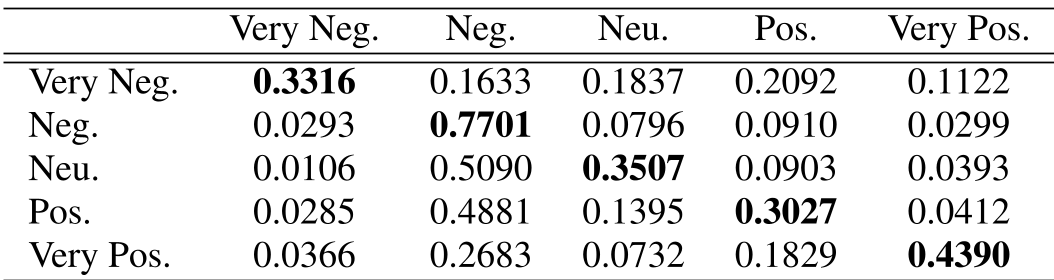
The confusion matrix reveals a classic "affective computing" phenomenon: the model is best at recognizing "Negative" emotions (High Recall), but it often mistakes other emotions for "Negative" (Low Precision). Interestingly, there remains a persistent confusion between "Very Negative" and "Very Positive," suggesting that extreme emotional intensity still blurs the valence line even for deep networks.
Conclusion & Future Outlook
This paper serves as a proof-of-concept for Semi-Supervised Affective Computing. While GANs have since been joined by Transformers and Self-Supervised Learning (like wav2vec), the core lesson remains: the best way to understand small, labeled datasets is to first look at the vast, unlabeled world.
Future Directions: The authors suggest moving toward sequential models like LSTMs (or modern Transformers) to capture the temporal dynamics of emotion, combined with this unsupervised pre-training approach.