
Beyond Centrality: Why "Skeleton Learning" is the New Meta for Social Influence
Learning Representative Nodes in Social Networks
The paper introduces a graph-based extension of Skeleton Learning (SKE), a statistical learning approach designed to identify a compact set of "representative nodes" in social networks. By minimizing a Bayesian communication cost framework, SKE selects influential seeds that are mutually exclusive, effectively maximizing information spreading coverage in the Independent Cascade Model (ICM).
TL;DR
Most social network algorithms (like PageRank) pick "popular" nodes that are all bunched together, wasting resources on redundant connections. This paper introduces Skeleton Learning (SKE) for graphs—a method that uses Bayesian inference to pick a "skeleton" of representatives that are non-overlapping and strategically positioned to maximize information spread.
The Problem: The "Echo Chamber" of Popularity
In social network analysis, we often want to find a small set of "seed" users to start a marketing campaign or broadcast news. The standard move is to pick the nodes with the most followers (Degree) or the highest PageRank.
However, there is a fundamental flaw: Neighbor Overlap. High-degree nodes tend to be friends with each other. If you pick the top 10 most "popular" users, they likely share 80% of the same audience. In terms of Influence Maximization, this is massive inefficiency.
The Insight: Mutual Exclusivity via Bayesian Routing
The authors propose a "routing" perspective. Imagine every node in the graph needs to communicate with a "representative." If we want to minimize the global cost of this communication:
- Locally: Representatives should be "hubs" to minimize distance to their neighbors.
- Globally: There should be as few representatives as possible (Sparsity).
- Exclusivity: If a region already has a representative, the "value" of another candidate in that same region should drop.
The Methodology
SKE uses a gradient-descent approach to minimize an energy function , where is a probability distribution over all nodes denoting their "representativeness."
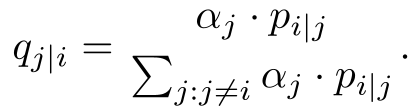
The logic is elegant: it calculates the probability that node is the representative for node . During optimization, nodes cast "votes." If a candidate provides a shorter path than the average, its importance increases. This creates a "competitive" environment where nodes effectively say, "I'm already covered by , so I don't need to be a representative."
Experiments: Performance in the Real World
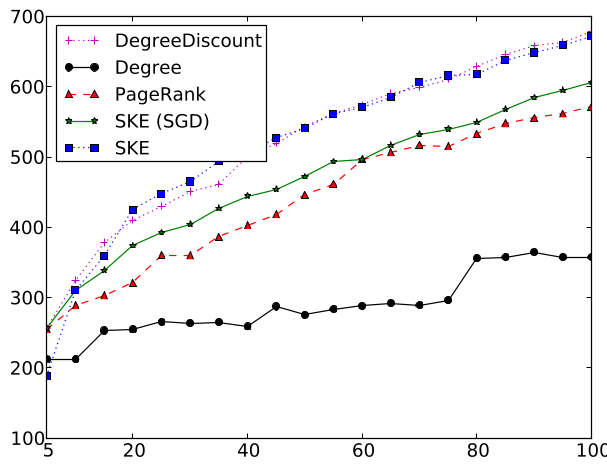
The paper tests SKE on scientific collaboration networks (authorship on Arxiv). They compared it against Degree Discount (the previous state-of-the-art heuristic) and standard PageRank.
Key Findings:
- Higher Coverage: Under the Independent Cascade Model (ICM), SKE consistently activated more nodes than PageRank because its seeds were spread out across different "communities" of the graph.
- Identifying "Hidden" Influencers: SKE often selects nodes with relatively low degrees but unique connections—people who bridge gaps between different social circles.
- Scalability: By using Stochastic Gradient Descent (SGD), the authors reduced the complexity from to , making it viable for large networks.
Critical Analysis & Takeaways
The brilliance of this work lies in its Minimum Message Length framework. Instead of using a greedy heuristic to prevent overlap, it builds the penalty into the math of the objective function.
Limitations: Interestingly, SKE performs worse than PageRank on Linear Threshold Models (LTM). In LTM, a node only activates if a certain percentage of neighbors are active. Since SKE avoids seed overlap, it fails to provide the "multi-hit" reinforcement that LTM requires.
Future Outlook: This approach is highly transferable. Beyond viral marketing, it could revolutionize Community Detection or Network Compression, where finding a "skeleton" of a graph is the key to understanding its underlying geometry.
Conclusion
If your goal is to spread a message fast and wide, stop looking for the most popular kids—look for the "Skeleton" of the network.