
Beyond Single Links: Decoding Social Circles via Multi-View Selective Clustering
Learning Social Circles in Ego-Networks Based on Multi-View Network Structure
This paper introduces a novel approach for social circle detection in ego-networks by leveraging multi-view network structures (relationships, interactions, and content) through a modified Multi-View Spectral Clustering algorithm. The proposed method, Selective Co-Trained Spectral Clustering (SCSC), significantly outperforms single-view baselines and standard multi-view techniques by specifically accounting for network incompleteness in sparse data views.
TL;DR
Automatically organizing "friends" into social circles is vital for privacy and content filtering. This paper moves beyond simple friendship graphs by integrating six different "views" of an ego-network—ranging from retweets to topic similarities. The authors introduce Selective Co-Trained Spectral Clustering (SCSC), a method that outperforms state-of-the-art baselines by treating network sparsity as an "incompleteness" problem rather than a structural given.
The "Missing Link" Motivation
Why is Facebook or Google+ circle management so tedious? Because it's manual. Previous automated attempts focused on either the network topology (who follows whom) or node profiles (who went to which school). However, profiles are often private, and a single friendship link doesn't capture the nuance of interaction.
The authors argue that an ego-net is naturally multi-view. You might not be "friends" with someone on Twitter yet, but you might reply to the same posts or share common interests. These disparate signals—Relationship, Interaction, and Content—provide a holistic view of social intimacy.
Methodology: High-Fidelity Fusion
The researchers modeled six distinct views from Twitter data:
- Friendship: Reciprocal follows.
- Common Friends: Shared connections.
- Reply & Co-Reply: Direct and indirect interaction.
- Retweet: Content endorsement.
- Topic: Post similarity (processed via TagMe and TF-IDF).
Selective Information Transfer
Standard multi-view spectral clustering often suffers from negative transfer. If one view is extremely sparse (incomplete), forcing it to be consistent with a dense view can "dilute" the quality of the clusters.
The core innovation is the Update Function, which selectively transfers grouping information:
eq t} C^{(t')} \circ (\mathbf{1}\{K^{(t')} eq \mathbf{0}\})^{\delta_{t'}}$$ This ensures that in an incomplete view, similarity is only boosted for pairs where connections were actually observed, effectively safeguarding the model against the noise of "unobserved" data.  ## Theoretical Insight: Spectral Perturbation One of the paper's academic highlights is its derivation of a **Bias Upper Bound**. By integrating Spectral Clustering theory with Matrix Perturbation theory, the authors prove that the "performance gap" between a complete graph and its incomplete observation is bounded by the ratio of the most active to least active alters ($\sigma_1/\sigma_n$). This provides a mathematical justification for why balancing the views is necessary. ## Experimental Showdown The authors tested their approach on 92 real-world Twitter ego-nets. ### 1. Robustness and Convergence SCSC converged significantly faster than standard Co-Trained Spectral Clustering (CSC). While CSC often struggled to find meaningful circles because it over-enforced consistency across sparse views, SCSC maintained high "cluster compactness." ### 2. SOTA Comparison Compared to **SCAN** (a standard structural clustering algorithm) and baseline **Spectral Clustering**, SCSC showed a dramatic improvement in the Total Similarity Ratio—a metric measuring how much more similar users within a circle are compared to those outside. 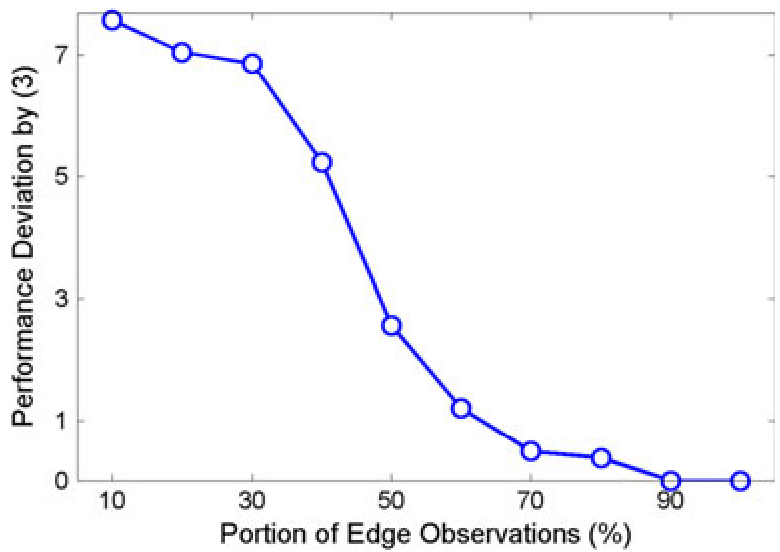 ### 3. Semantic Clarity By extracting discriminative tags, the authors showed that the detected circles weren't just mathematical abstractions—they represented real-world communities with distinct interests like "Technology," "Health Care," or "Sport." | Circle | Representative Tags | | :--- | :--- | | S2 | Valentine's Day, Dance, Sport | | S4 | Social media, Health, Cancer | | S5 | Yahoo!, Android, Software | ## Critical Analysis & Conclusion The major takeaway is the shift in perspective: **Sparsity $ eq$ Absence**. In social networks, a lack of an edge often means we haven't seen the interaction *yet*, not that the relationship doesn't exist. By selectively weighting these "uncertain" views, the SCSC algorithm provides a more resilient way to cluster nodes. **Limitations**: The study assumes circles are disjoint. In reality, a "Work" friend can also be a "College" friend. While the authors suggest extensions for overlapping circles, the current SCSC framework is optimized for exclusive membership. **Future Work**: This methodology opens doors for "cross-domain" detection—imagine using interaction data from LinkedIn to help cluster friends on Twitter.