
Predicting the Invisible: Learning Social Networks through Document Aggregation and Resampling
Learning social networks using multiple resampling method
The paper introduces a supervised learning framework to predict social network ties by transforming the task into a binary text classification problem. Using the Friend Of A Friend (FOAF) dataset and an SVM classifier, it reconstructs missing relationships by mining textual web resources associated with individuals.
TL;DR
This research tackles the challenge of predicting social ties between individuals by analyzing their web-based textual documents. By converting the social network link prediction problem into a supervised text classification task and employing a dual-resampling strategy to handle the inherent sparsity of social connections, the authors demonstrate a robust method for completing partially known social graphs.
Problem & Motivation: The Sparsity Trap
In the digital age, we leave "textual breadcrumbs" everywhere—blogs, CVs, and homepages. While we can use these to see who already knows whom (descriptive modeling), predicting unknown relationships is significantly harder.
The core difficulty lies in Sparsity. In a typical social network, the number of actual connections is a tiny fraction of the total possible pairs (often less than 0.1%). In machine learning terms, this creates a "Class Imbalance" nightmare where the "No-Relation" class dominates the "Connected" class. Standard classifiers trained on such data naturally default to predicting "No-Relation" for everyone to achieve high accuracy, while failing completely at identifying actual social ties.
Methodology: From Actors to Relations
The authors suggest a three-step pipeline to move from raw text to a predictive graph:
1. Actor and Relationship Modeling
Instead of simply measuring how similar two people's documents are (which collapses complex data into a single scalar), the authors propose Document Aggregation. For any two actors, they take their respective term vectors ( and ) and apply a MAX operator.
This creates a "Relation Vector" that retains the most discriminative features of both individuals, providing the classifier with richer data to distinguish between a "broken" tie and a "connected" one.
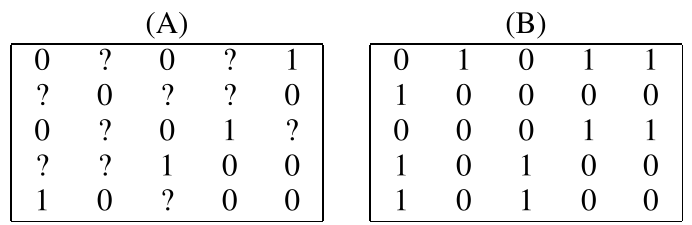 Caption: The transformation from an incomplete adjacency matrix (A) to a predicted complete network (B).
2. The Multiple Resampling Strategy
To solve the imbalance problem, the authors don't just pick one method; they combine Undersampling (removing samples from the majority class) and Oversampling (duplicating samples from the minority class). This re-balances the training set so the SVM classifier can actually "see" the patterns that define a friendship.
Experimental Insights
The method was tested on a real-world FOAF (Friend Of A Friend) dataset. The experiment analyzed how different sampling rates ( for positive, for negative) impacted the F-measure.
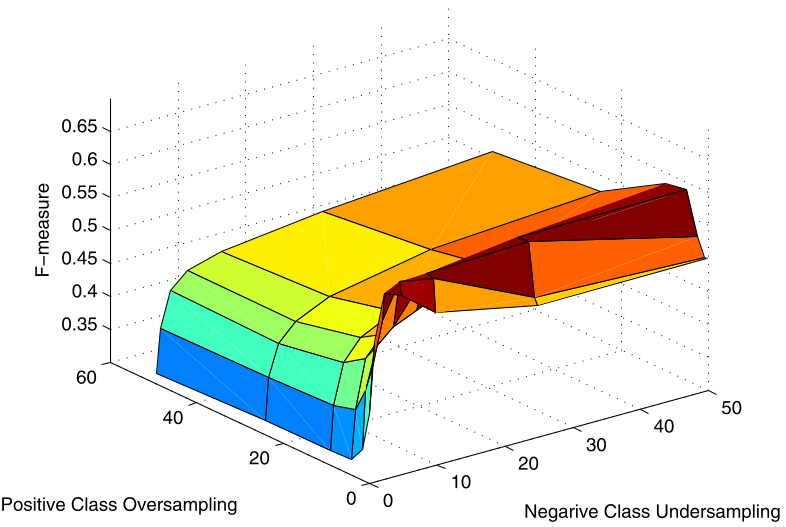 Caption: Overall performance of social network extraction vs. sampling rates of both classes.
Key Findings:
- The Sweet Spot: There is an optimal negative class sampling rate (found at roughly 1:10) where the positive class F-measure peaks.
- Macro-Averaging: The study used Macro-averaged F-measure to ensure that the minority class (actual friends) was treated with equal importance to the majority class.
- Performance: The system achieved a peak Macro-F1 of 0.5894, while a random guess on such imbalanced data would yield a mere 0.34.
Critical Analysis & Conclusion
Takeaway
The research successfully proves that social networking isn't just about "similarity"—it's about characteristic features that emerge when two individuals are viewed as a pair. The use of multiple resampling is a practical, necessary "hammer" for the "nail" of network sparsity.
Limitations & Future Work
The study notes a struggle with Precision—the model sometimes predicts ties where none exist. Future improvements could involve:
- Advanced Aggregation: Using fuzzy operators or latent semantic analysis instead of simple MAX operators.
- Context Awareness: Incorporating background knowledge (e.g., "Do they work at the same university?") to filter out false positives.
- Evolutionary Optimization: Using genetic algorithms to automatically find the perfect resampling rates and .
This paper provides a foundational look at how supervised learning can bridge the gap between unstructured text and structured social intelligence.