
Social Learning: Does Your Network Position Actually Make You Prettier... or Just Richer?
Learning in social networks: Selecting profitable choices among alternatives of uncertain profitability in various networks
This study investigates how social network structures influence "social learning"—specifically, the ability to select profitable choices in a multi-armed bandit setting. Using a combination of Bayesian simulations and laboratory experiments, the authors demonstrate that degree centrality and network density significantly improve profitable decision-making, while high betweenness centrality may paradoxically hinder it.
TL;DR
In a world saturated with information, we often look to others to figure out what works. This study tackles a fundamental question: Which network positions actually help you make more profitable choices? Through Bayesian simulations and lab experiments, the researchers found that having more friends (Degree Centrality) and living in a well-connected group (Density) are the biggest predictors of success. Surprisingly, being a "broker" (high Betweenness) between different groups might actually hurt your learning curve.
Background: The Gap in Social Capital Theory
For decades, sociologists have argued that "Social Capital"—who you know—is valuable. However, most evidence is correlational (e.g., people with more ties have better jobs). The why remains fuzzy. Does the network provide better info, or just more of it? This paper moves beyond correlations by using a controlled experimental setup to see how network structure affects the solution to the Multi-Armed Bandit problem.
Problem & Motivation: Beyond Intuition
Previous work (like Granovetter’s "Weak Ties" or Burt’s "Structural Holes") suggests that unique, non-redundant information is the key to success. But in many real-world scenarios—like farmers choosing seeds or consumers buying tech—is "unique" information better than "confirmed" information?
The authors identified three major gaps:
- Causality: Observational studies can't isolate the network's effect from individual talent.
- Explicit Value: Theoretical models often assume info is valuable without defining how.
- The Redundancy Paradox: Is it better to hear a secret from one person, or a confirmed fact from three?
Methodology: The Iowa Gambling Task in a Social Web
The researchers used the Iowa Gambling Task: 4 decks of cards with different profit distributions. Participants (and sims) don't know which deck is which. They must learn through trial and error—and by watching their neighbors.
The Topology of Learning
The study examined six specific 4-person networks to vary metrics like Degree (number of ties), Betweenness (brokerage), Density (total ties), and Centralization (power concentration).
 Figure 1: The six experimental network treatments: (a) empty, (b) complete, (c) circle, (d) line, (e) star, (f) two dyads.
Experiments & Results: More is Better
1. The Power of Direct Ties (Micro-level)
The results were clear: the more neighbors you have, the more profitable choices you make. In the simulation, increasing degree centrality by one unit boosted the odds of a profitable choice by 117.5%. In the human experiment, the boost was a solid 32.9%.
2. The Failure of the Broker
Intriguingly, the "broker" position (high betweenness, like the center of a star or line) did not outperform others. In many cases, it performed worse than positions in denser networks. This challenges the "structural hole" advantage in the context of pure learning; when info is stochastic, redundancy helps filter out noise.
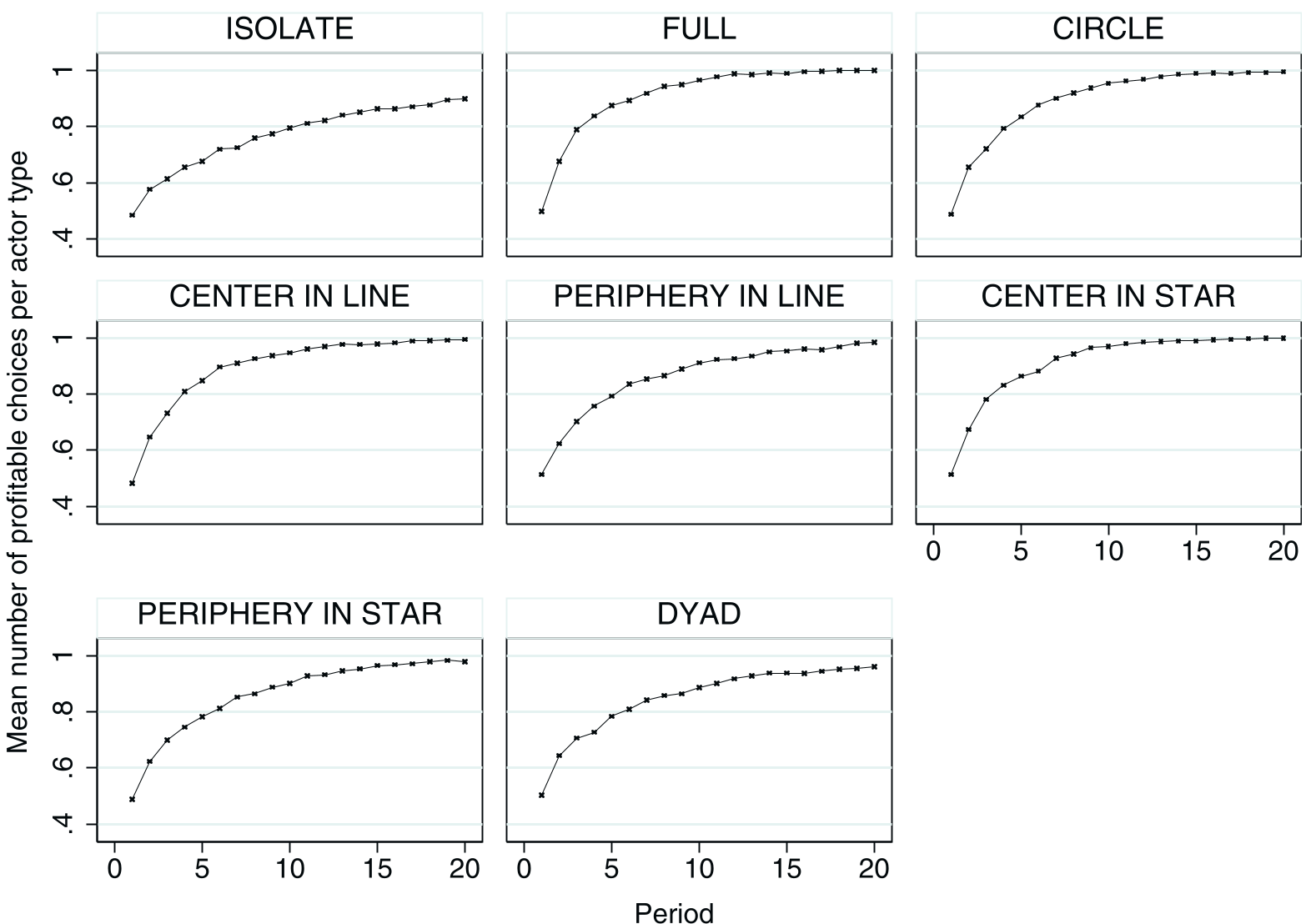 Figure 2: Performance over time. Note how the "Full" (complete) network consistently outperforms the "Isolate" (empty) network.
3. Group Dynamics (Macro-level)
Dense networks (where everyone knows everyone) were the fastest to reach the optimal choice. While some theories suggest dense networks lead to "herd behavior" on wrong choices, this study found that the sheer volume of information in dense networks usually led the group to the truth faster.
Critical Analysis & Takeaways
Conclusion
Direct information is the "king" of social learning. If you want to make better decisions under uncertainty, maximize your Degree Centrality and seek out Dense Networks.
Limitations
- Small Networks: The study used 4-person groups. In the real world, "redundancy" might look different in a 1,000-person network.
- No Competition: Participants weren't competing for the same resources. In a competitive market (like job hunting), "unique" information from brokerage might become more valuable again.
Future Outlook
This paper provides a rigorous baseline. The next step? Endogenous networks. Instead of being assigned a position, how much would you "pay" (in points/effort) to build a tie to a successful neighbor? That’s where the real social capital game begins.