
Neighbor Voting: Unlocking Objective Truth from Noisy Social Tags
Learning Social Tag Relevance by Neighbor Voting
The paper introduces a "neighbor voting" algorithm to refine social tag relevance by accumulating votes from visual neighbors. It demonstrates that tag relevance can be effectively learned in an unsupervised manner, achieving significant improvements in image retrieval (up to 24.3% MAP increase) and tag suggestion tasks.
TL;DR
Social tags are notoriously messy. This paper proposes a lightweight, unsupervised neighbor voting algorithm that treats visually similar images as "voters." By analyzing how neighbors are tagged and subtracting global noise (priors), the method identifies which tags actually describe the image content. Tested on 3.5 million images, it boosts retrieval accuracy by over 24%.
Problem & Motivation: The Chaos of Social Tagging
Social platforms like Flickr and YouTube are gold mines of data, but their "tags" are often useless for search. A user might tag a photo of a dog as "my_pet_coco" or "birthday_party" rather than "dog." These subjective and overly personalized tags create a bridge too wide for traditional search engines to cross.
The authors identify a fundamental gap: supervised learning (training a model for the "dog" concept) cannot scale to the millions of concepts found online. They sought an unsupervised way to find the "objective" truth within this subjectivity.
Methodology: The Neighbor Voting Intuition
The core insight is simple yet powerful: Objective tags are persistent across visually similar content. If three different people upload photos of a bridge and all use the tag "bridge," that tag is likely objective. If only one uses the tag "Grandpa," it's likely subjective.
The Algorithm
- Visual Neighbor Search: Find visual neighbors using low-level features (Color Correlagram, Moments).
- Unique-User Constraint: To prevent one user’s library from skewing results, only one image per user is allowed in the neighbor set.
- The Score: The relevance of tag for image is calculated as: Where is the count in the neighborhood and is the expected count based on the tag's total popularity in the database.
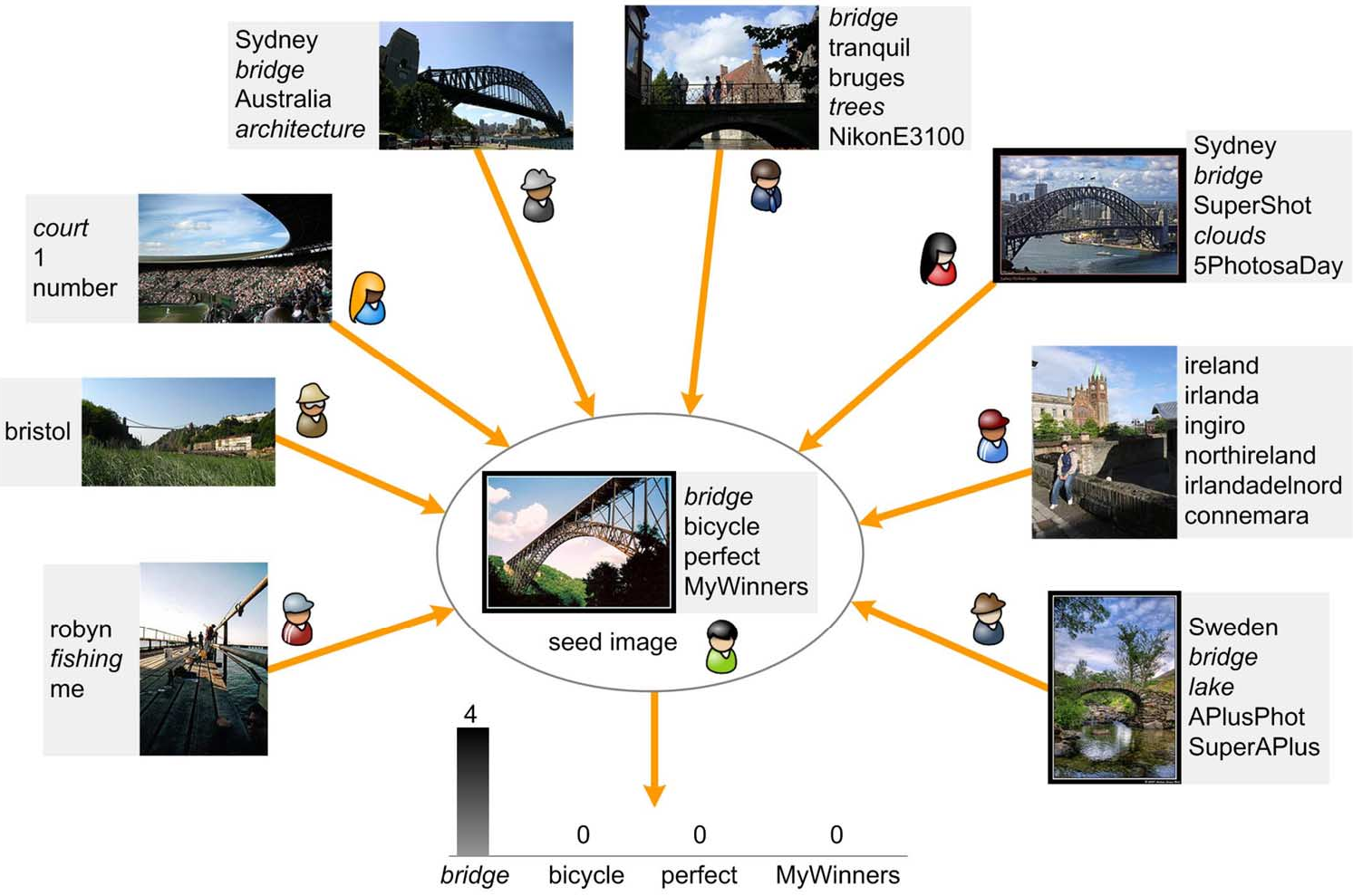 Figure 1: The neighbor voting pipeline showing how visual neighbors provide consensus for tag relevance.
Experiments & Results
The authors scaled this to a massive dataset of 3.5 million Flickr photos.
Social Image Retrieval
By replacing raw tag counts with learned relevance scores, the system's Mean Average Precision (MAP) jumped significantly. The method proved robust regardless of the number of neighbors () chosen, consistently beating the standard OKAPI-BM25 text baseline.
Tag Suggestion
The algorithm also excels at suggesting tags for new images. Unlike previous "model-free" approaches that over-weighted rare tags or under-weighted common ones, neighbor voting provides a balanced, noise-aware suggestion list.
 Table 1: Performance comparison showing tagRelevance consistently leading across all metrics (P@5, P@20, MAP).
Critical Analysis & Conclusion
Takeaway
The paper proves that "consensus" is a viable proxy for "truth" in social media. By mathematically proving that image ranking is easier than tag ranking (due to relaxed assumptions on visual search accuracy), the authors provide a theoretical foundation for why visual reranking works so well in commercial search engines.
Limitations
- Visual Feature Dependency: The method relies on the quality of the visual search. If the k-NN search returns visually irrelevant neighbors, the "votes" are meaningless.
- Computational Cost: Finding neighbors for millions of images is expensive, though the authors mitigate this using distributed supercomputing and k-means indexing.
Future Outlook
While this paper uses traditional global features, the logic is perfectly suited for modern AI. Integrating this neighbor voting scheme with foundation models (like CLIP) or Graph Neural Networks could further denoise the massive, uncurated datasets used to train today's Generative AI.