
From Chaos to Knowledge: Decoding the Semantics of Social Tagging
Learning Structured Knowledge from Social Tagging Data: A Critical Review of Methods and Techniques
This paper provides a comprehensive survey and taxonomy of methods for mining structured knowledge from social tagging data (folksonomies). It categorizes research into two main thrusts: learning term lists (Word Sense Disambiguation/Induction) and learning relations (hierarchies and ontologies) to bridge the gap between noisy user-generated tags and formal Knowledge Organization Systems (KOS).
TL;DR
Social tagging systems (Folksonomies) are vast repositories of collective intelligence, yet they are notoriously noisy and unstructured. This paper provides a critical roadmap for transforming these ambiguous tags into formal Knowledge Organization Systems (KOS). By categorizing methods into Term Learning (solving ambiguity) and Relation Learning (building hierarchies), the authors reveal how data mining and machine learning turn "meaningless keywords" into actionable ontologies.
The Cognitive Gap: Why Folksonomies are "Dormant"
Collaborative tagging (like del.icio.us or Flickr) creates a "folksonomy"—a bottom-up, user-driven classification. While flexible, it suffers from the classic flaws of human language:
- Polysemy: The tag "Apple" could mean the fruit or the tech giant.
- Synonymy: "Cinema" vs. "Movies."
- Noise: Personal tags like "toread" add no semantic value to the community.
The challenge is moving these tags from the "weak semantics" end of the spectrum toward the "strong semantics" of Ontologies, which allow for automated reasoning and precise information retrieval.
Methodology: The Two Pillars of Tag Semantics
The authors categorize the state-of-the-art into two primary tasks:
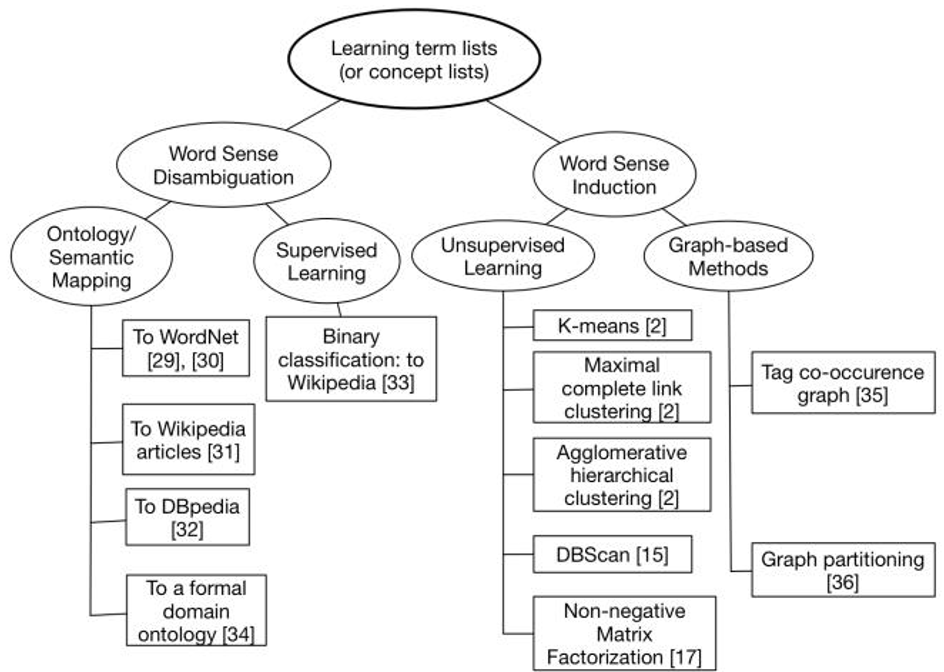
1. Learning Term Lists (Disambiguation & Induction)
How do we know what a tag actually means?
- Word Sense Disambiguation (WSD): This relies on "external anchors." Methods map tags to authoritative sources like WordNet, Wikipedia, or DBpedia. While high in precision (up to 99% in some classifiers), these methods are limited by the coverage of the external resource—often missing 50% or more of niche or new tags.
- Word Sense Induction (WSI): A more "organic" approach using unsupervised learning. Techniques like Non-negative Matrix Factorization (NMF) or Clustering (K-Means, HAC) group tags based on how they co-occur with resources or users, discovering senses without needing a pre-defined dictionary.
2. Learning Relations (Building the Backbone)
Once we have the terms, how do we connect them?
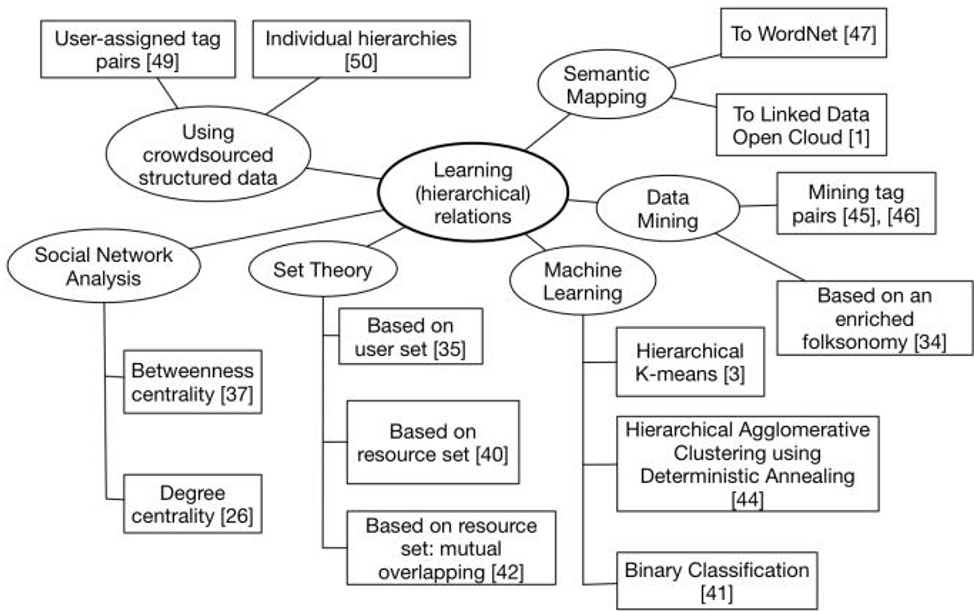
- Social Network Analysis (SNA): Researchers treat tags as nodes in a graph. The "Generality-Popularity" assumption suggests that nodes with high Betweenness Centrality are likely "Parent" concepts (e.g., "Software" is more central than "Photoshop").
- Set Theory: If the set of resources tagged with "Python" is almost entirely a subset of the resources tagged with "Programming," we can infer a subsumption (is-a) relationship.
- Machine Learning: Supervised models use features like co-occurrence probability and mutual overlapping to classify whether a pair of tags has a hierarchical relationship.
Critical Insights & Results
The paper highlights a significant tension in Knowledge Engineering:
- Centrality vs. Clustering: Centrality-based algorithms (SNA) often produce hierarchies that align better with human logic than complex hierarchical clustering.
- The Context Bias: Methods that look only at tag-resource co-occurrence miss the "user" dimension. The authors argue that the "Wisdom of the Crowd" is only truly captured when the Tripartite (User-Tag-Resource) relationship is preserved.
- Accuracy: Supervised approaches are reaching near-perfect F1 scores (99.6%) on specific datasets (like StackOverflow to Wikipedia mapping), indicating that the problem is no longer "can we map it?" but "how do we handle what isn't in our map?"
The Road Ahead: Evolving Knowledge
The survey concludes by identifying a major gap: Evolution. Social media data is not static. Our "Knowledge Organization Systems" must be as dynamic as the users who create them.
The next frontier isn't just building a static ontology from a 2026 dataset; it's creating systems that can observe "Big Social Data" in real-time, detecting when a tag's meaning shifts or when a new sub-discipline emerges from the noise of the crowd.
Senior Editor's Note: This work serves as a foundational bridge between traditional Library & Information Science and modern Data Mining. For practitioners, the takeaway is clear: don't rely solely on WordNet for your metadata—the most valuable labels are often the ones found in the dense, overlapping clusters of user behavior.