
Predictive Control in Education: Stopping Student Dropouts with Real-Time Data
Learning Support Methods based on Predictive Control Using Machine Learning for Educational Big Data
This paper introduces a comprehensive learning support system that utilizes Educational Big Data and Machine Learning to predict student dropout and postponement. By integrating real-time IC card attendance data with historical academic records, the authors propose a "state predictive control" model that achieves over 88% prediction accuracy by the end of the second year.
TL;DR
Higher education faces a persistent challenge: students dropping out or postponing graduation. This paper presents a sophisticated Learning Support System that moves away from reactive counseling to proactive intervention. By applying machine learning to seven years of university "Big Data" and daily IC-card attendance, the system can predict academic failure as early as the third week of class, allowing for timely, life-changing interventions.
The Problem: The "Too-Late" Intervention Gap
In most universities, the first sign of trouble is a failing grade at the end of a semester. However, academic failure is a process, not a sudden event. Prior work has focused on historical GPA, but this overlooks the daily behavioral decay—the skipped classes and missed lectures—that precedes a failed exam. The gap exists because existing systems lack:
- Granularity: Monitoring is done by semester, not by week.
- Quantification: Faculty often lack a specific "risk percentage" to motivate students or parents.
- Real-time mechanisms: There is no feedback loop to guide a student back to a "target state."
Methodology: From Predictive Modeling to State Control
The researchers at Kyushu Sangyo University treated the student experience like a controlled system in engineering.
1. Multi-Dimensional Data Fusion
The system doesn't just look at grades. It fuses:
- Static Internal Data: Enrollment records and admission info.
- Dynamic Academic Data: Credits earned and GPA.
- Real-time Behavioral Data: Daily attendance captured via IC card readers in lecture halls.
2. The Predictive Engine
The authors tested a battery of algorithms, including Naive Bayes, SVM, and Random Forests. While Naive Bayes performed surprisingly well with a 0.808 accuracy in the early stages, the real innovation lies in the Attendance Shade Patterns.
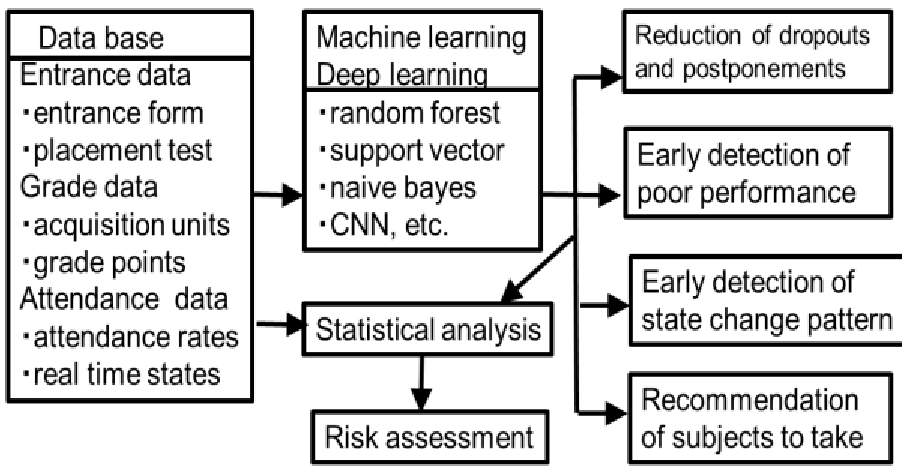 Fig 1: The holistic data flow from IC cards to predictive interventions.
3. CNN-Based Behavioral Analysis
By converting attendance records into 2D "shade patterns" (where black represents presence and white absence), the team used Convolutional Neural Networks (CNNs) to identify the specific rhythm of disengagement. This "visual" approach to attendance data allowed them to catch 50% of poor-performing students earlier than traditional statistical methods.
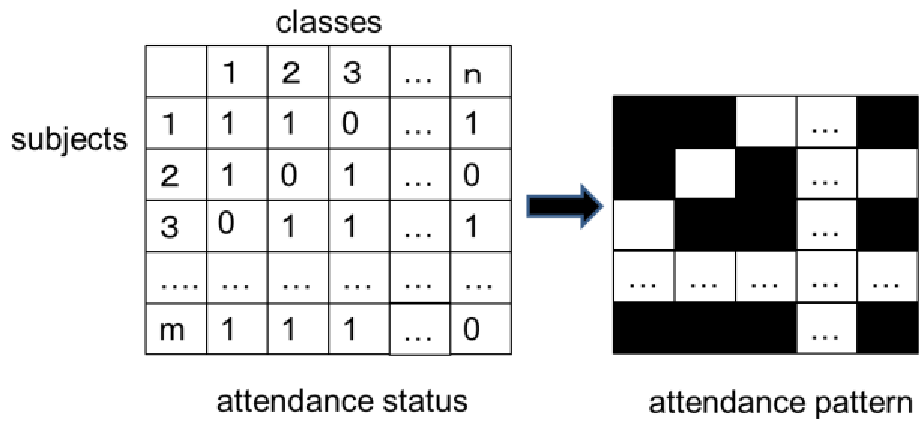 Fig 2: Transforming binary attendance data into visual patterns for CNN processing.
Experimental Results: The Power of Early Warning
The experiments yielded two significant findings:
- Accuracy scales with time: By the end of two years, the system identifies at-risk students with 88.7% accuracy.
- The 3-Week Window: Even with just three weeks of data in the first semester, the system could identify 46% of students who would eventually drop out or postpone. This provides a vital "golden window" for counselors to step in.
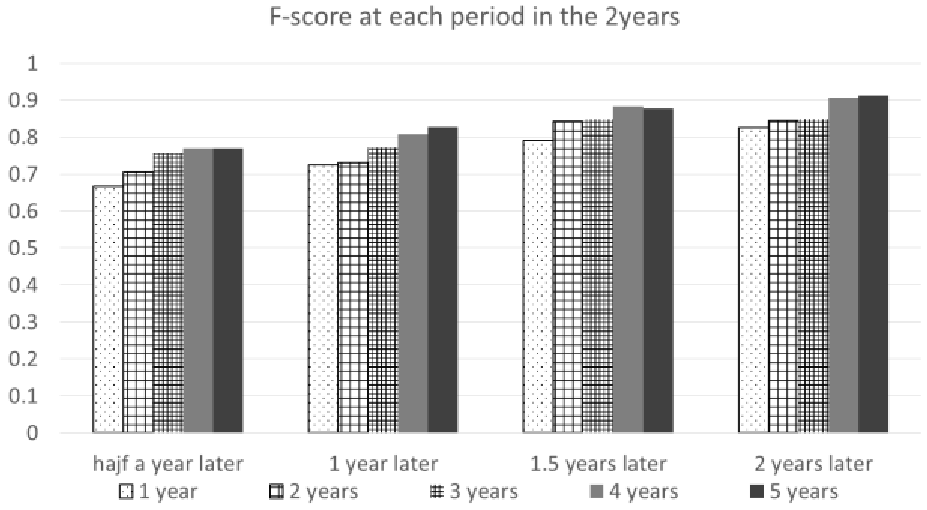 Fig 3: How prediction F-scores stabilize and improve as more longitudinal data is collected.
Critical Insight: Real-Time Risk Assessment
One of the paper’s most practical contributions is the Quantitative Risk Assessment. Rather than telling a student "you might fail," the system provides data-backed probabilities (e.g., "Students with your current attendance and credits have a 90% chance of postponement"). This "Predictive Control" logic (shown in Fig 8 of the paper) transforms the educational support into a closed-loop system where the "target state" is graduation, and the "control signal" is the early intervention.
Conclusion & Future Workspace
While the system is highly effective, the authors acknowledge that it currently relies heavily on attendance. Future iterations aim to include interview data and personality factors to understand why a student is disengaging.
For universities looking to modernize their student affairs, this research proves that the infrastructure for "Educational Big Data" already exists—we just need the right predictive control models to make it actionable.
Takeaway: Data doesn't just record the past; in education, it can precisely forecast—and change—the future.