
PLP-FGM: Turning Black-and-White Social Networks into Colorful Semantics
Learning to Infer Social Ties in Large Networks
This paper introduces the Partially-labeled Pairwise Factor Graph Model (PLP-FGM), a semi-supervised framework designed to automatically infer social relationship types (e.g., advisor-advisee, manager-subordinate) in large-scale networks. By treating relationships as nodes and incorporating attribute, correlation, and constraint factors, the model achieves state-of-the-art performance across Publication, Email, and Mobile domains.
TL;DR
While our real-world social circles are rich with roles—colleagues, family, mentors—online social networks are often "black-and-white," treating every connection as a generic "friend" or "follower." This paper introduces PLP-FGM, a universal semi-supervised factor graph model that learns to infer these hidden labels. By modeling relationships as inter-dependent entities and utilizing a distributed learning architecture, the researchers achieved high-accuracy inference across academic, corporate, and mobile communication networks.
The Motivation: The "Labeling Fatigue" Problem
Statistically, only a tiny fraction of users (around 16-23%) bother to label their contacts into groups. This lack of data creates a "semantic gap" for social network analysis. Previous attempts at relationship mining were siloed into specific domains—like identifying advisors in academic networks—and lacked a unified mathematical framework. The challenge is threefold: identifying the right features, leveraging the 80%+ of unlabeled data, and scaling the computation to millions of nodes.
Methodology: Putting Relationships at the Center
The core innovation of the Partially-labeled Pairwise Factor Graph Model (PLP-FGM) is its shift in perspective. Instead of modeling users as the primary variable nodes, it models the relationships themselves as nodes.
The Three Pillars of Inference
The model joint probability is defined by three specific factors:
- Attribute Factors: Local characteristics of a link (e.g., Does a mobile call happen at night? Do two authors share many conferences?).
- Correlation Factors: Captures the "social logic" (e.g., if User A and User B both call User C simultaneously, they might share a similar social role).
- Constraint Factors: Global rules (e.g., a student typically has a limited number of advisors).
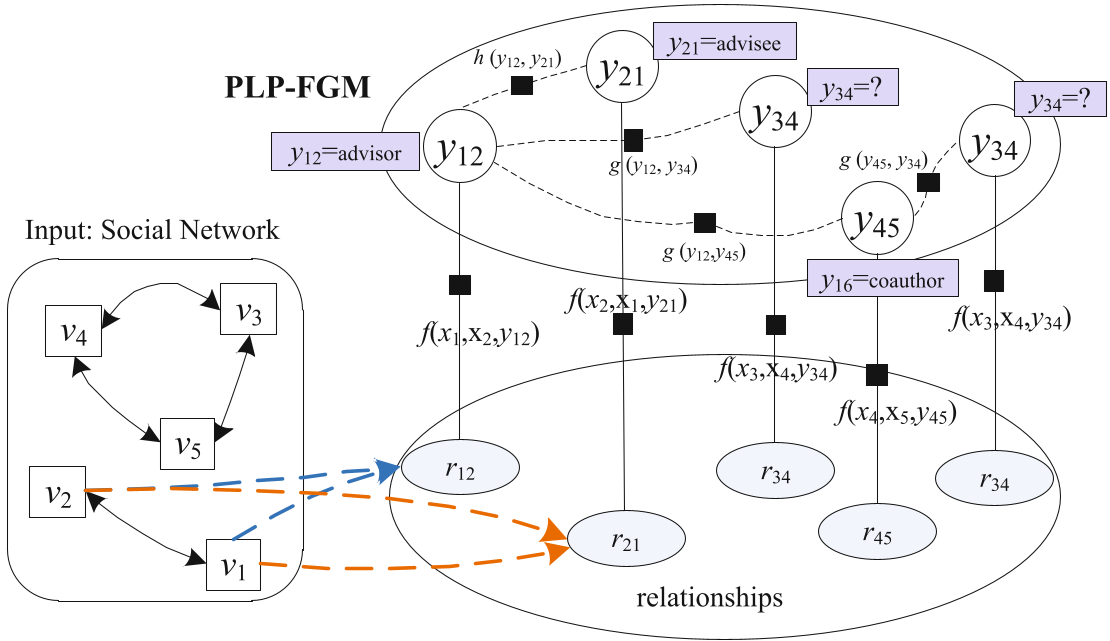 Figure: The PLP-FGM structure where y represents relationship labels and x represents features.
The model uses Loopy Belief Propagation (LBP) to estimate marginal probabilities and a gradient-descent approach to optimize the parameters ().
Scaling to the Millions
To handle enormous datasets like the Arnetminer publication network, the authors developed a distributed learning algorithm using MPI (Message Passing Interface). The graph is partitioned using METIS, distributed across slave nodes, and gradients are aggregated by a master node. This approach achieves an impressive 8x speedup with 12 cores, making it viable for industrial-scale networks.
Experimental Evidence
The model was tested on three diverse datasets:
- Publication: Coauthor networks (Advisor-Advisee).
- Email: Enron corporate network (Manager-Subordinate).
- Mobile: Calling/Location logs (Friendship).
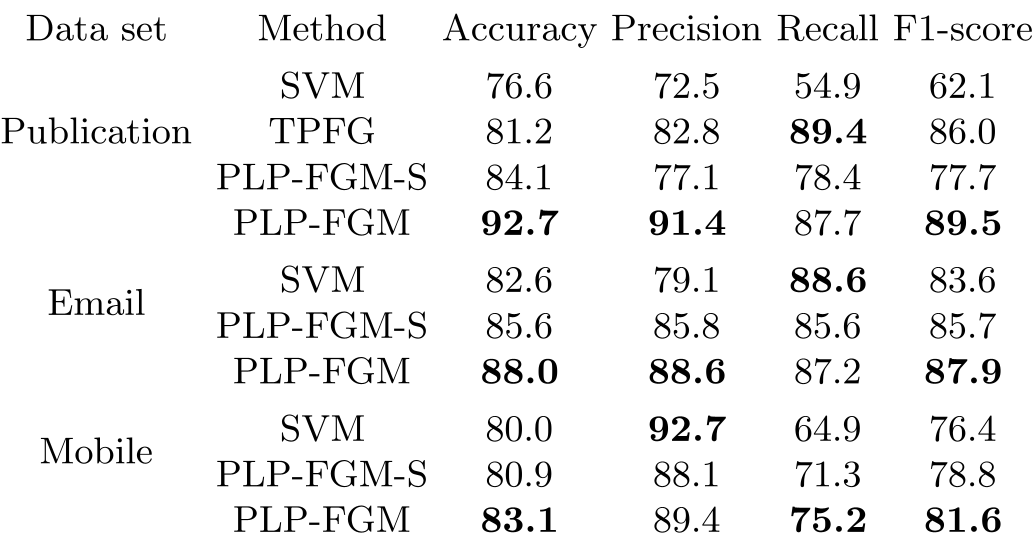 Table: Comparison shows PLP-FGM consistently outperforming SVM and domain-specific baselines.
Key Insights from Results:
- The Power of Unlabeled Data: The semi-supervised nature allows the model to "learn" from the structure of the unknown parts of the network, significantly boosting F1-scores compared to supervised baselines (SVM).
- Factor Synergy: Ablation studies revealed that while individual factors (like "co-location") provide small boosts, the combination of all factors yields a massive improvement, proving that social ties are emergent from multiple overlapping signals.
Critical Analysis & Future Outlook
PLP-FGM provides a robust, generalized blueprint for relationship mining. Its primary strength lies in its Inductive Bias—modeling social transitivity and constraints explicitly rather than hoping a black-box model picks them up.
Limitations: Currently, the model focuses on static relationships. However, social ties are dynamic; a subordinate can become a manager, and students graduate.
Future Work: The logical next step is extending this to Temporal Factor Graphs and exploring how these "colorful" labels can improve recommendation systems or community detection. By understanding who is connected to whom and why, we move closer to a digital representation of human society that is as nuanced as the real thing.
Summary: This work bridges the gap between raw link data and semantic social knowledge, offering a scalable, high-accuracy solution for one of the most persistent "missing data" problems in social network analysis.