
Social Matching: Moving Beyond the Amazon Model for People-to-People Recommendation
Learning to Make Social Recommendations: A Model-Based Approach
The paper proposes a specialized model-based framework for "people-to-people" social recommendations (e.g., online dating). By integrating user profiles, behavioral patterns, and interests into a decision tree-based classifier with a novel probabilistic ranking function, the system significantly outperforms traditional collaborative filtering in predicting successful mutual interactions.
TL;DR
Recommending a book is easy; recommending a partner is hard because the partner has to "like you back." This paper introduces a model-based social recommendation framework that combines user profiles with behavioral data. By using decision-rule generation and a specialized probabilistic ranking function, it achieves a 114% improvement in interaction success rates over standard baselines.
Background: The Reciprocity Problem
In traditional e-commerce (like Amazon), recommendations are unidirectional. If you like a book, the book doesn't need to like you back for a "successful transaction" to occur. However, in social networks—specifically online dating—a recommendation is only successful if there is a mutual match.
Traditional Collaborative Filtering (CF) collapses here because it focuses on similarity in "taste" but ignores the "attractiveness" or "responsiveness" of the target. The authors argue that a specialized model is needed to capture the intersection of what a user wants and what they can actually achieve in a social marketplace.
Methodology: Rules and Reciprocity
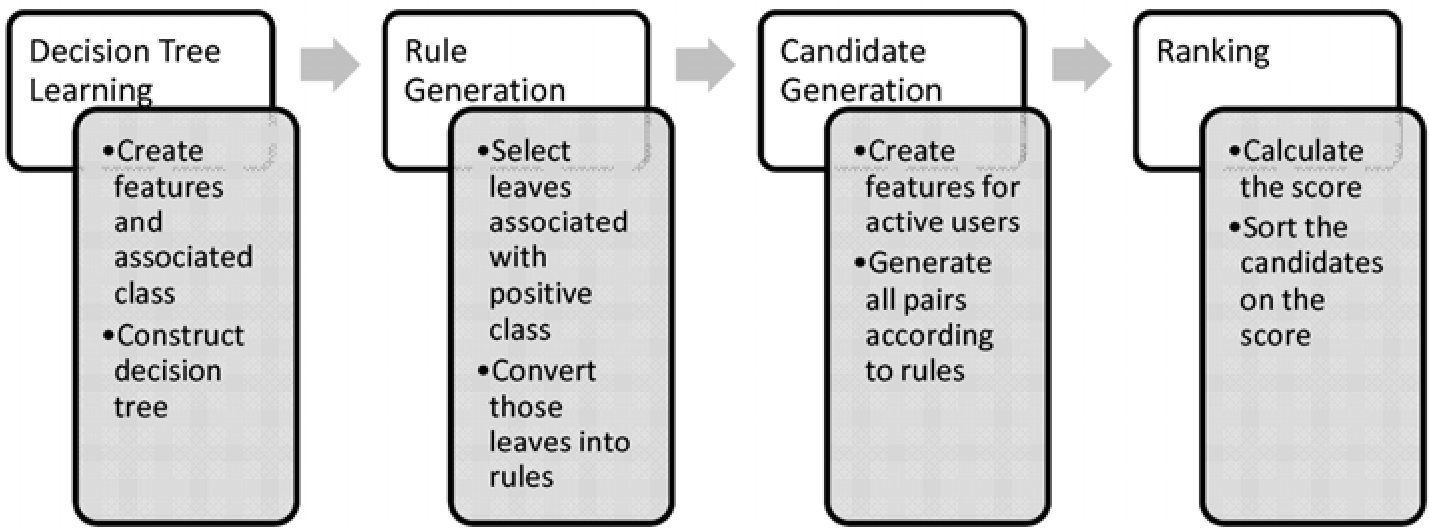
The authors propose a three-stage pipeline: Feature Construction, Model Learning, and Probabilistic Ranking.
1. Hybrid Feature Engineering
The system doesn't just look at whether you like "hiking" or "coding." It categorizes features into:
- User Profiles: Age, occupation, etc.
- User Behavior: How active is the sender? How popular/responsive is the recipient?
- User Interests: Keywords from free-text descriptions.
2. Candidate Generation via Decision Rules
Instead of a "black-box" model, the authors use See5 decision trees to extract explicit rules. These rules define groups of "compatible" users. For instance, a rule might identify a specific cluster of active males who tend to get positive responses from a specific cluster of female profiles.
3. The Probabilistic Ranking Function
This is the "secret sauce." To rank candidates, the authors model the probability of a successful interaction as the product of the probability of sending a message and the conditional probability of receiving a positive reply. Since this data is often missing for new pairs, they approximate it using the "rule groups" identified in the training phase.
Experimental Results
The model was tested against two baselines: the Default Success Rate (users finding matches themselves) and Standard CF.
| Metric | Model-Based (Top 5) | Default Rate | Collaborative Filtering |
|---|---|---|---|
| Success Rate | 42.7% | 20.0% | 19.8% |
| SRI (Improvement) | 2.14x | 1.0x | 0.99x |
The most striking finding is that Standard CF performed worse than doing nothing (Default). This highlights that "users who liked this person also liked that person" is a fundamentally flawed logic for dating, as it often recommends highly popular users who are unlikely to respond to the active user.
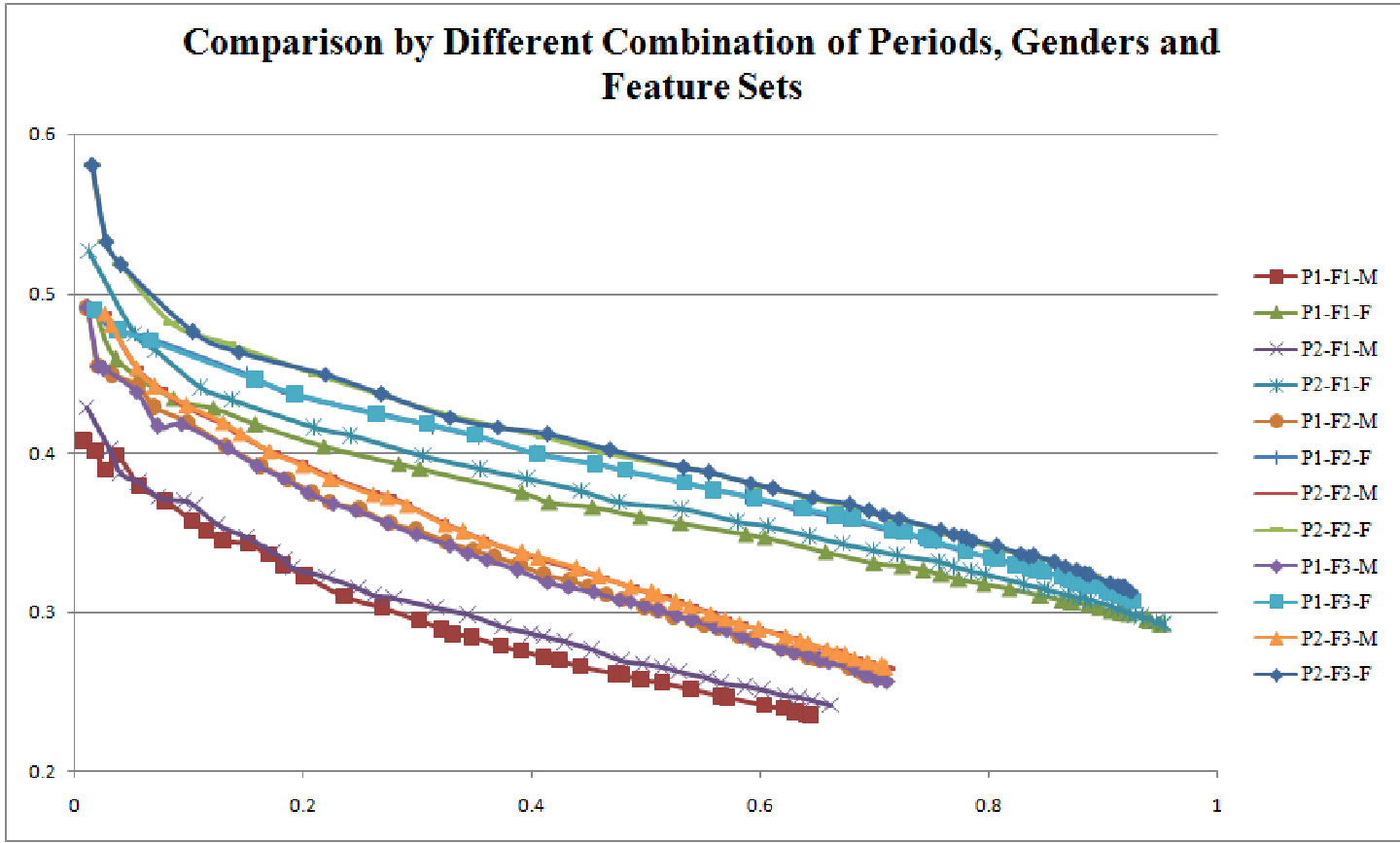 Analysis shows that as cost-weighting for successful interactions increases, the system achieves a better balance of precision and recall.
Critical Insight & Conclusion
The core takeaway is that Behavioral Features (F2/F3) are far more predictive than Profile Features (F1) alone. Knowing how a user actually interacts within the system tells us more about their "social value" and "real-world preferences" than their self-reported bio.
Limitations
- Rule Staticity: While decision rules are interpretable, they may not capture the high-dimensional nuances that modern Latent Factor models or Graph Neural Networks can.
- Gender Binary: The study is strictly segmented by Male/Female models, which may not generalize to more diverse social platform dynamics.
Future Directions
This work paves the way for "Reciprocal Recommendation" as a distinct sub-field. Future advancements likely involve Real-time Feedback Loops where the model updates its ranking the moment a user is rejected, preventing the "dead-end" recommendation syndrome.