
Decoding Social Evolution: How Triads and Elite Status Shape Our Networks
Learning to predict reciprocity and triadic closure in social networks
This paper introduces the Triad Factor Graph (TriFG) model, a semi-supervised learning framework designed to predict reciprocity (follow-back) and triadic closure in directed social networks like Twitter. By incorporating fundamental social theories such as structural balance, homophily, and social status, the model achieves a state-of-the-art F1-score of 0.92-0.93 for reciprocity prediction.
In the vast digital ecosystem of Twitter, a simple "Follow" button hides a complex sociological dance. Why do some users follow us back while others remain distant? Why do certain groups form tight-knit communities while others stay fragmented? The paper "Learning to Predict Reciprocity and Triadic Closure in Social Networks" by Lou et al. provides a rigorous mathematical answer to these questions by bridging the gap between social psychology and machine learning.
Executive Summary
TL;DR: The researchers developed the Triad Factor Graph (TriFG) model, a framework that predicts not just the existence of a link, but its evolution from a one-way (parasocial) tie to a two-way (reciprocal) friendship, and eventually into a three-way (triadic) closure. By encoding "Social Balance" and "Homophily" into the algorithm, they achieved a massive 20-30% performance boost over traditional methods.
This work is a cornerstone in Structural Social Analysis, as it moves link prediction from simple feature-matching to understanding the "physics" of social circles.
The Pain Points: Why Link Prediction is Hard
Existing link prediction methods often treat a social network like a static snapshot. However, social ties are vibrant and directional. The authors identified a fundamental missing link: Structural Intuition.
- Prior Work Deficits: Most algorithms ignore the difference between a fan following a celebrity (parasocial) and two friends following each other (reciprocal).
- The Triadic Gap: While we know "triadic closure" (joining a friend’s friend) is how networks grow, there was no principled model to predict when and how this happens using social theories.
Methodology: The Triad Factor Graph (TriFG)
The core innovation is the Factor Graph approach. Instead of just looking at the features of User A and User B, the model looks at the Triad (A, B, and C).
1. The Social Theory Engine
The model incorporates three pillars of sociology:
- Homophily: "Birds of a feather flock together." The model checks for shared interests and geographic proximity.
- Social Balance: The "Friend of a friend is a friend" logic. The paper proves that 88% of reciprocal triads on Twitter are balanced, while one-way follow networks are largely unbalanced.
- Social Status: The "Rich get richer" (Preferential Attachment). Elite users (opinion leaders) follow each other at rates 30x higher than ordinary users.
2. The Architecture
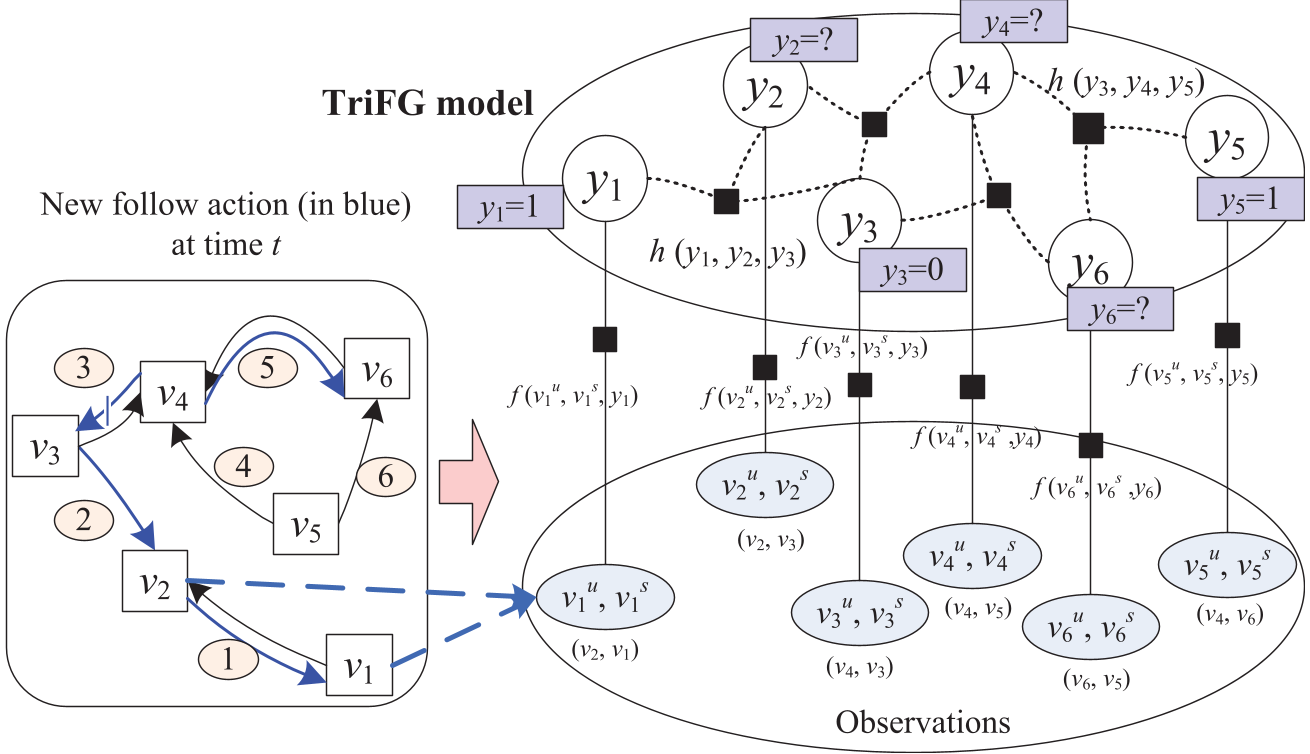 Figure: The TriFG model converts the social network (left) into a factor graph (right), where hidden variables (y) represent missing links and factors (h, f) represent social constraints.
The model uses Loopy Belief Propagation (LBP), allowing it to learn from both labeled (known follows) and unlabeled data—a critical feature for real-world networks where most data is incomplete.
Experimental Proof: Better Than the Baselines
The authors tested TriFG against standard methods like SVM and Logistic Regression. The results were definitive:
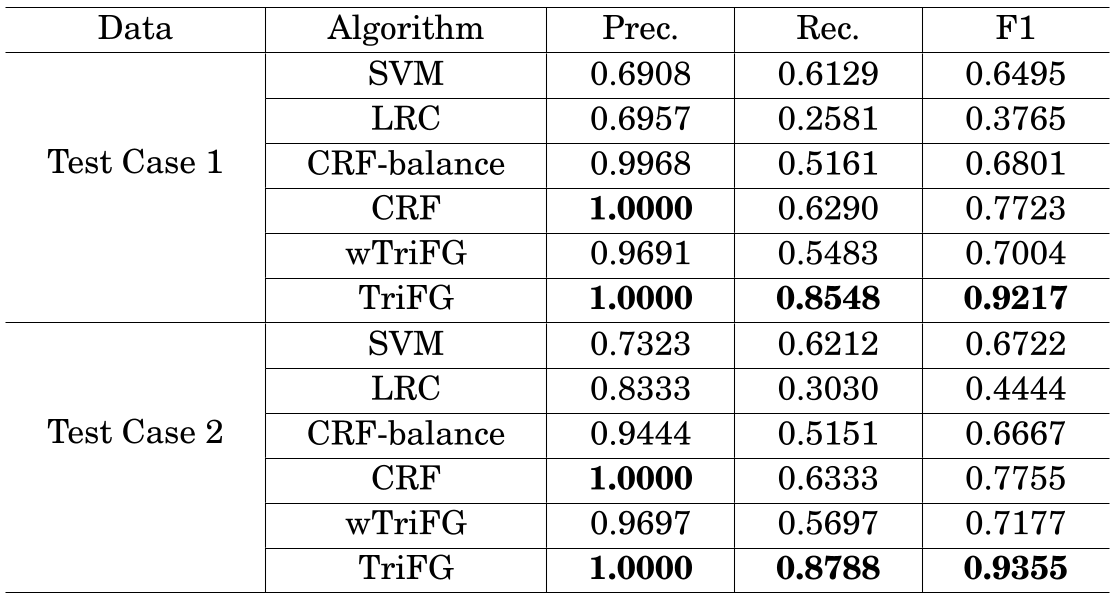 Table: TriFG consistently outperforms SVM and CRF across all metrics, particularly in Recall.
Key Insights from the Results:
- The "Elite" Factor: High-status users act as catalysts for triadic closure. If an elite user follows you back, the probability of forming a new triad increases by 10x.
- The "Local-Global" Paradox: While the Internet is global (distance doesn't stop follows), users in the same time zone are 20x more likely to have reciprocal relationships. Proximity still matters for true "friendship."
Critical Analysis & Future Outlook
Conclusion
The TriFG model demonstrates that social networks are not random graphs; they are governed by deep-seated psychological rules. By making "Structural Balance" a first-class citizen in the model's loss function, Lou et al. have set a new standard for link prediction.
Limitations
- Dynamic Decay: The model focuses on link formation but spends less time on link dissolution (unfollowing).
- Computation: LBP on massive graphs is computationally expensive, though the authors managed 112k nodes within minutes.
The Future of Social AI
This research opens the door for better recommendation engines—ones that don't just suggest "people you might know," but "people you might actually connect with." It suggests that future SNS product features should focus on helping users navigate toward "balance" in their social triads to increase user retention.
Technical Editor's Note: This paper is a must-read for anyone working on Recommendation Systems or Graph Representation Learning.