
A Learning to Rank Framework: Optimizing Developer Matching in Software Crowdsourcing
A Learning to Rank Framework for Developer Recommendation in Software Crowdsourcing
The paper proposes a Learning to Rank (LTR) framework for developer recommendation in software crowdsourcing. It combines a CRF-based criteria extraction model with feature engineering (topic modeling and skill matching) to rank the most suitable developers for complex software tasks, achieving high precision (P@1 > 0.95) on real-world data.
TL;DR
Matching the right developer to a complex software task is notoriously difficult due to the specialized skills required. This paper introduces a Learning to Rank (LTR) framework that extracts requirements from unstructured text using CRF and ranks developers based on a blend of semantic topic similarity, taxonomic skill matching, and normalized reputation scores. The result is a system capable of identifying the best developer with over 95% accuracy on real-world platform data.
Background: Why General Crowdsourcing Fails Software Engineering
Most crowdsourcing research focuses on "micro-tasks" (e.g., labeling an image or identifying an entity) that anyone can do with common sense. Software crowdsourcing is a different beast:
- High Stakes: Tasks take weeks and involve significant financial rewards.
- Domain Complexity: A developer who knows Java might not know low-level C++ or specialized frameworks like HTML5.
- Unstructured Data: Most platforms provide a messy "free-text" description rather than a clean list of requirements.
The Core Insight: From Classification to Ranking
Instead of asking "Is this developer a good fit?" (Binary Classification), the authors ask "Who is the best fit among these candidates?" (Learning to Rank). This shift bypasses the class-imbalance problem (where only one developer is hired among hundreds) and allows the model to learn the relative nuances between similar experts.
Methodology: The Three Pillars of Recommendation
1. CRF-based Criteria Extraction
The framework uses Conditional Random Fields (CRF) to scan task descriptions for hidden constraints.
- Location: "Developers from Beijing are better."
- Skill: "This project should be developed using HTML5."
By modeling this as a sequence-labeling problem, the system moves beyond simple keyword matching to understanding the intent within a sentence.
2. Semantic and Taxonomic Matching
The authors didn't just look for matching words; they looked for matching expertise:
- LDA Topic Models: These capture the high-level context of a developer's history.
- Taxonomy Similarity: Using a software programming taxonomy (with 30,000+ terms), the system calculates the "distance" between skills. If a task asks for "Python," a developer with "Django" experience is ranked higher than one with "Java" because they are closer in the taxonomy tree.
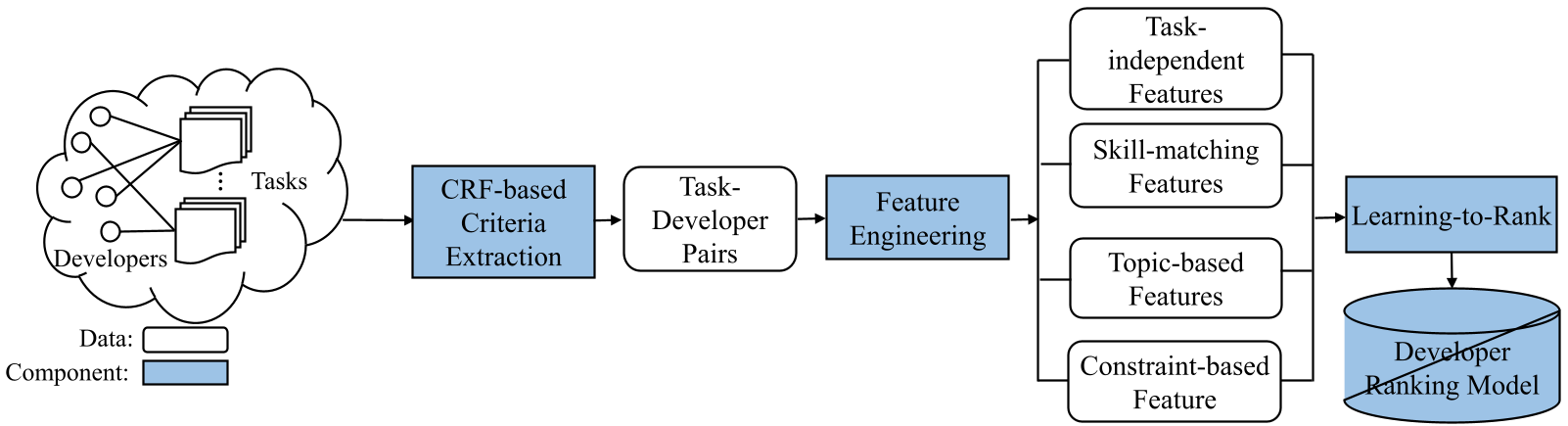
3. Reputation Normalization via Wilson Interval
A common pitfall in recommendation is the "raw score" bias. Developer A (1 task, 5.0 score) often looks better than Developer B (100 tasks, 4.9 score) to simple algorithms. This paper uses the Wilson Confidence Interval to find the lower bound of a developer’s score, ensuring that high-volume, consistent performers are prioritized over "lucky" newcomers.
Experimental Performance
The researchers tested various LTR algorithms (Pointwise, Pairwise, and Listwise) on data from Zhubajie, China's largest crowdsourcing site.
| Metric | Pointwise (MART) | Pairwise (RankNet) | Listwise (ListNet) |
|---|---|---|---|
| P@1 | 0.9559 | 0.9414 | 0.9414 |
| P@3 | 0.9424 | 0.9069 | 0.9159 |
Interestingly, the Pointwise approach (MART) outperformed more complex listwise methods. This is likely because crowdsourcing datasets usually only have one "correct" ground truth (the winning bidder), making it difficult for listwise models to learn a full ordering of "irrelevant" developers.
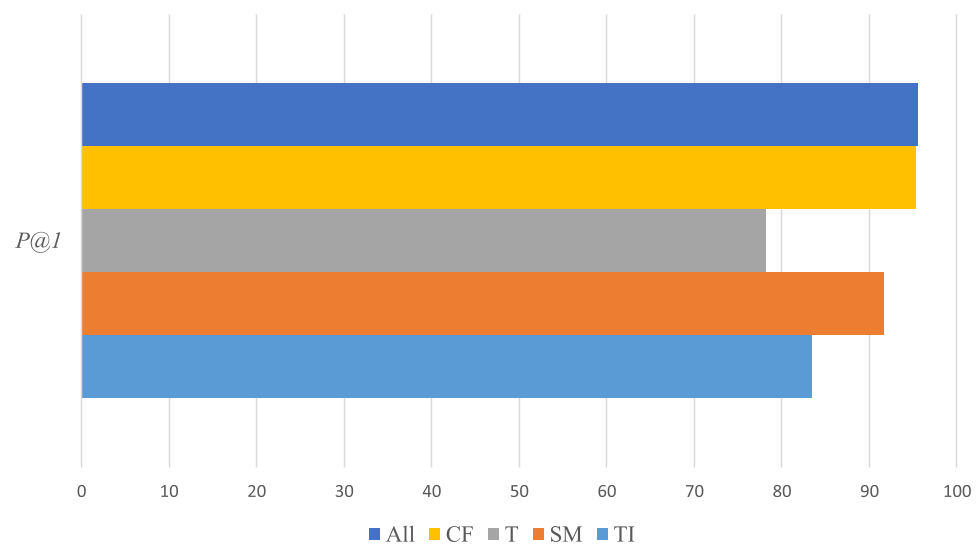 Feature Contribution Analysis: Topic-based features (T) and Task-independent reputation (TI) are the most critical drivers of accuracy.
Critical Insight & Limitations
The primary strength of this work is its practicality. By using CRF to handle noisy text and Wilson intervals to handle biased ratings, it solves the "messy data" problem of real-world platforms.
Limitations:
- Cold Start: The model relies on "historical tasks" to build developer distributions. New developers on the platform might be unfairly penalized.
- Temporal Dynamics: Developer skills evolve. A developer who did Java 5 years ago might now be a specialist in Rust; a static historical average might not capture this migration.
Future Outlook
As software crowdsourcing continues to grow, integrating LLMs (Large Language Models) for criteria extraction could further improve the "context-awareness" of these systems. Furthermore, adding "real-time" bidding behavior as a feature could help platforms predict not just who is best, but who is likely to accept the task.