
AL2R+RL2R: Revolutionizing Apparel Retrieval with Economically-Efficient Active Learning
Learning to Rank Similar Apparel Styles with Economically-Efficient Rule-Based Active Learning
The paper introduces AL2R+RL2R, a novel Learning to Rank (L2R) framework designed to retrieve similar apparel styles from social media. It combines a rule-based active learning algorithm with an economically-efficient rank aggregation strategy based on Pareto Efficiency to achieve state-of-the-art results with minimal human labeling.
TL;DR
Building specialized search engines for fashion usually requires thousands of hand-labeled images. This paper introduces AL2R+RL2R, a system that uses Association Rules to pick only the most "informative" images for humans to label. By viewing image ranking through the lens of Pareto Efficiency, the system achieves an 8% boost in accuracy while requiring 92% less human effort.
Problem & Motivation: The Fashion Metadata Gap
Retrieving clothing styles from "in-the-wild" social media posts (like Instagram) is notoriously difficult. Standard Learning to Rank (L2R) models are data-hungry, yet labeling style similarity is subjective and exhausting for human annotators.
The authors identified two major flaws in existing approaches:
- Redundancy: Most training sets contain similar images that offer no new "knowledge" to the model.
- Modality Mismatch: Query images are purely visual, but indexed database images often have rich textual comments. Bridging this gap usually requires manual metadata engineering.
Methodology: Rules and Economic Logic
The framework consists of three surgical strikes against the labeling problem:
1. Rule-Based Active Learning (AL2R)
Instead of random sampling, the AL2R algorithm identifies "informative" images by checking if existing association rules can already describe them. If a candidate image is already "covered" by many existing rules, it’s redundant. If it’s not, it's considered diverse and sent to a human for labeling.
2. Query Expansion
Since a user only provides a query image, the system uses Expansion Rules to predict likely text tags (via association with visual features). This allows the model to search through both image descriptors and associated social media comments simultaneously.
3. Pareto-Efficient Rank Aggregation
This is the paper’s most creative "insight." Different image descriptors (Color vs. Texture vs. Shape) often disagree. Instead of a simple weighted average, the authors treat each descriptor as a dimension in a scattergram. They then identify the Pareto Frontier—images that are "dominant" because they excel in at least one category without being inferior in others.
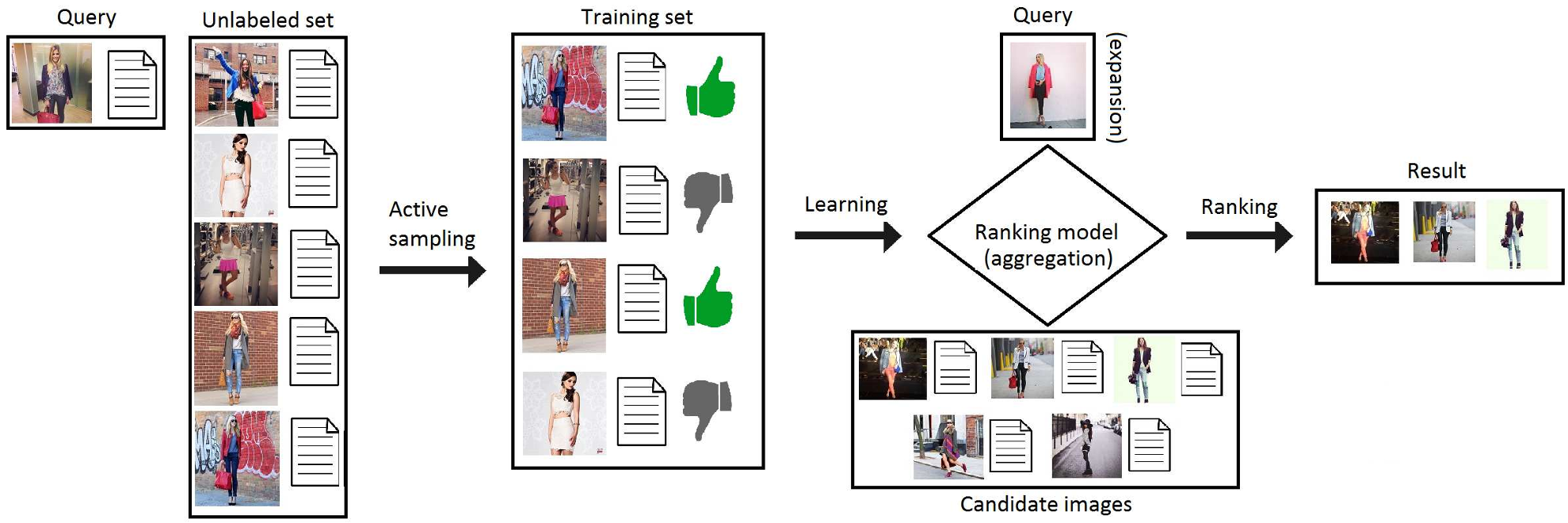 Figure 1: The model workflow, from feature extraction to Pareto-based ranking.
Experiments & Results: More for Less
The authors crawled over 1.6 million Instagram images to validate their approach.
- Efficiency: The AL2R sampler stopped needing new data after labeling only 8% of the available pool.
- Effectiveness: Despite the tiny training set, the model outperformed heavyweights like Rank-SVM and ListNet.
- Diversity: The system was tested across 10 styles (Vintage, Grunge, Sporty, etc.). While complex styles like "Grunge" required more labels, "Beach-wear" reached peak accuracy almost instantly.
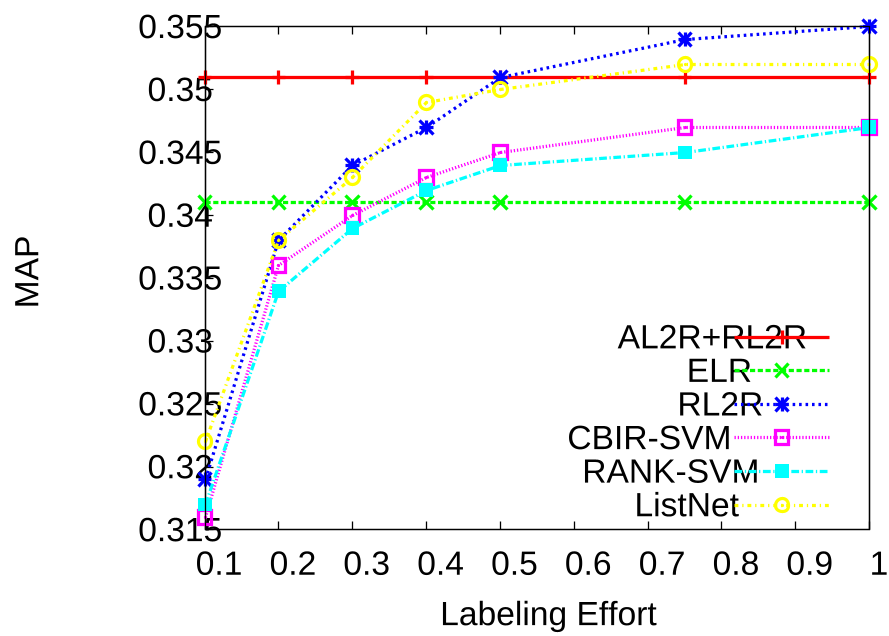 Figure 2: MAP scores vs. Labeling Effort. Note how AL2R (red) dominates the performance curve with minimal data.
Critical Analysis & Conclusion
The brilliance of this work lies in the AL2R stopping criterion. By identifying the point of diminishing returns in rule generation, it avoids "over-labeling." Furthermore, the use of Pareto Efficiency provides a robust way to handle the "Style" problem, where a user might care more about the color of a shirt in one query and the texture in another.
Limitations: The 2014-era descriptors (TF-IDF, Edge Orientations) are now largely superseded by Deep Learning (CNNs/ViTs). However, the Active Learning logic and Pareto aggregation strategy remain highly relevant for fine-tuning modern foundation models on niche, unlabeled datasets.
Future Outlook: This approach could easily be adapted to modern "Multi-modal RAG" (Retrieval-Augmented Generation) systems, where choosing the most informative context is critical for LLM performance.