
LTRSB: Beyond Binary Labels — Ranking the Severity of Social Bots
Learning to Rank Social Bots
The paper introduces LTRSB (Learning-To-Rank-Social-Bots), a novel framework that shifts social bot detection from binary classification to a ranking paradigm. By integrating features from state-of-the-art detectors like BotOrNot, DeBot, and BotWalk, it utilizes Learning-to-Rank (LTR) algorithms to identify bots across varying degrees of severity.
TL;DR
Social bots are no longer just "on" or "off." They operate on a spectrum of sophistication. This paper presents LTRSB, the first framework to apply Learning-to-Rank (LTR) to social bot detection. By treating bot detection as a relevance ranking problem rather than a simple yes/no classification, the authors achieve high-precision identification of automated accounts even when they attempt to blend in with human users.
The Core Challenge: The "Cyborg" Spectrum
The evolution of social bots has led to a "gray area" where accounts exhibit both human and automated traits. Previous SOTA methods (Prior Work) suffered from two main flaws:
- Binary Rigidity: They force a hard decision (Bot=1, Human=0), ignoring accounts that are only partially automated or exhibit low-intensity bot behavior.
- Feature Silos: Most tools focus exclusively on one dimension—either temporal spikes, network topology, or content metadata—making them easy for bot-masters to circumvent.
The authors argue that we should instead ask: "How much like a bot is this account?"
Methodology: The LTRSB Pipeline
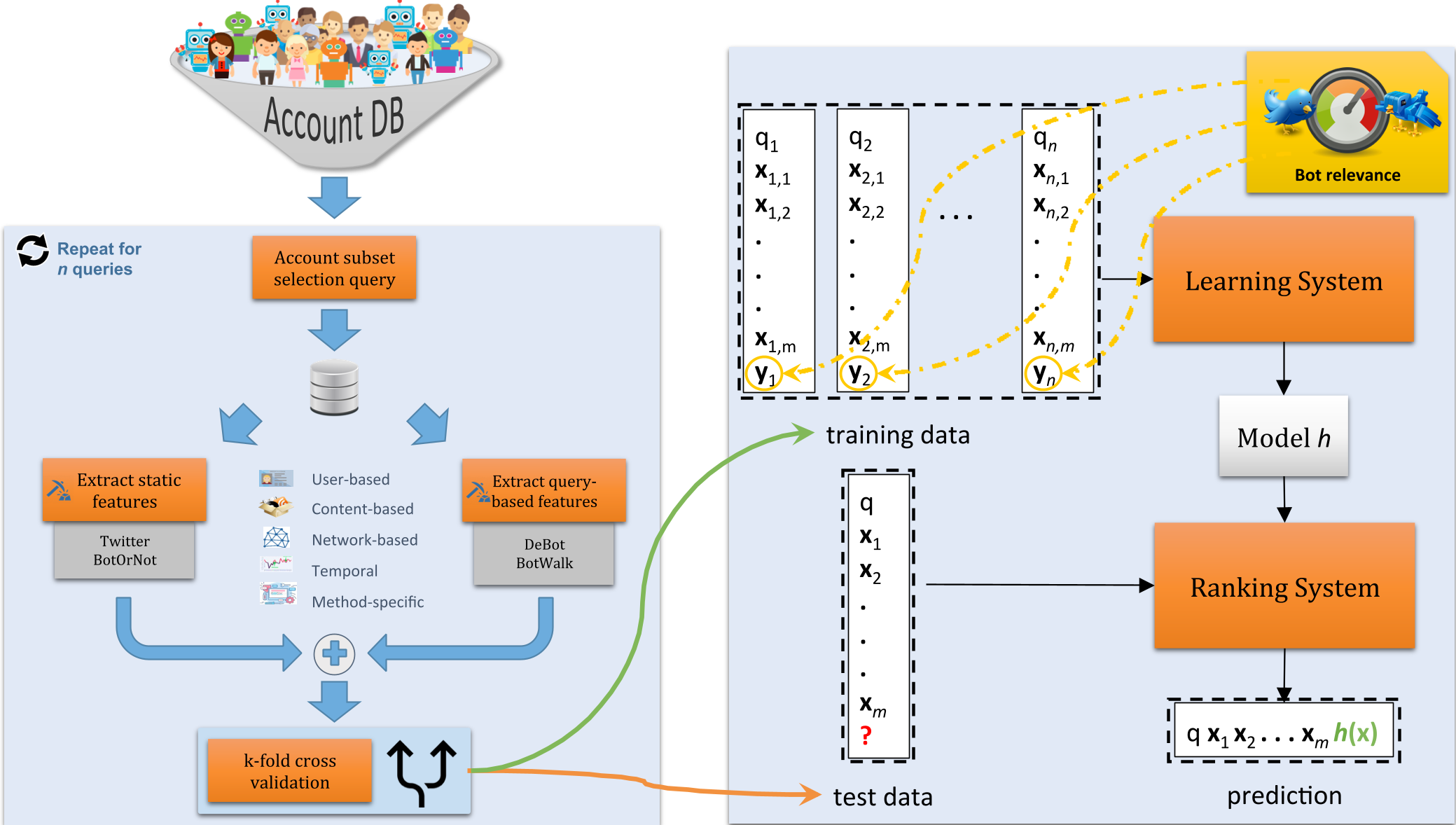
The LTRSB framework functions as an ensemble orchestrator. It pulls "weak signals" from existing detectors and raw Twitter metadata to build a high-dimensional feature space.
1. The Five Feature Frontiers
- User-based: Profile age, language, and verification status.
- Network-based: Follower/friend ratios and mention centrality.
- Temporal: Inter-arrival time of tweets, burstiness (using distributions), and warped correlation (DTW).
- Content-based: Diversity of hashtags, URLs, and Jaccard similarity between tweet bodies.
- Aggregate: Probabilistic scores imported from BotOrNot, DeBot, and BotWalk.
2. Learning to Prioritize
Instead of minimizing classification error, LTRSB optimizes for nDCG (Normalized Discounted Cumulative Gain) and Precision@k. The framework tests four heavy-hitters of the LTR world: RankNet, AdaRank, Coordinate Ascent, and LambdaMART.
Experimental Analysis: What Works?
The study utilized a massive dataset of 19,000 accounts. The researchers didn't just look at "clean" data; they tested Unbalanced (where bots are rare) and Graded (7 levels of bot-ness) scenarios.
Key Findings:
- LambdaMART & Coordinate Ascent: These emerged as the champions. In balanced settings, they achieved almost perfect scores in ranking the most dangerous bots at the top of the list.
- The Power of Heterogeneity: As shown in the heatmaps below, using a single feature category (like only "User-based") leads to inconsistent results. The "Aggregate" category—which combines sophisticated anomaly detection scores—is the most potent single predictor, but the full feature space is required for maximum robustness.
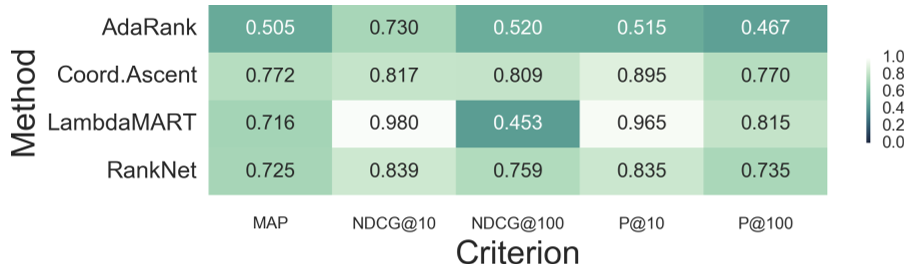 (Heatmap showing how different feature groups impact ranking precision. Note the superiority of aggregate features compared to raw user metadata.)
Critical Insights & Future Outlook
The shift to a ranking paradigm is a massive win for platform moderators. In a real-world scenario with limited human resources, a moderator doesn't need a list of 10,000 "possible" bots; they need the top 100 most certain bots to investigate immediately. LTRSB provides exactly that prioritization.
Limitations: The framework currently relies heavily on Twitter-specific API fields (e.g., lists, favorites). Adapting this to "darker" social platforms or encrypted messengers remains an open challenge.
Conclusion: LTRSB proves that by combining "weak" detection signals through a sophisticated ranking model, we can stay one step ahead of the bot-masters. The future of OSN integrity lies not in labeling, but in ranking the threat.