
PMFUI: Why Your Recommendation Engine Needs Both Social Circles and Item Graphs
Learning to recommend with social relation ensemble
This paper introduces PMFUI, a collaborative filtering framework that enhances recommendation quality by ensembling social relations and item connections. By extending Probabilistic Matrix Factorization (PMF), the model integrates the user-item rating matrix, the user social graph, and the item relation graph into a unified latent feature space.
TL;DR
Most social recommender systems focus on who you trust, but they forget what you are looking at. This paper introduces PMFUI, a framework that breaks the "i.i.d. item" assumption by fusing item-to-item relations (like product similarities or friend hierarchies) directly into a Probabilistic Matrix Factorization model alongside social trust graphs.
The "Independent Item" Fallacy
In the academic world of recommendation systems, we often treat items as isolated islands. However, in reality:
- Friend Recommendation: You don't just add random people; you add friends of friends.
- Product Recommendation: If you buy a tennis racket, your probability of buying shuttlecocks (or tennis balls) skyrockets.
Previous works like SoRec or RSTE focused heavily on the "Social" aspect—the intuition that if User A trusts User B, they likely share tastes. But they ignored the structural relationships between items. The authors of this paper argue that ignoring these connections limits the accuracy of latent feature learning.
Methodology: The Unified Latent Space
The core innovation of this paper is the tripartite ensemble. Instead of just factorizing the User-Item () matrix, the authors factorize three matrices:
- User-Item Rating (): The traditional preference matrix.
- User Social Graph (): Similarities derived via the Katz algorithm from social links.
- Item Relation Graph (): Structural similarities between items.
By sharing the User Latent Matrix () and Item Latent Matrix () across these three factorization tasks, the model "forces" the latent vectors to capture the wisdom of both social circles and item hierarchies.
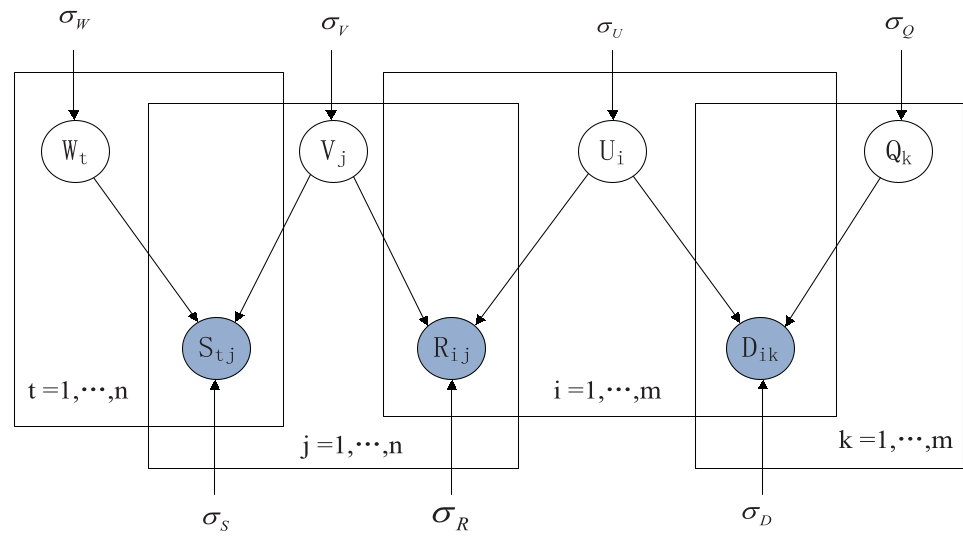 Figure 1: The PMFUI Graphical Model showing how User () and Item () factors are influenced by both ratings () and their respective social/relation graphs ().
Experimental Results
The authors tested their hypothesis on a massive slice of the Tencent Weibo dataset. They compared the basic PMF, PMFU (User ensemble only), and PMFUI (User and Item ensemble).
| Method | RMSE | MAP |
|---|---|---|
| PMF | 0.4700 | 0.2079 |
| PMFU | 0.4757 | 0.2282 |
| PMFUI (Ours) | 0.4671 | 0.2304 |
The results clearly show that adding item relations () provides a measurable boost in Mean Average Precision (MAP).
The Balancing Act ()
One of the most insightful parts of the study is the sensitivity analysis of . This parameter controls the influence of item relations. As shown in the graph below, there is a "sweet spot." Relying too little on item relations makes the model blind to item structures, while relying too much distorts the actual user preference data.
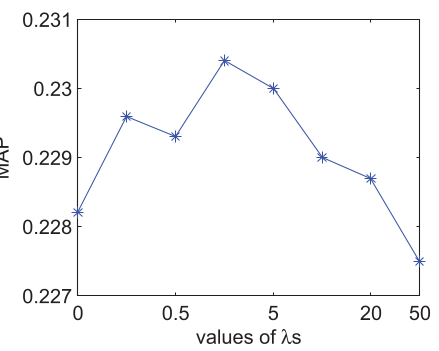 Figure 2: Recommendation quality (MAP/RMSE) peaks at a specific lambda value, proving that fusion is better than using any single source of data.
Critical Insight & Conclusion
While this paper was published in 2012 (CIKM), its core lesson is timeless: latent features are only as good as the context you give them.
Pros:
- Effectively utilizes the "item-side" of the social network.
- Mathematically sound extension of PMF that maintains efficiency.
Limitations:
- The use of the Katz algorithm for similarity is computationally expensive for extremely large graphs compared to modern Graph Neural Networks (GNNs).
- It assumes item relations are directed and structured, which might not always be available in pure e-commerce datasets without metadata.
Future Outlook: Modern practitioners can take this "Ensemble" logic and apply it to modern GNN architectures (like LightGCN), where item-item similarity graphs act as a powerful inductive bias for cold-start problems.