
Predictive Analytics in Neonatal Care: Deep Knowledge Tracing for Global Health
Learning to represent healthcare providers knowledge of neonatal emergency care: findings from a smartphone-based learning intervention targeting clinicians from LMICs
This study presents a Deep Knowledge Tracing (DKT) approach using Long Short-Term Memory (LSTM) networks to model the clinical knowledge of healthcare providers in Low- and Middle- Income Countries (LMICs). Using the "LIFE" smartphone application for neonatal emergency training, the research achieves performance prediction accuracies ranging from 74.8% to 88.3% for critical medical tasks.
TL;DR
Researchers from the University of Oxford have developed a deep learning framework to track how clinicians in Low- and Middle-Income Countries (LMICs) learn life-saving neonatal resuscitation skills. By applying Long Short-Term Memory (LSTM) networks to data from a smartphone app called "LIFE," they can predict with up to 88% accuracy whether a doctor or nurse will perform a clinical step correctly, while also modeling the "forgetting curve" of medical knowledge over time.
The "Last Mile" Challenge in Global Healthcare
In the Global South, more than 20% of the disease burden is managed by only 3% of the global health workforce. Face-to-face training is prohibitively expensive. Smartphone-based "serious games" offer a scalable alternative, but they lack a "brain"—they don't know when a learner is just guessing or when they are starting to forget vital steps in an emergency algorithm.
The core difficulty lies in the conjunctive solution space. Unlike a multiple-choice math test, neonatal emergency care requires a specific sequence of timed actions. If a clinician forgets one step, the "baby" (and in reality, the patient) does not survive.
Methodology: Deep Knowledge Tracing (DKT)
The researchers moved beyond traditional Bayesian models to use Deep Knowledge Tracing.
1. The Architecture
The team utilized a two-layer LSTM. Why LSTMs? Because human learning is inherently temporal. We build on what we just did (Short-Term) and what we learned weeks ago (Long-Term). The model uses embeddings—vector representations—of learner actions, including:
- Task Performance: Success or failure on a specific step.
- Temporal Features: Time taken to solve a task and hours passed since the last session.
- Instructional Context: The level of feedback provided by the app.
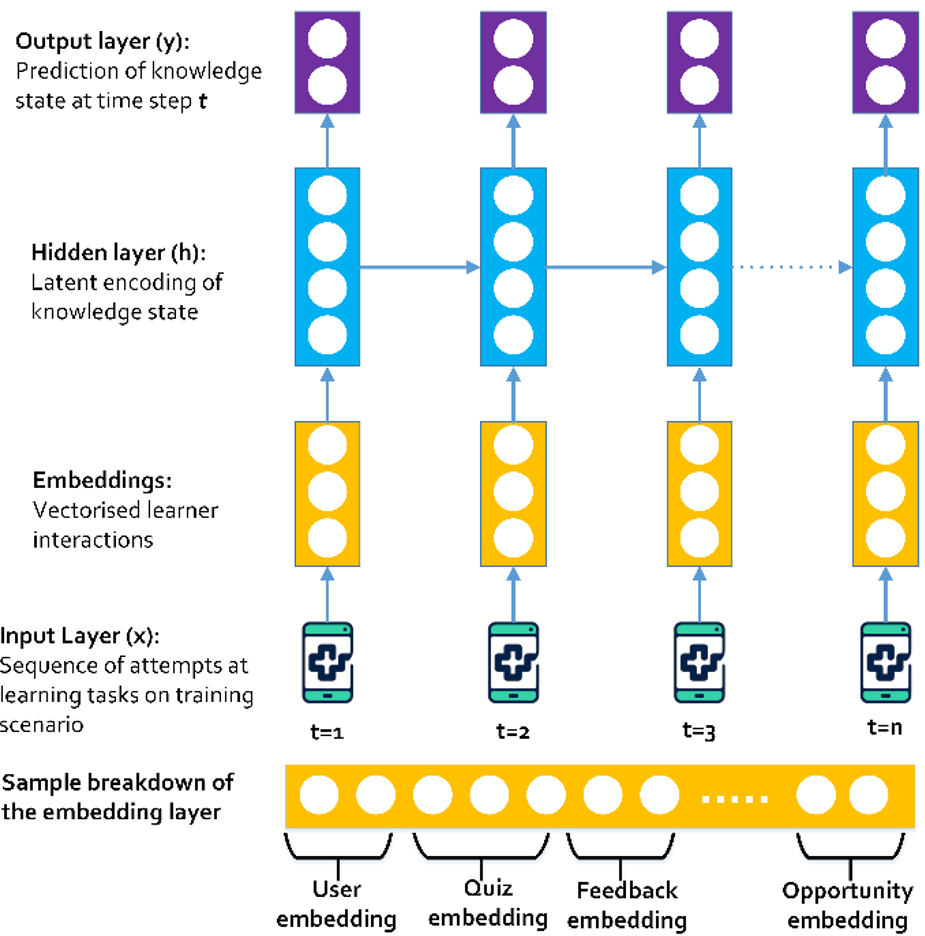 Figure 1: The unfolded RNN architecture used to represent healthcare providers' knowledge states.
Insights from the Data: The Forgetting Curve
One of the most profound findings of this study is the relationship between Learning Spacing and Knowledge Decay.
Clinical knowledge isn't static. The researchers used t-SNE (a visualization technique) to cluster learning behaviors. They found that while many clinicians prefer "cramming" (sessions spaced by less than an hour), those who spaced their learning weekly maintained a 70% retention rate.
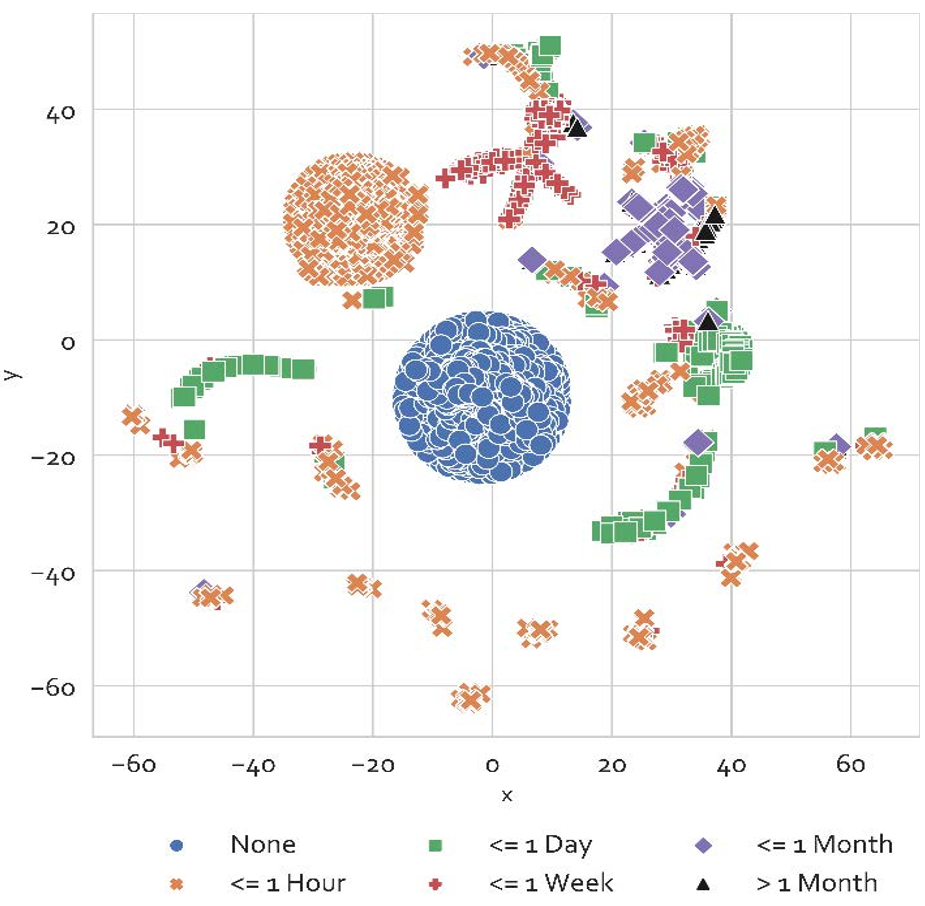 Figure 2: Performance varies significantly based on how learners space their training sessions.
Key Breakthrough: The Power of History
The study proved a clear correlation: The longer the history tracked, the better the prediction. Using a "sliding window" approach, the authors showed that a history of 14 previous steps reached an AUC (Area Under Curve) of 0.947, essentially allowing the system to "know" the clinician's skill level better than the clinician might themselves.
Critical Analysis & Future Outlook
This work signals a shift from "Generic Training" to "Precision Education."
The "Dark Play" Risk
The authors highlight an interesting phenomenon: Dark Play. Some clinicians purposely make wrong choices to see the feedback-based consequences—a form of "what-if" learning. DKT models need to evolve to distinguish this exploratory behavior from genuine ignorance.
Real-World Application
The ultimate goal is an Automated Hint System. Imagine a smartphone app that senses you are about to fail a resuscitation step because you haven't practiced in three weeks, and then provides a "just-in-time" hint or personalized refresher before the mistake happens in a real-world ward.
Conclusion
By representing clinical knowledge as a dynamic, latent state within a neural network, this paper moves LMIC healthcare training from static PDFs to adaptive, intelligent systems. It proves that deep learning isn't just for Silicon Valley; it's a vital tool for saving lives in the places that need it most.