
Decoding the Atoms of Influence: How Triadic Structures Shape Social Behavior
Learning triadic influence in large social networks
This paper introduces a structural approach to social influence by focusing on triadic structures (groups of three nodes) within large social networks like Weibo and CrossFire. By categorizing 30 distinct triadic patterns based on relationship strength and user behavior, the authors develop a predictive model that significantly enhances behavior prediction accuracy.
TL;DR
Social influence isn't just about who you know, but how the people you know are connected to each other. This paper moves beyond simple follower counts to analyze Triads—the simplest group structures in a network. By examining millions of interactions on Weibo and CrossFire, the researchers found that specific triadic patterns can boost behavior prediction accuracy (AUC) by up to 13%, proving that the local "structural geometry" of your friends is a primary driver of your actions.
The Motivation: Moving Beyond Simple Neighborhoods
Why do we retweet some friends but ignore others? Why does one gamer buy a premium skin while another stays "Free-to-Play"? Most existing models look at Individual Influence (your features) or Direct Influence (how many friends did the action).
However, the authors argue that this is too simplistic. They suggest that Triadic Influence—the interaction between you and a pair of your friends—is the true cornerstone of network formation. The core problem is that existing methods ignore the internal structures of a user's friends. For instance, if your two best friends don't know each other, their influence on you might be vastly different than if they are also best friends with each other.
Methodology: The 30 Flavors of Triads
The researchers categorized user neighborhoods based on three dimensions:
- Behavioral Label: Was the friend "Positive" (performed the action) or "Negative"?
- Tie Strength: Is the relationship "Strong" (frequent interaction) or "Weak"?
- Structural Closure: Is the triad "Closed" (the two friends are connected) or "Open"?
This resulted in 30 distinct triadic patterns. They then used Ordinary Least Squares (OLS) regression to quantify the significance of these patterns.
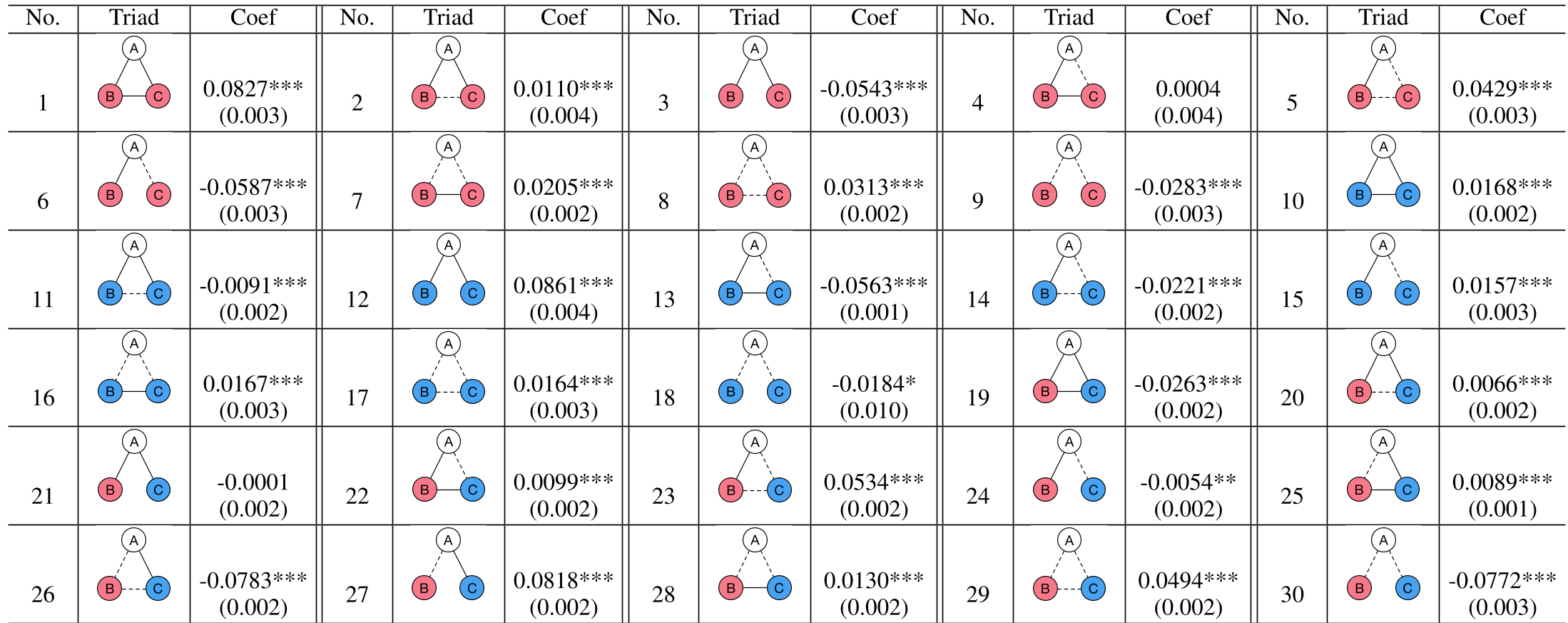
Key Intuitions from the Analysis:
- The Power of Closure: Closed triads (where your friends are also friends) generally exert stronger influence than open ones.
- Tie Strength Paradox: While strong ties usually imply strong influence, the relationship is non-linear. Sometimes, a high volume of weak ties can outweigh a single strong tie in specific contextual behaviors.
- Diversity Inhibits Retweeting: Users with more "Open" triads (diverse, unconnected friend groups) are actually less likely to retweet, suggesting that social reinforcement within tight-knit clusters is a stronger catalyst for content viralization.
Experiments and Results
The authors compared their Triadic model (LRC-T) against models using only Basic user attributes (LRC-B) and Neighborhood counts (LRC-N).
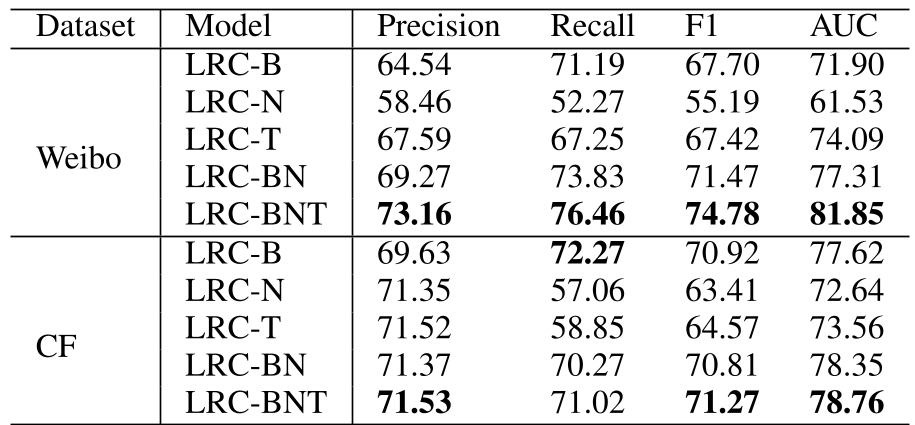
The results were compelling:
- On Weibo: The combination of all features (LRC-BNT) achieved an AUC of 81.85%, significantly outperforming the basic model.
- On CrossFire: Even in a gaming environment with vastly different incentives, the triadic features consistently improved the F1-score and Precision.
The Ablation Study verified that triadic features are not just redundant versions of neighborhood features; they capture a unique "Structural Inductive Bias" that neighborhood counts completely miss.
Critical Analysis & Conclusion
The value of this work lies in its granularity. While "Influence" is often treated as a vague viral coefficient, this paper provides a structural "periodic table" of how influence actually manifests in localized groups.
Limitations
- Static snapshots: The paper analyzes triads at a specific point in time, whereas social influence is inherently temporal and dynamic.
- Computational Complexity: Calculating all possible triads in a massive graph is computationally expensive (though easier than larger motifs).
Future Outlook
This research paves the way for more sophisticated Graph Neural Networks (GNNs) that explicitly incorporate triadic or higher-order motifs. For product managers and marketers, the takeaway is clear: don't just target "influencers"; target "influential clusters" where the internal bonds between followers amplify your message through structural reinforcement.