
Turing-RL: Mastering the Art of Human Mimicry via Indistinguishability
Learning User Simulators with Turing Rewards
The paper introduces Turing-RL, a reinforcement learning framework for training Large Language Model (LLM) based user simulators. By optimizing for indistinguishability through a discriminative Turing reward (using an LLM judge) rather than simple response matching, the method achieves new SOTA performance in simulating specific individual behaviors across conversational chat (PRISM) and forum (Reddit) domains.
TL;DR
Researchers from MIT and Stanford have introduced Turing-RL, a method that shifts user simulation training from "matching what a user said" to "being indistinguishable from what a user could say." By using an LLM-based Turing Test as an RL reward signal, they've created 8B-parameter simulators that humans and large models find more "human" than even the world's most powerful frontier models.
Background: The "Assistant" Trap
Current LLMs are trained to be helpful, harmless, and honest assistants. While great for productivity, this makes them terrible at simulating real people. Humans are often impulsive, opinionated, messy, and stylistically distinct. Previous attempts to simulate users focused on Response Matching—trying to force a model to guess the exact tokens a human used. But because humans are unpredictable, this objective creates "average" behaviors that feel sterile and robotic.
The Insight: Indistinguishability as an Objective
The authors argue that a perfect user simulator doesn't need to predict your exact next word; it needs to pass a Turing Test conditioned on your history.
The Methodology: Turing-RL
The pipeline follows a sophisticated RLHF-like structure:
- SFT Warm-start: The model is fine-tuned on user data with "Chain-of-Thought" (CoT) traces to elicit the reasoning behind human responses.
- The Discriminative Judge: Instead of a reward model scoring a single output, a "Turing Judge" compares the model's output side-by-side with real human text.
- GRPO Optimization: Using Group Relative Policy Optimization, the model learns to maximize the probability of outputs that the judge cannot distinguish from the ground truth.
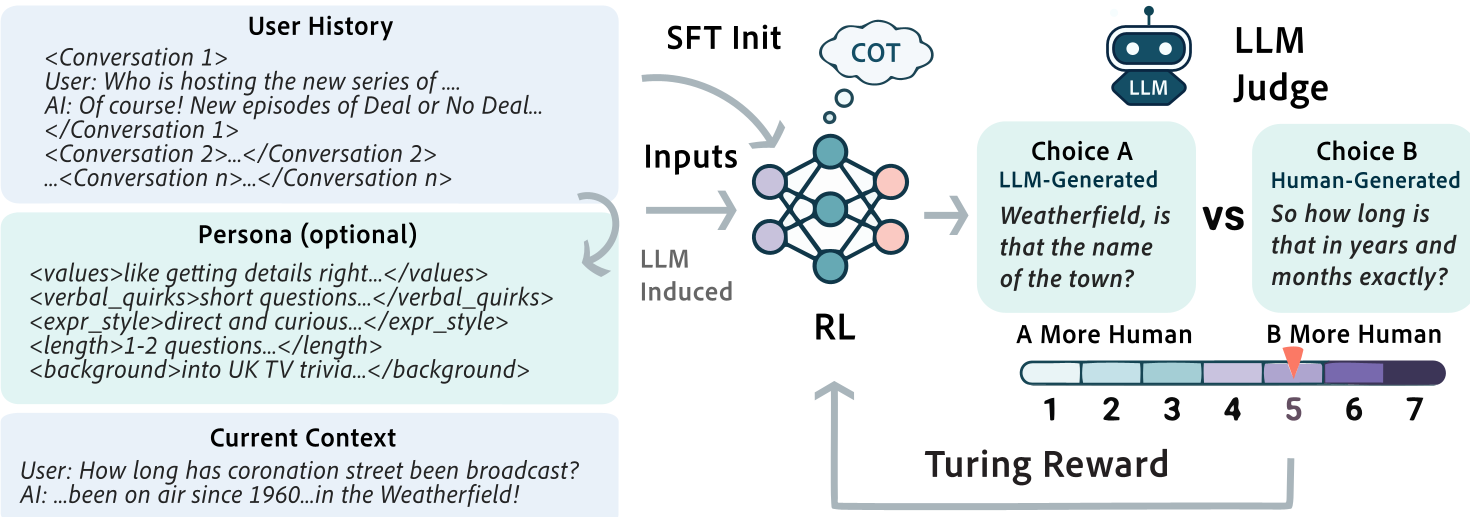 Figure 1: The Turing-RL workflow, showing the interaction between user history, CoT generation, and the discriminative LLM judge.
Methodology Detail: Why it Works
The secret sauce is the Turing Reward. In the experimental setup, a Qwen3.5-397B model acts as the judge. It analyzes:
- Targeting: Does the response address the specific point in the conversation?
- Human Goal: Is the intent plausible for this specific individual?
- Communication Style: Does the rhythm, slang, and "roughness" match the user's history?
By capping the reward (preventing the model from trying to be "more human than human"), the researchers avoided the common pitfall of "reward hacking" where models might adopt exaggerated caricatures of a persona.
Experimental Battleground: Reddit vs. Chat
The team tested the model on two very different data sources: PRISM (diverse human-LLM chats) and ConvoKit (Reddit threads).
Key Results:
- Superiority over Baselines: Turing-RL consistently beat "Sim-RL" (similarity rewards) and "Logprob-RL" (likelihood maximization).
- The "Frontier" Paradox: Interestingly, massive models like GPT-5 and Qwen3.5-397B (untuned) performed poorly in the Turing Test. They were "too polished," writing in the helpful-assistant style that clearly flagged them as AI.
- Human Approval: In a blind test with over 300 human participants on Prolific, Turing-RL responses were chosen as the "real user" more often than the actual ground truth in many cases (Win Rate > 0.5).
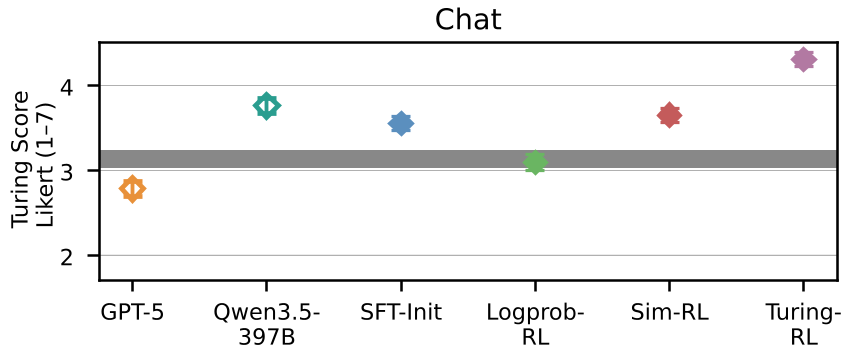 Figure 2: Turing-RL leads across multiple domains in human-likeness scores.
Deep Dive: Does Content Alignment Suffer?
One might fear that by focusing on "style" and "indistinguishability," the model might lose the "substance." However, the results in Figure 3 show that Turing-RL actually maintains a high degree of semantic similarity to the ground truth, matching the performance of models explicitly trained for similarity.
 Figure 3: Semantic similarity remains high, proving that style doesn't have to come at the cost of substance.
Conclusion & Future Look
Turing-RL proves that Indistinguishability > Imitation. For the future of AI, this means we can build more realistic "social world models." Imagine training a customer service bot against a simulator that actually gets annoyed, or a social science researcher simulating how different demographics might react to a new policy—not in an "average" way, but with individual authentic voices.
The Road Ahead: The authors note that while 8B models can now mimic humans effectively, the next challenge is ensuring these simulators don't lean into the "dark side" of human mimicry, such as scaling fraud or sophisticated social engineering.