
Beyond the Lone Pixel: Revolutionizing Image Annotation via Flickr Group Contexts
15714_Learning Visual Contexts for Image Annotation From Flickr Groups.
Summary
Problem
Method
Results
Takeaways
Abstract
The paper introduces a novel framework for image annotation that leverages the visual context of image batches matched against pre-learned Flickr groups. By transitioning from a global annotation model to group-specific experts, it achieves state-of-the-art performance on benchmarks like Corel-5K.
## TL;DR
Most AI models look at a single image and try to guess its tags. This paper argues that images rarely travel alone; they come in "batches" (like a vacation album). By matching these batches to specific **Flickr Groups** (e.g., "Rome" vs. "Forest"), the authors achieved a 100% accuracy boost by using context-specific "expert" models instead of one-size-fits-all classifiers.
## Background: The Limits of Global Vision
Image annotation—the task of automatically assigning tags like "Eiffel Tower" or "Mountain"—is notoriously difficult due to **intra-class variation** (a "building" in Rome looks nothing like a "building" in Tokyo) and **ambiguity**. Traditional SOTA methods treat every image as an island. This "independent and identically distributed" (i.i.d.) assumption is a mathematical convenience that fails in the real world, where photos are captured in coherent sequences.
## The Insight: Flickr Groups as Semantic Anchors
The authors suggest that the "context" of an image (the other photos taken around the same time/place) holds the key to disambiguation. They turn to **Flickr Groups** as a goldmine for training data. Why?
1. **User-Driven Intelligence**: Humans have already done the hard work of categorizing images into meaningful semantic clusters.
2. **Granularity**: With over 200,000 groups, there is a specialized "expert" model for almost any niche topic.
## Methodology: The Three-Step Pipeline
The proposed framework isn't a new model itself, but a wrapper that improves existing ones (like Texton or PLSA).
### 1. Group Training
Instead of training one global model $\phi$, the system trains distinct models $\phi^g$ for each Flickr group. This allows the model to learn that the tag "Candle" is highly probable in a "Birthday" group but rare in a "Safari" group.
### 2. Group Matching
When a user uploads a new batch of photos $\mathcal{X}'$, the system calculates which Flickr group $g^*$ best explains the visual features of the *entire batch* using a maximum-likelihood criterion:
$$g^* = \arg \max_{g \in G} p(\mathcal{X}' | \phi^g)$$
### 3. Context-Specific Annotation
Once a group is selected, the "expert" model for that group provides the final tags. This captures two types of context: **Frequency** (certain tags are more common) and **Appearance** (how things look in that specific setting).
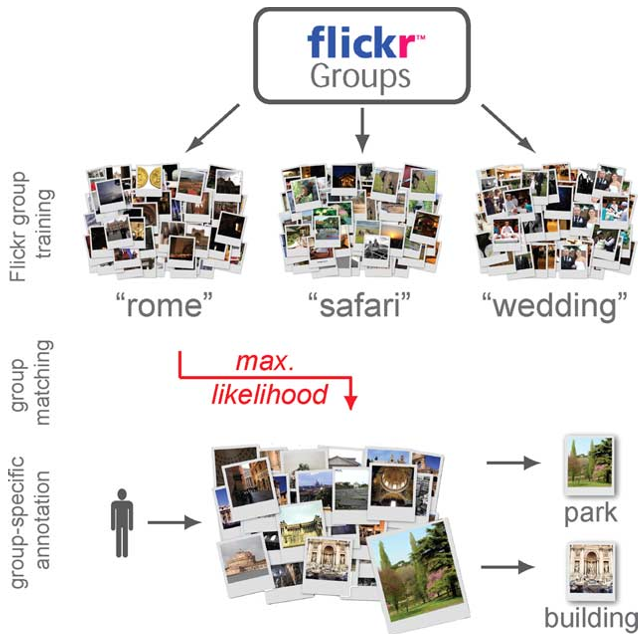
*Fig 1: The framework matches image batches to Flickr-learned categories to refine annotations.*
## Experimental Evidence: Why Context Wins
The results across Corel and Flickr datasets were staggering. The context-aware models outperformed global baselines by over **100%** in many cases.
### Key Findings:
* **Batch Size Matters**: Matching a single image to a group is noisy. However, as the batch size increases (e.g., to 20 images), the matching accuracy stabilizes, leading to superior tagging.
* **Appearance vs. Tags**: The authors found that using *both* group-specific visual appearance and group-specific tag frequencies is essential. Relying on just one only provides partial gains.
* **Competitive SOTA**: On the standard Corel-5K benchmark, this approach propelled simple models to compete with the most complex systems of the time.

*Table 1: The context-aware versions of PLSA and Texton models significantly outperform their "no context" counterparts on the Corel-5K benchmark.*
## Critical Analysis & Future Outlook
While highly effective, this method has a "cold start" problem: it requires a batch of images to work effectively. A single, isolated photo doesn't provide enough context for group matching. Furthermore, as the number of Flickr groups scales to the hundreds of thousands, the computational cost of matching batches increases linearly.
**The Takeaway**: This research highlights a shift from "General AI" to "Contextual AI." By leveraging the way humans naturally organize information on the web, we can build models that are not just smarter, but more attuned to the specific environment of the user. In the modern era of LLMs and CLIP, this "retrieval-augmented" logic remains more relevant than ever.