
Learning What Makes A Society Tick: Uncovering the Latent Micro-Laws of Social Evolution
Learning What Makes A Society Tick
This paper introduces a machine learning methodology for discovering agent dynamics in evolving social groups. Using the ViSAGE (Virtual Simulation and Analysis of Group Evolution) framework, the authors propose an Expectation-Maximization (EM) style approach to infer the "micro-laws"—parameterized behavioral rules—that govern how individuals join, leave, or stay in social communities.
TL;DR
Understanding why social groups form, grow, or dissolve is a fundamental challenge in computational social science. This paper presents a machine learning framework that moves beyond simple observation to infer the hidden "micro-laws" governing individual agent behavior. By treating social evolution as a parameterized stochastic process, the authors demonstrate that we can accurately predict a society's future state by learning the specific "nature" (parameters) of its constituents.
Background: Beyond Static Graphs
Most social network analysis (SNA) treats communities as static snapshots. However, societies are living organisms. To understand "what makes a society tick," we must look at the agent dynamics: the micro-level decisions—joining a group, leaving a group, or remaining loyal—that aggregate into macro-level social shifts.
The authors position this work as a bridge between Agent-Based Modeling (ABM) and Machine Learning, effectively creating a "Learnable ABM" where the rules of the simulation are derived from real-world communication or membership data.
The ViSAGE Model: The Mechanics of Interaction
The core of the research relies on the ViSAGE (Virtual Simulation and Analysis of Group Evolution) framework. In this model, every actor possesses:
- Type: Influences preferences for group size (e.g., Leaders prefer small groups; Followers prefer large ones).
- Rank & Qualification: Represents the actor's prestige and position within a group.
- Resources: A dynamic pool that determines which actions an actor can afford to take.
Model Architecture
The evolution process follows a cycle: Current State Actor Decision Social Feedback (Reward/Penalty) State Update.
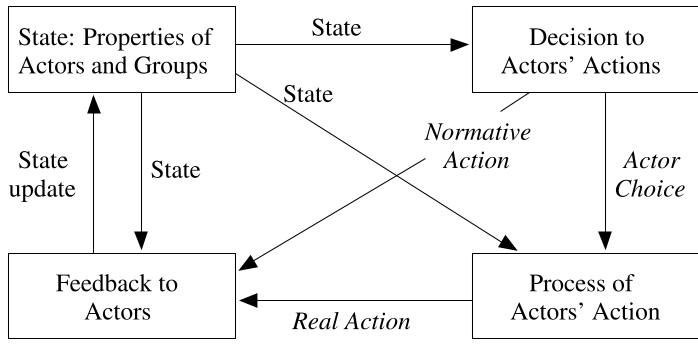 Figure 1: The cyclic process of social evolution where micro-actions update macro-properties.
The Learning Challenge: Mixed-Parameter Optimization
The authors face a daunting optimization task: finding the best parameters that maximize the likelihood of the observed history. This involves:
- Independent Discrete Parameters: Handled via a greedy search.
- Independent Continuous Parameters: Optimized via gradient-based ascent.
- Dependent Discrete Parameters: Addressed using an Approximate Expectation-Maximization (EM) style algorithm to avoid the "dimensionality curse."
If the groups aren't explicitly known (e.g., just a list of emails), the authors first apply overlapping community detection and a greedy bipartite matching algorithm to reconstruct the "path" of each group across time.
Experimental Success: Accuracy and Prediction
The efficacy of the "Learn" algorithm was tested against a "Cluster" heuristic (which only looks at average group size).
| Method | Accuracy | Key Insight |
|---|---|---|
| Cluster (3-means) | 52.83% | Fails to account for social influence and ambition. |
| Learn (Proposed) | 83.75% | Successfully captures latent behavioral motivations. |
The study also reveals a critical insight for social forecasting: the environment matters more than the starting point. As shown in the prediction error analysis, choosing the wrong "Society Reward" parameter () causes a massive spike in error over time, whereas getting the initial resources wrong has a negligible long-term effect.
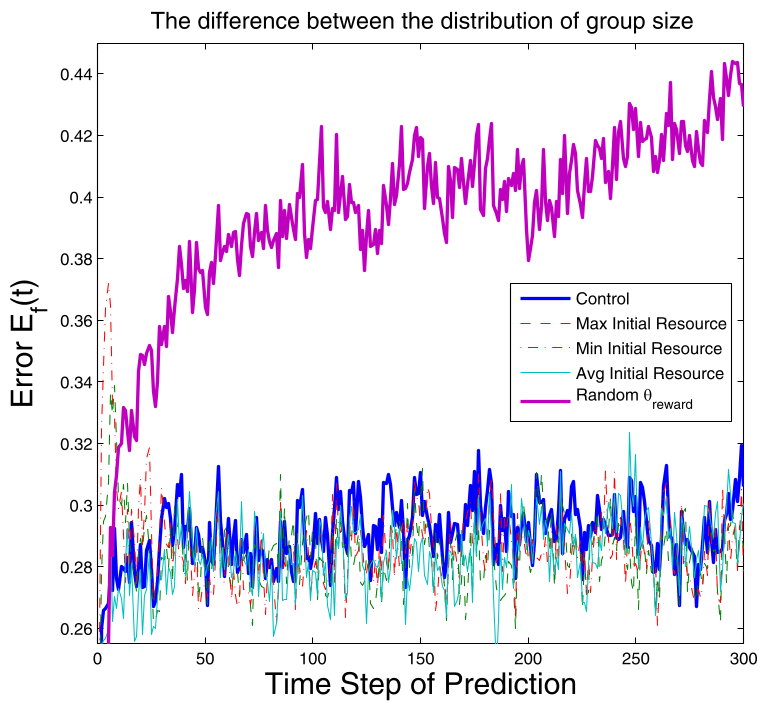 Figure 2: Sensitivity analysis showing the critical importance of learning reward parameters over initial conditions.
Critical Analysis & Conclusion
The power of this methodology lies in its generalizability. While demonstrated on specific types like "Followers" and "Leaders," the framework can be extended to any parameterized micro-law.
Limitations:
- Scalability: While the authors use heuristics to mitigate complexity, the EM-style algorithm for dependent parameters may still struggle with millions of agents.
- Semantics: The current model ignores the content of communications, focusing only on the structure.
Final Takeaway
This work marks a shift from descriptive social science to predictive social modeling. By proving that we can "reverse-engineer" the behavioral DNA of a community from its communication logs, the authors provide a blueprint for understanding the resilience and evolution of any modern online society.