
Beyond Silos: Optimizing Influence Maximization Across Multiplex Social Networks
Least Cost Influence Maximization Across Multiple Social Networks
This paper introduces a unified framework to solve the Least Cost Influence (LCI) problem across multiplex social networks. It proposes "Lossless" and "Lossy" coupling schemes to map multiple overlapping networks into a single graph, enabling the identification of a minimum seed set that triggers a target cascade (β-fraction) across the entire ecosystem.
TL;DR
In the modern digital landscape, users don't live in a single network; they are nodes in a complex "multiplex" ecosystem. This paper tackles the Least Cost Influence (LCI) problem—finding the minimum number of users to trigger a wide information cascade—by effectively modeling the bridges between platforms like Twitter and Foursquare. The researchers introduce coupling schemes that transform multi-layered networks into a single manageable graph, proving that targeting "overlapping users" can slash marketing costs by nearly 50%.
Problem & Motivation: The Multi-Platform Blind Spot
Most influence maximization research treats social networks as isolated islands. However, "Jack" might see a book recommendation on Twitter and share it with his friends on Facebook.
If a marketing strategist only analyzes Twitter, they see Jack's influence as limited to his Twitter followers. In reality, Jack is a bridge node. The authors argue that failing to account for these overlapping users results in a massive miscalculation of true social capital. The challenge is twofold:
- Modeling complexity: How do you mathematically represent a user who exists in three different networks with different thresholds and neighbors?
- Computational scale: Multiplex networks grow exponentially in complexity, making standard greedy algorithms prohibitively slow.
Methodology: Coupling Schemes & State Synchronization
The core innovation lies in mapping multiple networks into a single, unified graph through Coupling Schemes.
1. Lossless Coupling (The Precision Approach)
To preserve every property of the original networks, the authors create:
- Representative Vertices: A node for each network a user belongs to.
- Gateway Vertices: A centralized "hub" for each user that synchronizes their active state across all their platforms.
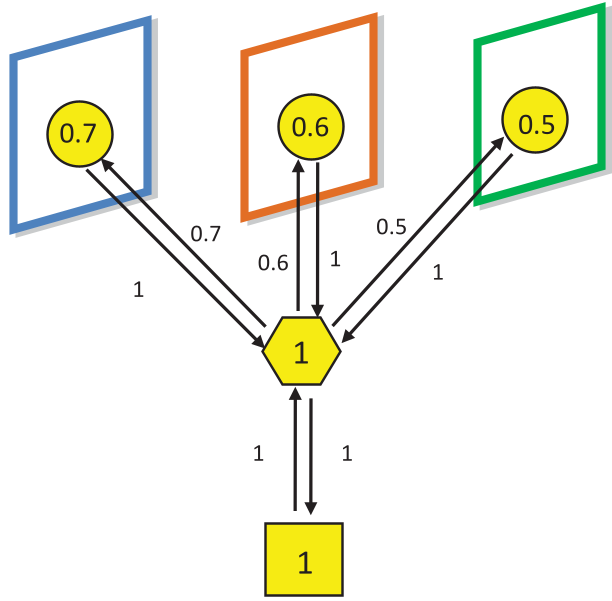
The paper compares Clique vs. Star synchronization. While Clique connects all representative nodes directly, the Star scheme (shown below) uses an intermediate vertex to reduce the number of edges, making it more efficient for users who inhabit many networks simultaneously.
2. Lossy Coupling (The Efficiency Approach)
For massive datasets, the authors propose a "Lossy" scheme. It collapses the multiplex into a single layer by heuristically weighting a user's "Easiness" (how easy they are to influence across all networks) or "Involvement." This requires less memory but maintains high solution quality.
Experiments & Results: The Power of Overlap
The researchers tested their framework on real-world data, including a Twitter-Foursquare dataset and scientific co-author networks.
Key Findings:
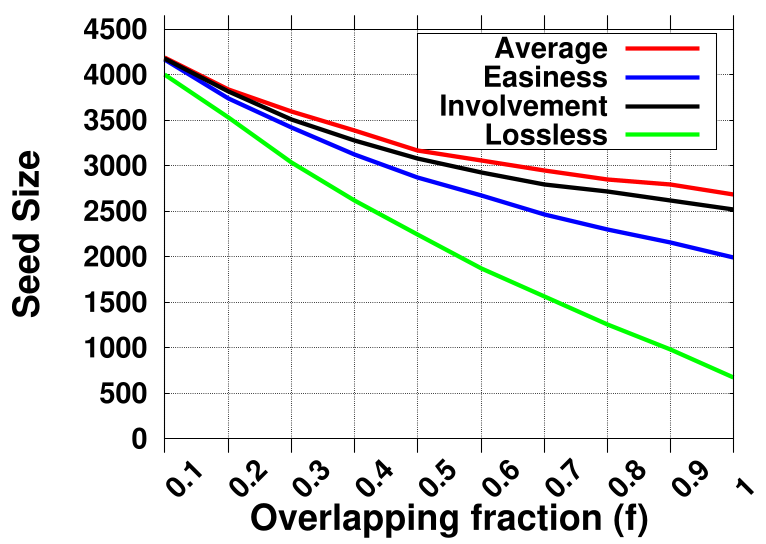
- Cost Reduction: Using the Lossless coupling method resulted in seed sets 30%-47% smaller than if one simply combined the best seeds from individual networks.
- The Overlapping Advantage: Even if overlapping users make up only 5% of the total population, they often constitute over 25% of the selected seed set. They are simply more efficient "force multipliers" for information.
- Scaling Up: Their "Improved Greedy" algorithm, which uses a max-heap and "light" iterations to avoid redundant calculations, proved to be up to 700 times faster than native greedy approaches.
Critical Analysis & Conclusion
This work demonstrates that the "context" of a user—the sum of their digital footprints—is more important than their popularity on any single platform.
Insights:
- Cross-Network Support: The study reveals that a user doesn't need to be an "influencer" on Platform A to be valuable; if they can relay information from a dense Platform B to a sparse Platform A, they are a primary target for LCI.
- Limitations: The current model assumes we can perfectly identify overlapping users (User Identity Linkage), which remains a difficult task in the wild due to privacy settings and varying usernames.
Future Outlook
The next frontier is Heterogeneous Diffusion. What if information spreads like a virus (SIR model) on Twitter but follows a threshold model on LinkedIn? Extending these coupling schemes to handle mixed propagation logic will be the "Holy Grail" of cross-platform viral marketing.
Takeaway for Practitioners: Don't just find the person with the most followers; find the person who bridges the gaps between your target communities.