
LCRB: Strategically Shielding Social Communities from Viral Rumors
Least Cost Rumor Blocking in Social Networks
The paper introduces the Least Cost Rumor Blocking (LCRB) problem to minimize protectors needed to stop rumor spread in social networks. It focuses on "bridge ends" between communities and proposes a Greedy algorithm for the Opportunistic One-Activate-One (OPOAO) model and a Set Cover Based Greedy (SCBG) algorithm for the Deterministic One-Activate-Many (DOAM) model.
TL;DR
Rumors in social networks don't just spread; they invade across community boundaries. This paper introduces the Least Cost Rumor Blocking (LCRB) framework, which identifies "bridge ends"—the gateway nodes between social clusters. By focusing protection on these critical points, the authors provide algorithms (Greedy and SCBG) that effectively "quarantine" rumors within their originating community at a minimal cost.
Contextual Positioning
In the landscape of Influence Maximization (IM) and Influence Blocking (IB), most research treats the network as a monolithic structure. This work differentiates itself by acknowledging the Community Structure property: social networks are clusters of densely connected individuals. The paper is a tactical pivot from "protecting everyone" to "protecting the gates," transforming a global problem into a boundary-optimization task.
The Core Insight: Bridge Ends
Why is this method effective? The authors observe that rumors spread quickly within a community () but cross to neighbor communities (-neighbor communities) via specific edges. The target node at the end of such an edge in a neighbor community is a Bridge End.
By protecting these specific nodes, we can prevent a rumor from cascading across the entire network.
Methodology: Two Models, Two Solutions
The authors analyze the problem under two distinct diffusion flavors:
1. The OPOAO Model (Opportunistic One-Activate-One)
Mirroring person-to-person contact (like direct messaging), where an active node picks one neighbor at a time.
- The Math: The authors prove that the expected number of protected bridge ends is submodular. This means that adding a protector to a small set has a higher marginal benefit than adding it to a large set (Diminishing Returns).
- The Algorithm: A classic Greedy Algorithm that iteratively selects the node with the maximum marginal gain, achieving a approximation.
2. The DOAM Model (Deterministic One-Activate-Many)
Mirroring a broadcast (like a public post), where a node activates all inactive neighbors instantly.
- Analysis: This problem is harder. The authors prove that no approximation exists unless .
- The SCBG Algorithm: By converting the LCRB-D problem into a Set Cover instance, the authors use Bridge End Backward Search Trees (BBST) to find which protectors cover which bridge ends.
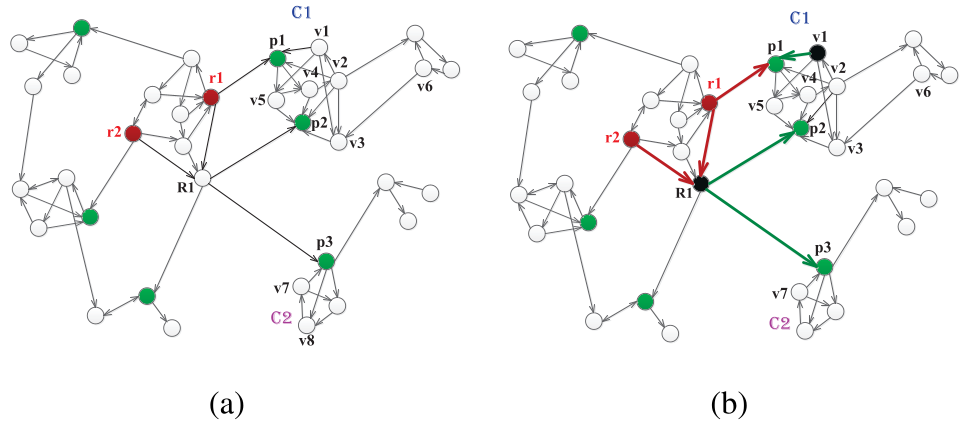 Figure: Rumor originators (red) and the target bridge ends (green) at the community boundary.
Experimental Evidence
Testing on the Enron Email and Hep Collaboration datasets, the researchers compared their methods against MaxDegree (picking popular nodes) and Proximity (picking nodes near rumors).
- Efficiency: In the DOAM model, as the rumor size increased, the number of protectors required by the SCBG algorithm grew much slower than heuristics. In a community of 2631 nodes, SCBG needed ~50 protectors, while Proximity required over 1,000.
- Effectiveness: Across both models, the "Greedy" and "SCBG" approaches consistently resulted in fewer total infected nodes after the diffusion process stabilized.
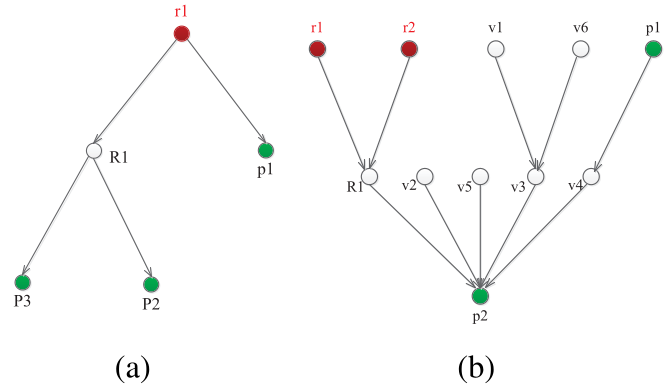 Figure: The dual search strategy—Forward to find targets, Backward to find the best seeds.
Critical Analysis & Conclusion
The LCRB approach is highly effective because it exploits the bottlenecks of social topologies. Rather than fighting a rumor everywhere, it fights it at the "bridges."
Pros:
- Significant reduction in protection costs (number of seeds).
- Mathematically grounded with approximation guarantees.
- Validated on real-world communication data.
Limitations:
- Computational Complexity: The Greedy algorithm for the OPOAO model is time-intensive due to Monte Carlo simulations.
- Originator Detection: The model assumes we already know where the rumor starts, which is a difficult task in the real world.
Future Outlook: Integrating these algorithms with real-time community detection could allow platforms to deploy "digital vaccines" to bridge end users the moment a malicious rumor is detected, potentially stopping "fake news" before it jumps from one social bubble to the next.